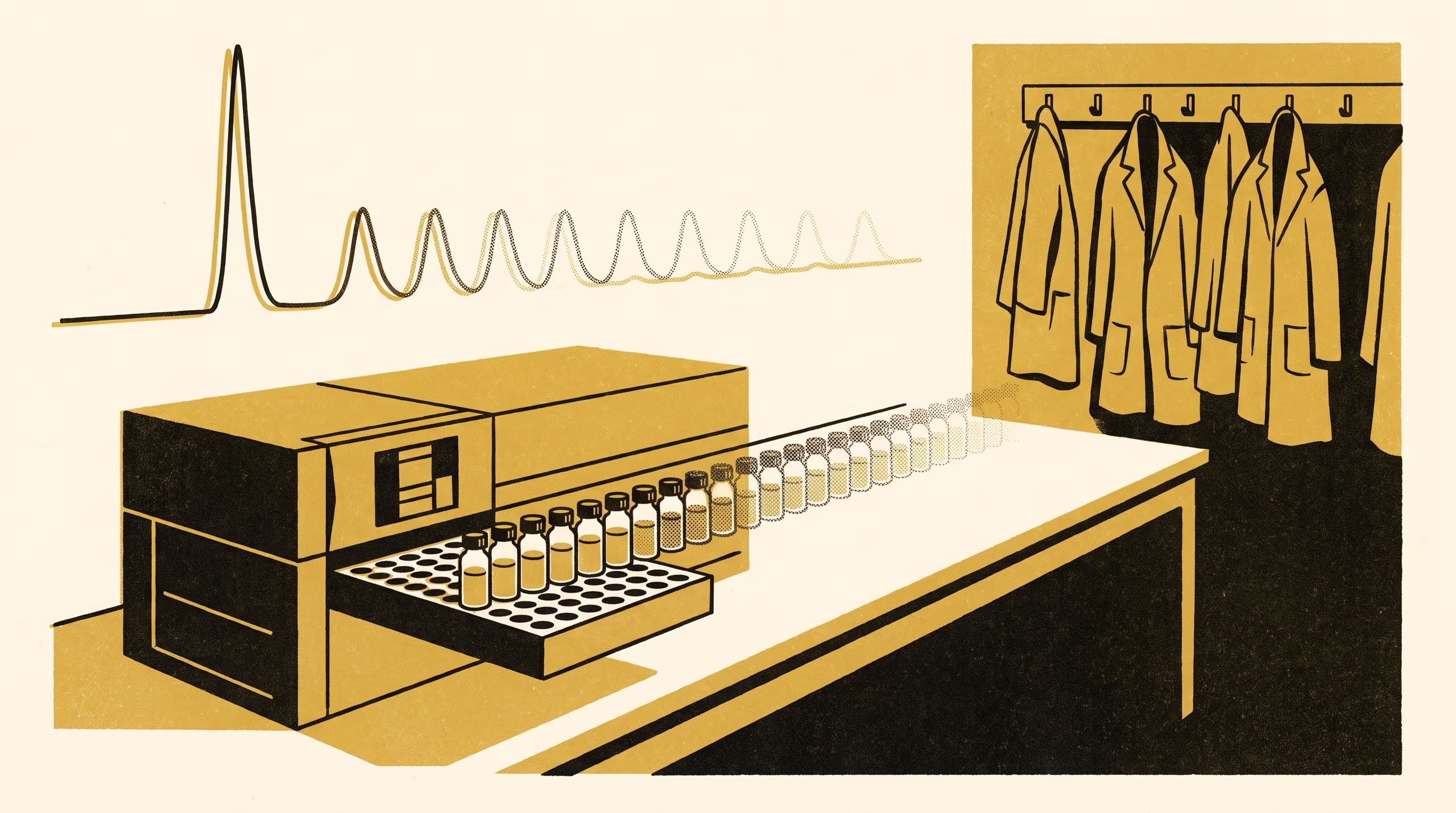
A paper from the School of Continuous Improvement follows 9,838 ghost features across a year of post-batch blanks on a shared instrument and finds that almost half of what can be traced did not come from the preceding user.
A year of solvent blanks on one multi-user LC–MS instrument, traced back to the batches that left their traces
On a shared laboratory instrument, the person who ran the last batch is not always the person who left something behind. Whose Peak Is It? Attributing Carryover in the Blank Injections of a Shared LC–MS Instrument to the Batches That Left It, a new paper from the School of Continuous Improvement, finds that 44 per cent of the traceable carryover in a year of solvent blanks came from two or more batches earlier.
The paper is led by Dr Sten Okwuosa, Senior Research Fellow and Convenor of the Impact Pathway Atlas, with Associate Professor Casimir Beng, Lead of the Adaptive Metrics Lab, and Dr Vigdis Emenike, Senior Lecturer in the School of Underlying Conditions. It brings the Atlas’s long-standing interest in where a contribution travels, and who ends up credited with it, to the bench.
Credit tends to settle on whoever happens to be standing nearest. It has been a privilege to watch that happen at the scale of a five-microlitre injection, and to add one more instrument to the University’s long conversation about where things go once they leave our hands.
— Dr Sten Okwuosa, Senior Research Fellow and Convenor, Impact Pathway Atlas
Working across 1,156 blanks and the batches that preceded them, the team combined accurate-mass matching, retention-informed provenance modelling and a purpose-built tracer exercise into an integrated, instrument-scale account of how shared analytical infrastructure carries its recent history forward.
“Every instrument has a memory,” said Associate Professor Beng. “We have tried to listen to this one patiently, and to write down what it told us.”
The University counts the work among its most careful contributions to the stewardship of things that many hands share.
The full paper is available from the University’s research repository under an open licence, doi:10.5555/slop.22uoty.