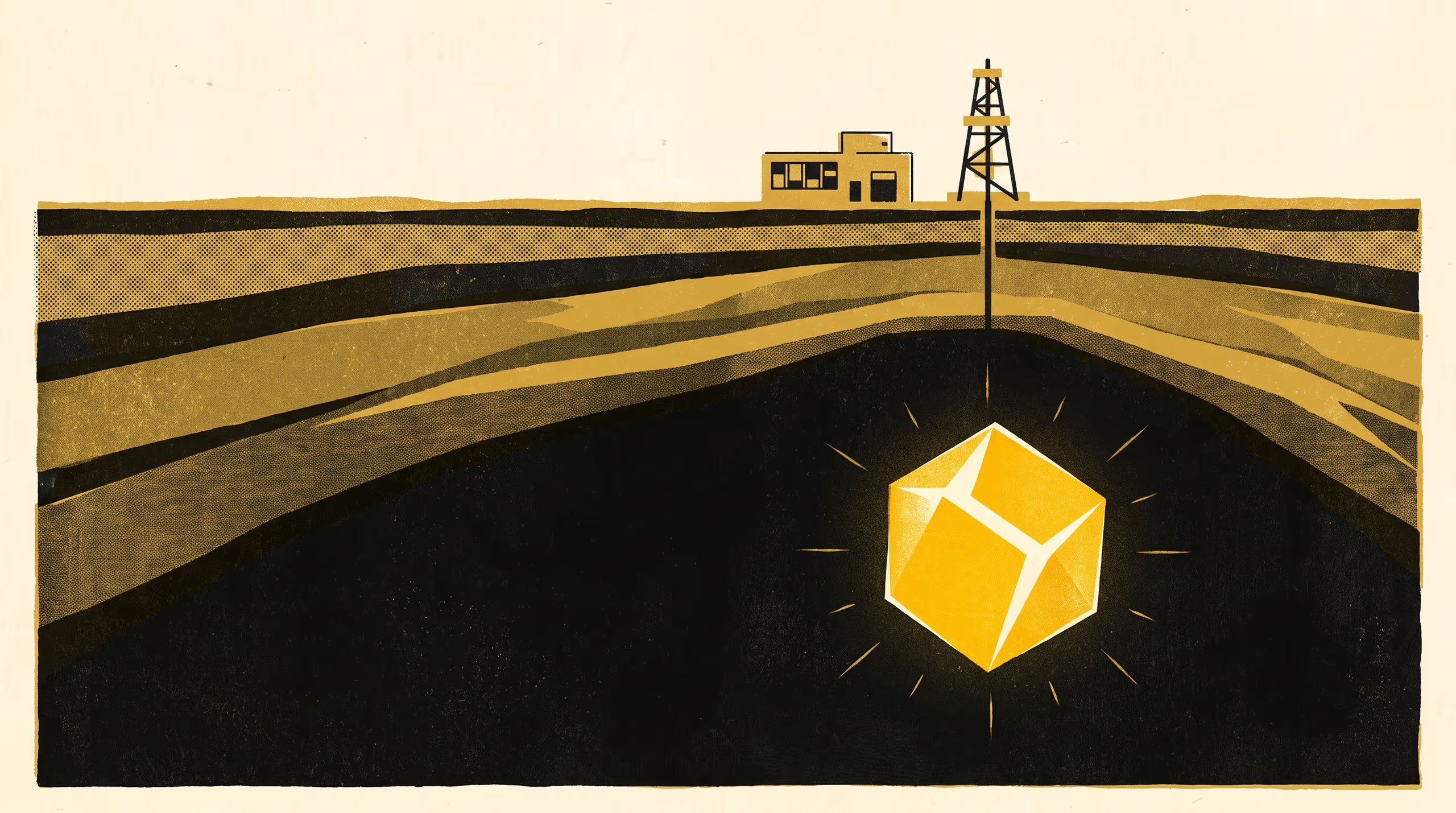
A new brochure from the School of Underlying Conditions introduces the perovskite programme that grows, presses and measures crystals in place of rock no drill can recover.
A research-showcase brochure presents bench-grown crystals as stand-ins for the deep earth
No drill string has ever returned a sample of the rock beneath its deepest core, and the School of Underlying Conditions has stopped waiting for one. The Rock Nobody Brings Up, a research-showcase brochure released today, sets out how the School is meeting that absence instead: with crystals of its own.
The brochure follows the School’s perovskite programme through three streams of activity. In the basement press, small sample assemblies are brought towards the conditions they represent and then read along their length. At the transport bench, crystals are wired and followed as they change how they carry current. In the cryostat, their magnetic response is tracked from growth to last measurement. Throughout, the School positions each sample as a documented substitute rather than a recovered specimen, an approach that aligns its laboratory capability with the core-logging discipline from which the School grew.
A core tray is honest about what it is missing. We wanted a laboratory that could be honest in the same way, and I think a reader will find that we have one.
— Associate Professor Ragnhild Uzoma, Lead, Basement Relations Group
The publication also draws together seven studies from across the University, from archived high-pressure run products to a thin-film laboratory’s logbooks, and introduces the researchers behind the work. Dr Vigdis Emenike, Senior Lecturer, described the result as “a portrait of a School that measures carefully and claims modestly”, while Dr Brynjar Obiora, Senior Research Fellow, said it had given colleagues “a single place to point when someone asks what we do down there”.
The brochure takes its place among the University’s growing body of institutional publications as a statement of where the School’s attention now rests.
The full brochure is available from the University’s research repository under an open licence, doi:10.5555/slop.axzsx3.