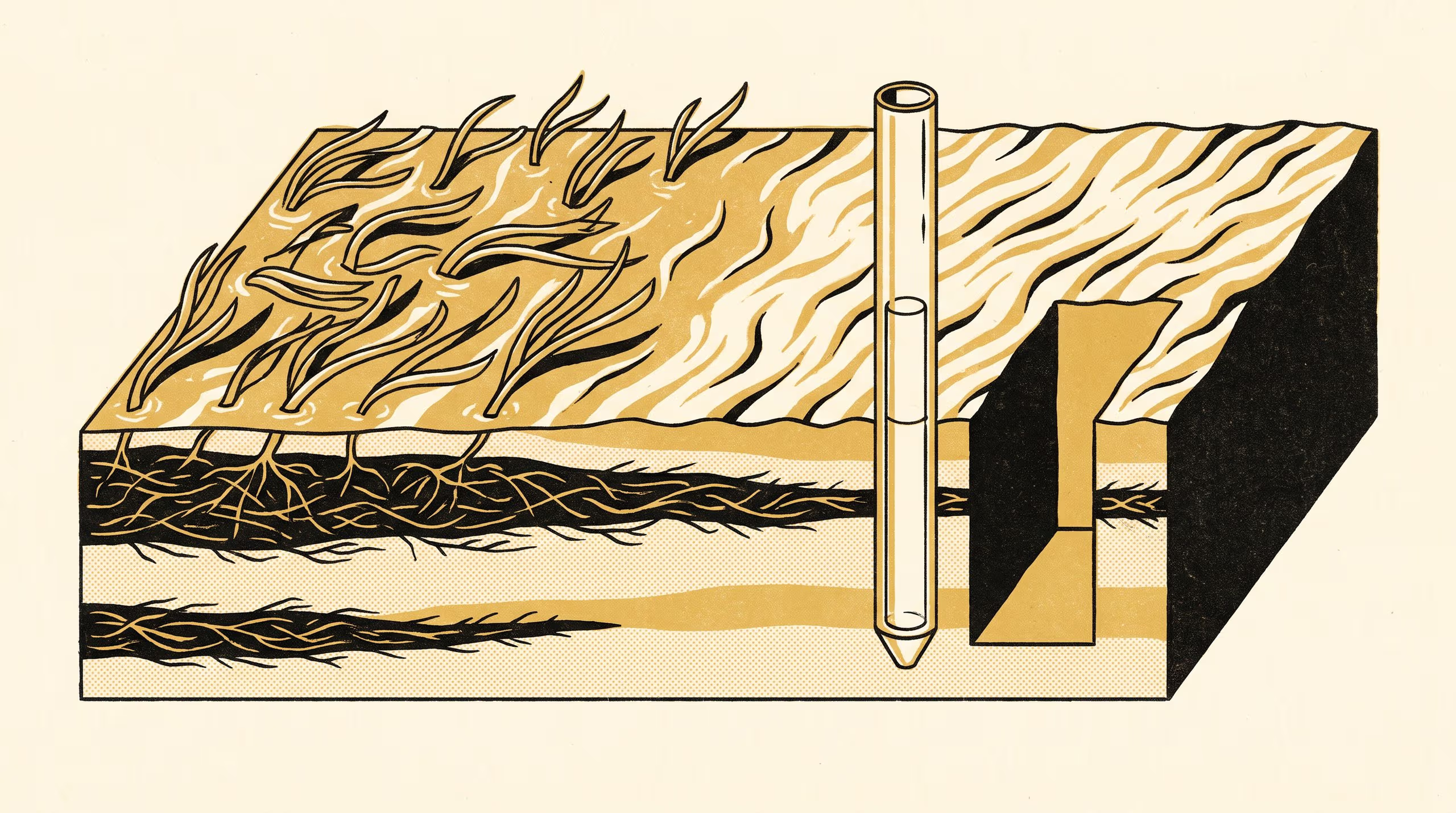
A new paper from the School of Underlying Conditions reads the buried root mats of a seagrass meadow as a record of where it has grown, and finds it has twice been buried and twice come back.
Push cores and pits across an estuarine sand flat find two older meadows beneath the sand
Eighteen plastic tubes, three pits and two spring low tides have given Slop University a longer view of one small seagrass meadow than the meadow’s surface could offer. In The Meadow Has Been Further Out, Associate Professor Ragnhild Uzoma, Lead of the Basement Relations Group, and Dr Brynjar Obiora, Senior Research Fellow, both of the School of Underlying Conditions, find that the bare sand beyond the meadow’s present edge is ground it has held before.
Beneath the living meadow, the cores recover two older mats of buried roots and rhizomes, each sealed by a sheet of clean sand. The middle meadow, buried roughly four decades ago, extended well past the furthest core the team drove.
A meadow keeps its own minutes, and it keeps them underneath. We have read two of the older entries so far, and I suspect the flat has more it would be willing to share.
— Associate Professor Ragnhild Uzoma, Lead, Basement Relations Group
The work brings the School’s established practice in recovered core and described profiles to the coastal margin, integrating field sampling, laboratory characterisation and depth reconstruction within a single stratigraphic framework. Along the way it offers a practical refinement for anyone pushing a tube into soft ground, attending closely to where a core loses its length as well as how much.
It is one more step in the School’s patient engagement with what lies below the visible surface of things, and the University is pleased to see that engagement reach the water’s edge.
“The tide gave us a few hours each day, and we were grateful for every one of them,” said Dr Obiora.
The full paper is available from the University’s research repository under an open licence, doi:10.5555/slop.fkbmr6.