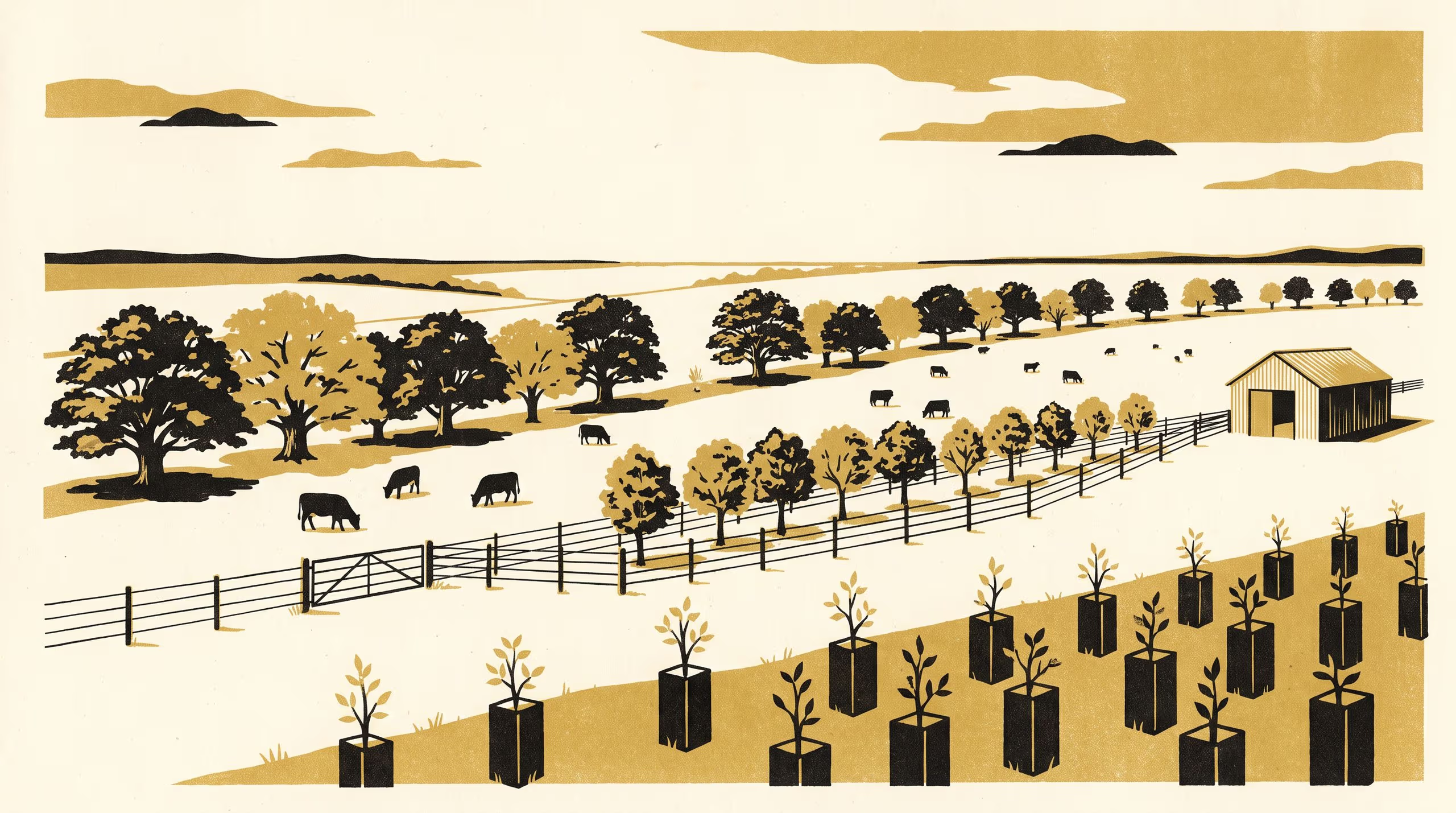
A research poster in organisation studies follows how one grazing cooperative's committees have looked after shade and fodder trees that outlive every office on its board.
A poster from the School of Emergent Priorities reads thirty-two years of committee minutes kept beside a planted silvopastoral run
“Trees — ongoing.” For thirty-two years, those two words have sat on the agenda of a member-owned grazing cooperative, through fourteen chairs and 352 sets of minutes, and in 197 meetings they were noted and carried forward. They are the starting point of Nobody’s Portfolio: How a Grazing Cooperative’s Committees Carry Trees That Outlive Every Office, a research poster released today by the School of Emergent Priorities.
Ms Sunniva Balogun, Doctoral Candidate, Dr Anneke Tolan, Senior Research Fellow and Deputy Convenor of Futures in Committee, and Mr Halvard Nnamani, Doctoral Candidate, bring the School’s interest in organisational time to a setting where time is measured in canopy. Pairing a complete reading of the committee record with conversations across successive generations of office-holders, the team traces how a shared landscape asset stays in view as governance settings turn over around it, and identifies the moments at which a tree becomes something a committee can decide.
Every institution keeps a few things it has agreed to look after without ever quite deciding to. We were glad to find one that has been looked after so faithfully, and we intend to keep it on our own agenda for some time.
— Dr Anneke Tolan, Senior Research Fellow and Deputy Convenor, Futures in Committee
Ms Balogun described the project as “a long conversation with people who were never in the room at the same time”, and credited the cooperative’s members for the patience of their record-keeping.
The poster joins a growing body of work in which the School attends to the commitments an organisation inherits rather than chooses, and to the quiet apparatus that carries them from one meeting to the next.
The full poster is available from the University’s research repository under an open licence, doi:10.5555/slop.1o3t1p.