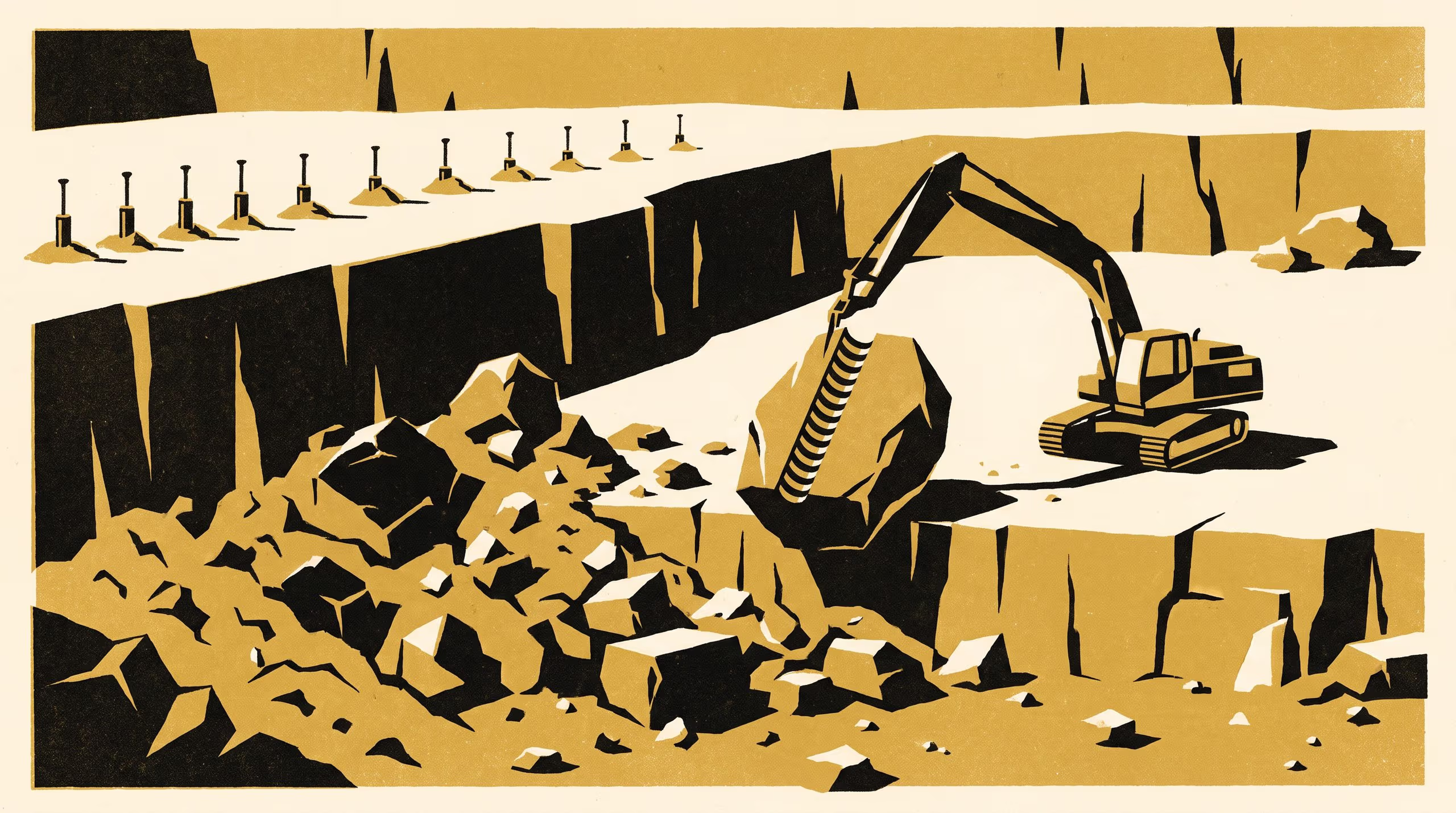
A paper from the School of Underlying Conditions finds that most of the oversize it can date from three quarry blasts began in the upper two metres of the bench, inside the part of each blasthole the explosive never reaches.
Colour-banded grout in ninety marker holes dates the depth of oversize rock from three dolerite blasts
Most of the boulders a quarry has to break twice began their lives in the part of the bench the explosive never touches. That is the conclusion of Where the Oversize Comes From: Tracing Boulders to the Uncharged Collar of a Dolerite Bench Blast, a new paper by Associate Professor Ragnhild Uzoma and Dr Brynjar Obiora of the School of Underlying Conditions.
The study brings the School’s long practice of borehole logging to the working face, aligning drilling records, field inspection and careful sampling into a single account of where broken rock comes from. Narrow holes filled with grout, a different colour for each metre of depth, let the team read a boulder’s starting point off its own surface, and the drill’s routine log of the ground it passed through confirmed the picture from the other side.
A core logger learns early to write down what didn’t come up. This study let us do the same for what did, and I suspect the School will be asking the question of every pile of broken rock it walks past for some time.
— Associate Professor Ragnhild Uzoma, Lead, Basement Relations Group
The paper also gives a place to an older source of evidence. “The drill crews had been writing ‘broken top’ in the margin for years, and we are grateful they let us read over their shoulder,” said Dr Obiora, Senior Research Fellow.
The University regards this kind of patient, ground-level inquiry as part of its obligation to know the earth it stands on, and welcomes the paper to the School’s growing body of work on what the ground keeps to itself.
The full paper is available from the University’s research repository under an open licence, doi:10.5555/slop.7vh3fg.