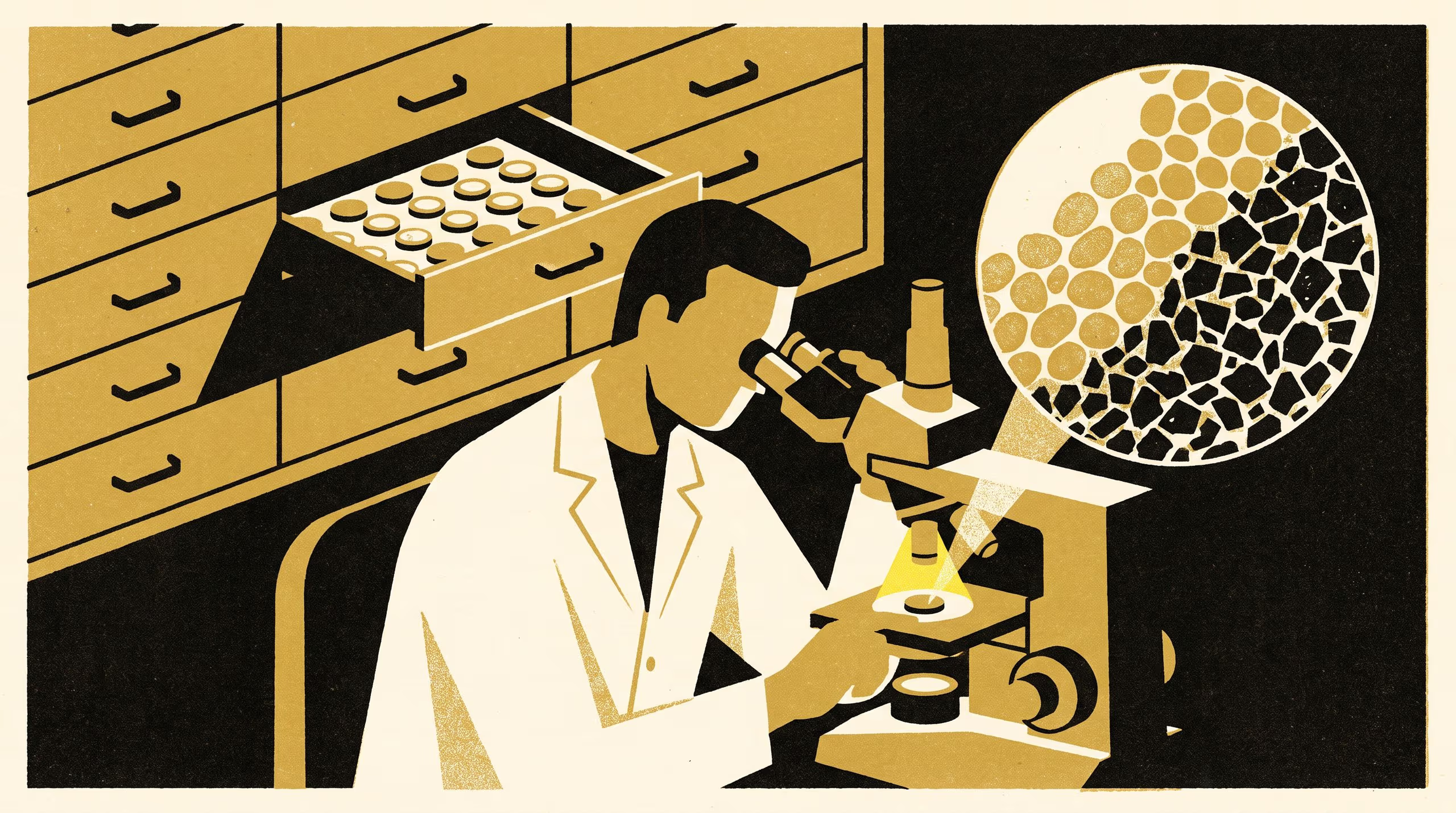
A research poster from the School of Underlying Conditions re-reads an archive of quenched high-pressure experiments along their thermal gradients, recovering 23 boundary positions without a single new run.
A re-description of 61 archived multi-anvil charges finds phase boundaries already sitting inside 23 of them
I came to these capsules expecting to catalogue them. They asked instead to be walked, a tenth of a millimetre at a time, and I have tried to do them that courtesy.
— Dr Brynjar Obiora, Senior Research Fellow, School of Underlying Conditions
Every Charge a Transect: Re-describing Quenched Olivine–Wadsleyite Run Products along Their Thermal Gradients, a new research poster by Dr Obiora and Associate Professor Ragnhild Uzoma, returns to the School’s archive of high-pressure experiments with a single proposition: a sample held under a thermal gradient remembers more than one temperature. Of 61 archived charges described station by station from hot spot to capsule end, 23 hold both minerals in distinct zones, and each meeting of those zones is a boundary the original run table never wrote down.
The work brings field description, thermal modelling and archival stewardship into a single practice of attention, repositioning the completed experiment as a renewable research asset rather than a closed account. Its station descriptions now sit with the School’s reference collection of described profiles, where they join a growing body of evidence about what the University’s instruments have already seen.
“Every drawer in that archive has been waiting for someone to read it the long way,” said Associate Professor Uzoma, Lead, Basement Relations Group.
The University takes quiet satisfaction in a study whose most productive press time turned out to be the time already spent, and counts it among the School’s contributions to the stewardship of deep-Earth evidence.
The full poster is available from the University’s research repository under an open licence, doi:10.5555/slop.v2u8xv.