A year-long stability study from the School of Underlying Conditions finds that a herbal nanoemulsifying fill drifts inside its soft-gelatin capsule, while the same fill in an HPMC capsule holds steady.
Soft-gelatin shells gave up glycerol and water to a self-nanoemulsifying fill, and its droplets grew almost fivefold
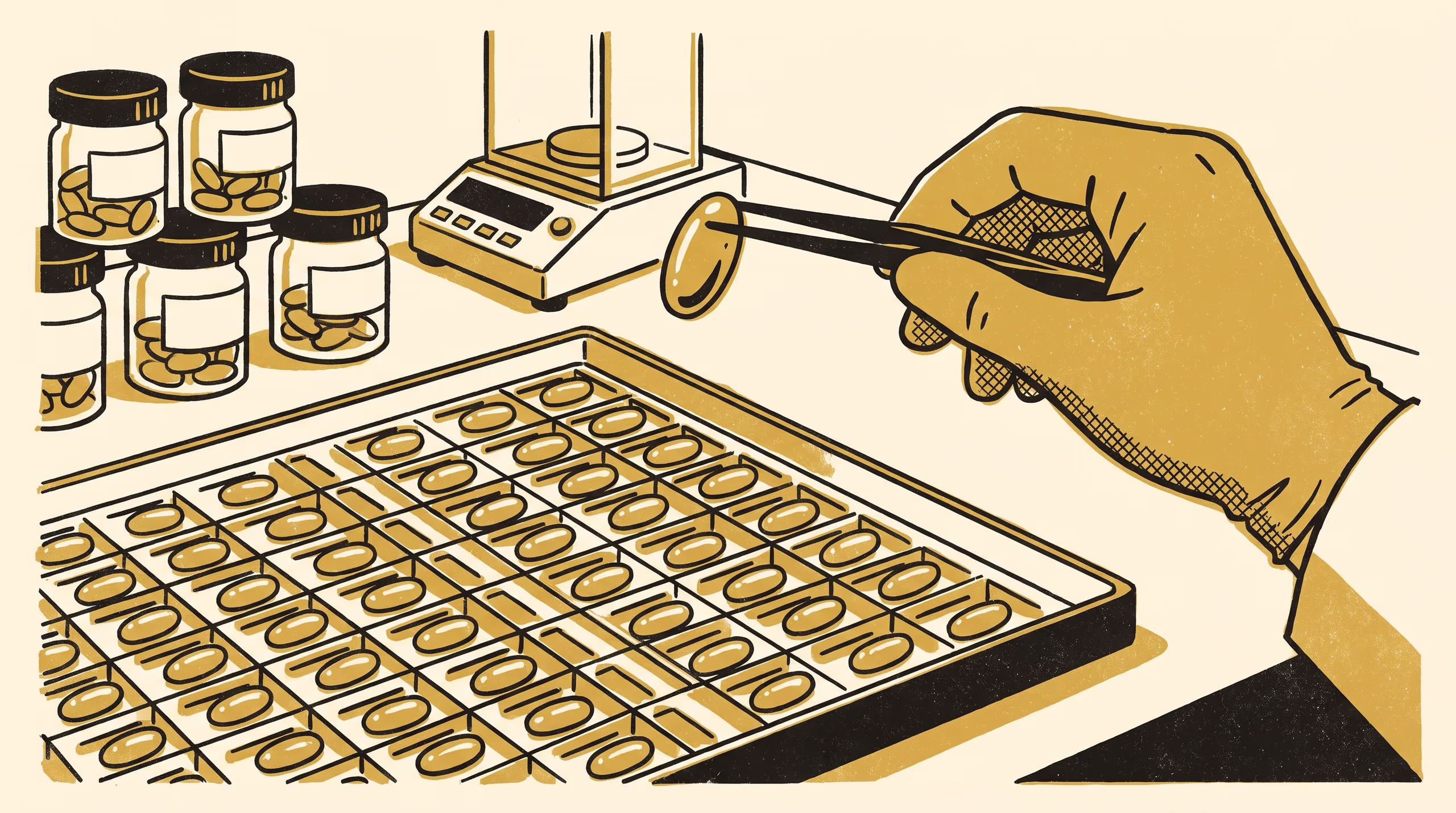
For twelve months, 840 capsules of a single herbal formulation sat in two climate-controlled cabinets at the School of Underlying Conditions, and every so often someone came to cut a few of them open.
Twelve Months in the Shell: Fill–shell migration and the slow loss of self-nanoemulsification in a soft-gelatin polyherbal SNEDDS, a new research poster by Dr Vigdis Emenike and Associate Professor Ragnhild Uzoma, reports what the cabinets gave back. The herbal extract itself held steady. The soft-gelatin shell around it did not keep to itself: glycerol and water moved from shell to fill, and by the end of the year the fill dispersed into droplets almost five times their original size. The same fill in HPMC capsules barely moved.
We tend to treat a container as the end of a story. It has been a real pleasure to spend a year treating one as the middle of it, and I suspect the School will go on doing so for some time.
— Associate Professor Ragnhild Uzoma, Lead, Basement Relations Group
The poster brings stability science, colloid characterisation and sustained attention to the post-manufacture life of a dosage form into a single frame, positioning the capsule shell as an active participant in formulation performance rather than a passive enclosure. It is exactly the kind of unhurried, shelf-level inquiry the University is glad to give room to.
“Every one of those capsules was sealed on the same afternoon,” said Dr Emenike, Senior Lecturer in the School of Underlying Conditions. “What they did after that was their own business, and we were grateful to be let in on it.”
The full poster is available from the University’s research repository under an open licence, doi:10.5555/slop.h65e16.