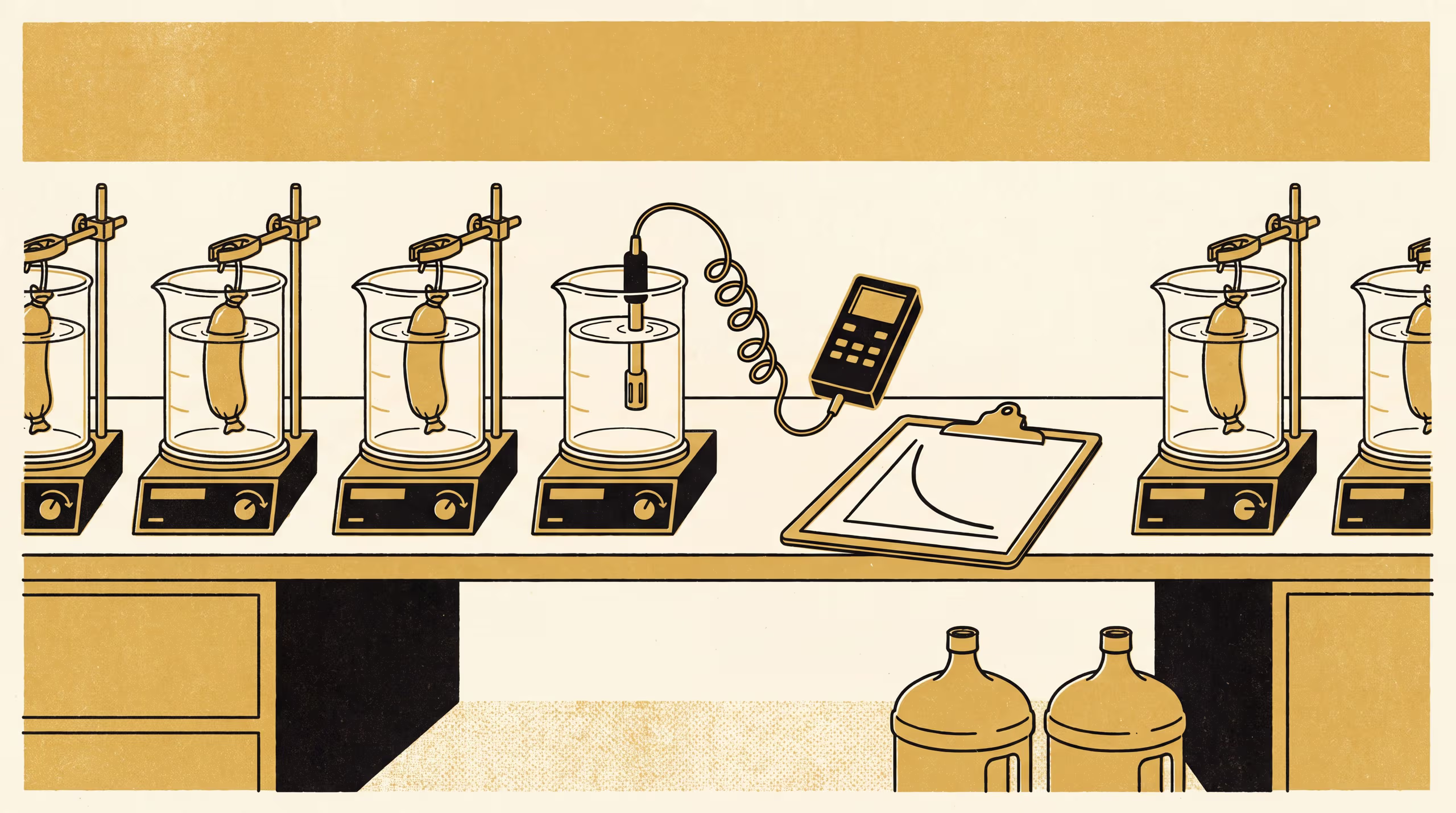
A research poster from the School of Underlying Conditions follows twelve batches of fish-skin collagen through dialysis and finds that the conductivity of the rinse water can say when the salt has gone, about a third of the way short of the scheduled finish.
A research poster reads the rinse water as a hydrologist reads a stream, and finds most batches clean by the sixth change
How many changes of water does a batch of collagen need before the salt used to recover it is gone? A new research poster from the School of Underlying Conditions, The Sixth Change of Water: A recession endpoint for dialysing acid-soluble collagen from fish skin, by Dr Vigdis Emenike and Associate Professor Ragnhild Uzoma, proposes that the rinse water can answer the question for itself.
There is nothing in this poster a careful technician has not half-known for years, and I hope it reads that way. The School is happiest when one of its instruments ends up somewhere it was never bought for.
— Dr Vigdis Emenike, Senior Lecturer, School of Underlying Conditions
Carrying the School’s field-hydrology habits across the corridor to its cold room, the team followed twelve extraction batches through a five-day rinsing schedule, reading each falling conductivity record as a recession curve and checking the recovered collagen against it as the schedule ran. Eight batches were clean by the sixth change. The other four slowed noticeably, each traced to gel fragments that had gone into the bag undispersed. On the authors’ proposed rule, roughly a third of the scheduled water was not required.
The University counts the work among a steady run of occasions on which a method raised in one of its schools has proved quietly at home in another, and is glad to see the cold room join that company.
Associate Professor Uzoma, Lead of the Basement Relations Group, said the poster had “given the cold room a hydrograph to pin above the sink, which is more than most cold rooms can say.”
The full poster is available from the University’s research repository under an open licence, doi:10.5555/slop.hdg0k1.