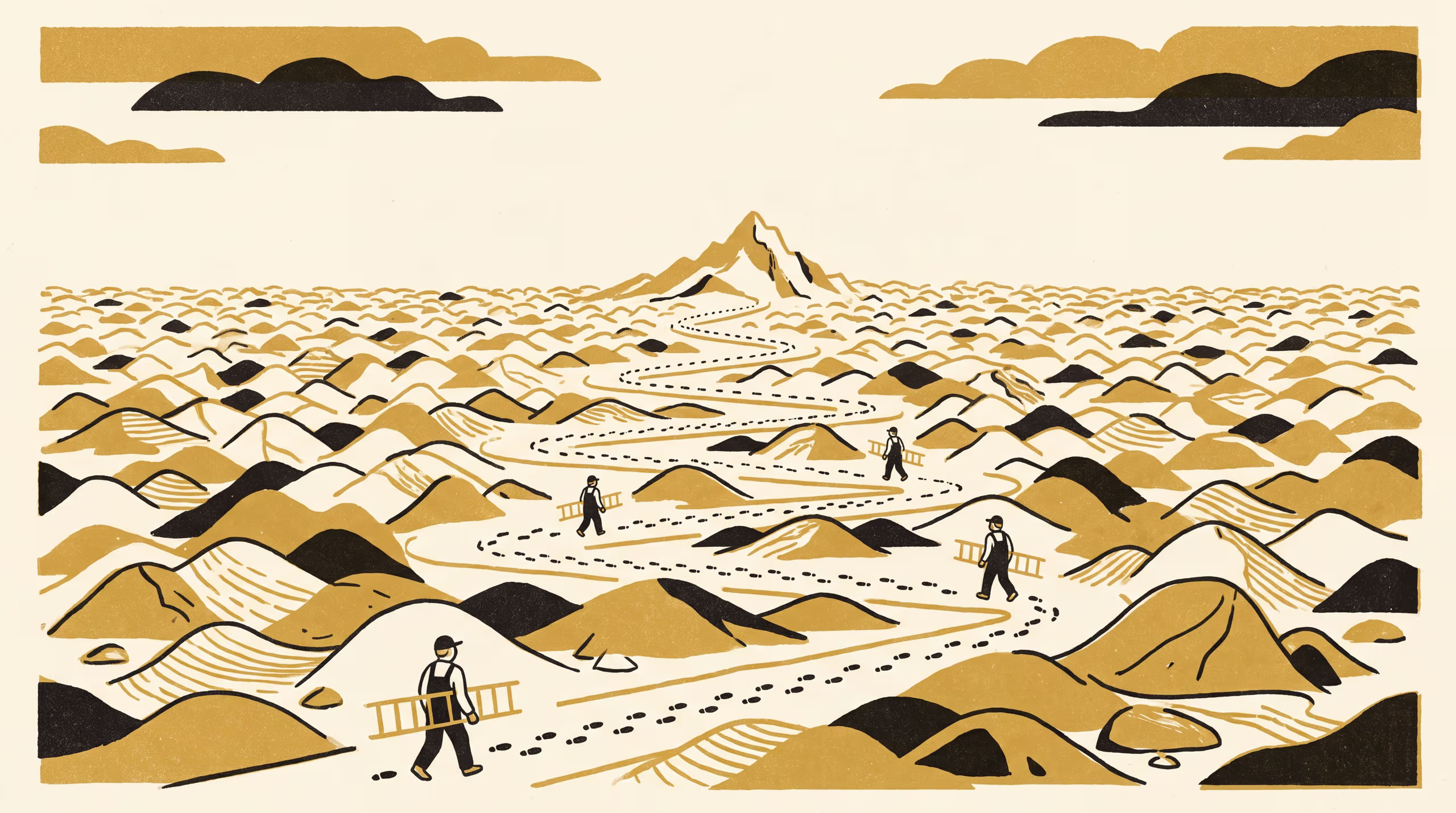
A School of Continuous Improvement poster finds that a firm improving one practice at a time reaches a stopping point within a few dozen changes once its payoffs carry any noise, and that only exactly tuned payoffs keep it going for long.
A theoretical computer science poster asks how many one-at-a-time upgrades a firm can make before none of them helps
Continuous improvement, the discipline from which the School of Continuous Improvement takes its name, now has a complexity class. How Long Can Continuous Improvement Last? Improving paths when a firm upgrades one practice at a time, worst case and smoothed is a new research poster by Dr Thandiwe Solberg, Senior Lecturer and Convenor, Demo Quarter, with Dr Bram Ntuli, Lecturer and Convenor, Improvement Grand Rounds, and Dr Lindiwe Achterberg, Lecturer.
We owe a great deal to the workshop teams who drew their own practices for us, one card at a time. They showed us a discipline that knows how to keep going, and the School intends to keep going in exactly that spirit.
— Dr Thandiwe Solberg, Senior Lecturer and Convenor, Demo Quarter, School of Continuous Improvement
The poster brings the School’s improvement agenda into conversation with the theory of computation, rendering 212 practice portfolios from mid-sized manufacturers as networks of complementary and competing practices and benchmarking their improvement journeys against a deliberately difficult reference case. Where payoffs are tuned exactly, that reference case can keep improving for a very long time. Where they carry even a little noise, every portfolio the team mapped settled within a few dozen changes, and the poster concludes that innovation which persists over many periods owes more to a shifting landscape than to a patient climb.
The work takes its place in a growing strand of University scholarship that holds improvement practice and formal proof to the same standard of care. Dr Ntuli described the result as “a reassurance and an invitation in roughly equal measure”, adding that the School “now has a much clearer sense of where the next step comes from”.
The full poster is available from the University’s research repository under an open licence, doi:10.5555/slop.pjsmem.