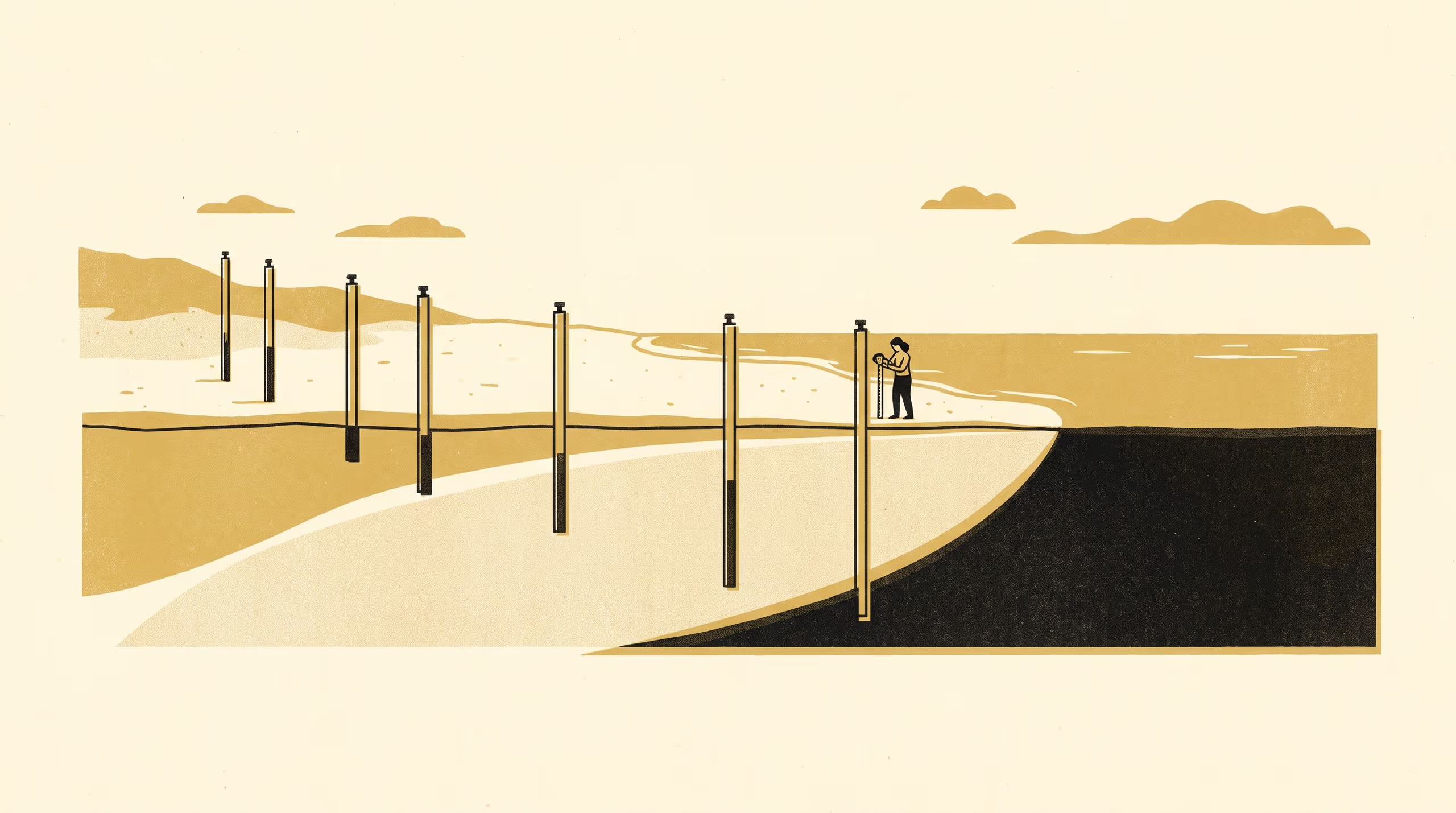
The School of Underlying Conditions has published The Coast Begins Underground, a prospectus that asks future coastal practitioners to start with the ground behind the beach.
A School of Underlying Conditions brochure approaches coastal and marine management by way of the dune, the bore and the profile pit
Prospective students weighing a future in coastal and marine management have a new place to begin. The Coast Begins Underground: An invitation to study coastal and marine management from below, published this week by the School of Underlying Conditions, sets out a way into the field that starts some distance back from the waterline, among the monitoring bores and profile pits where the School does its fieldwork.
The shore has been patient with us for a long time. This is our way of asking a few more people to come down and be patient with it in return.
— Dr Vigdis Emenike, Senior Lecturer, School of Underlying Conditions
The prospectus moves through three linked areas of activity. It begins with the groundwater held behind the beach, turns to the shore as a layered deposit to be described with care, and closes on the governance settings through which shorelines come to be prioritised, renewed and patrolled. Each strand is carried by a field image and a voice from the people who teach it, and the whole is anchored in a selection of the University’s published coastal research.
The publication brings the earth sciences and priority studies into a shared coastal offering, and the University regards that alignment as one of the more quietly consequential developments of the School’s first season. Associate Professor Kwame Lindqvist, Director of the Master of Priority Studies, described it as “the moment two schools noticed they had been standing on the same beach, and decided to say so to the people who will join them there.”
The brochure was prepared with Senior Research Fellow Brynjar Obiora, whose work on the shore informs its second section.
The full brochure is available from the University’s research repository under an open licence, doi:10.5555/slop.h4e1jr.