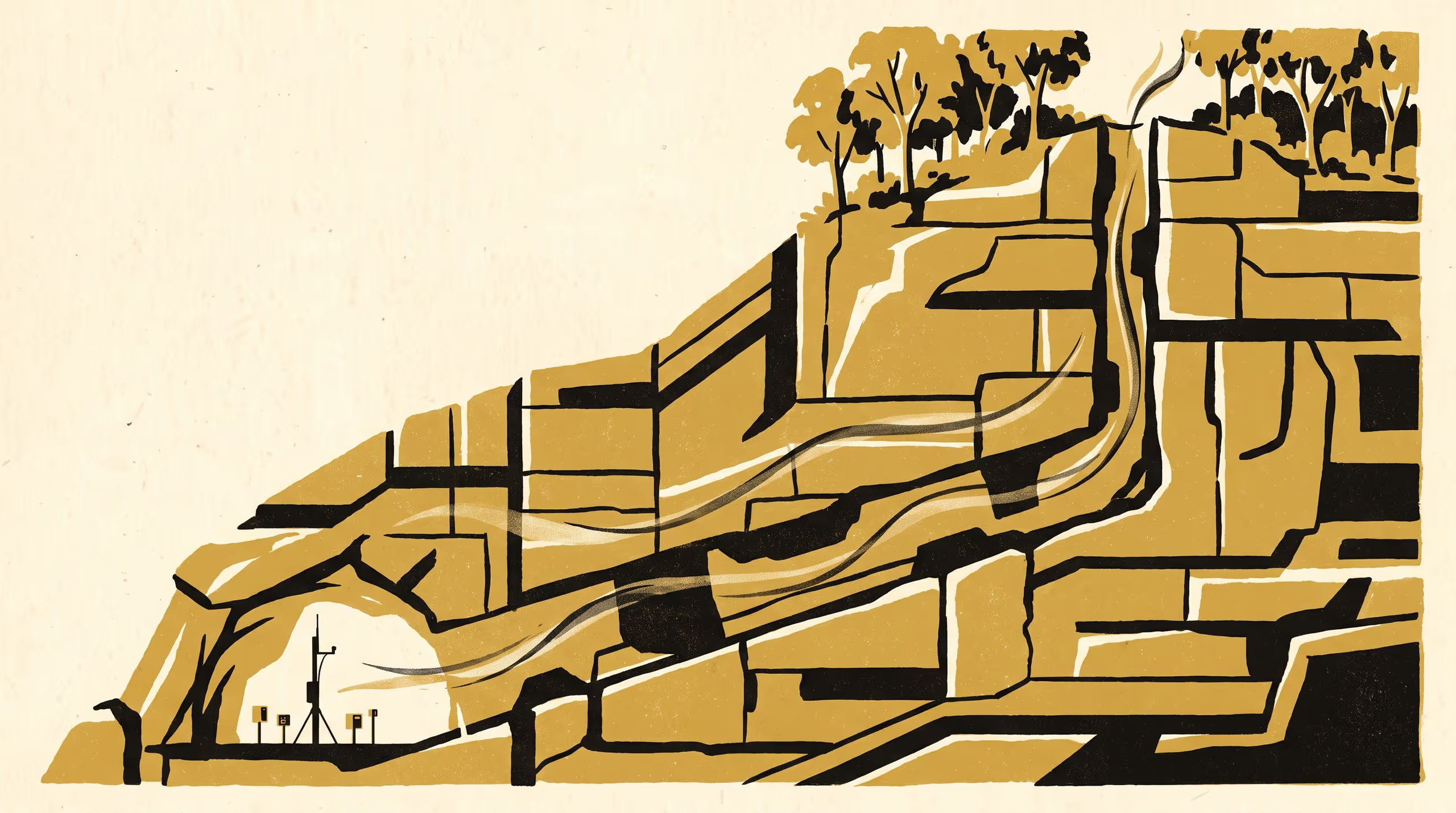
A new research poster from the School of Underlying Conditions follows the air through an undeveloped limestone cave in both directions of its seasonal draught, and reports what the passages hold back.
Paired particle counts at both openings of an undeveloped cave trace how its seasonal draught filters the air passing through
Winter is when a cave inhales. Cold air slides in at its lowest opening and leaves, warmed, through whatever gap the rock offers higher up, and in summer the whole arrangement runs the other way. Recovered at the Vent: Size-resolved particle penetration through a limestone cave in its two seasons of draught, a new research poster by Associate Professor Ragnhild Uzoma, Lead of the Basement Relations Group, and Dr Vigdis Emenike, Senior Lecturer, asks how much of the air’s particle load survives the journey.
The answer depends on the season. Instruments stationed at both ends of the cave over thirteen months show the passages recovering fine particles best and keeping most of the coarse ones, with the slower summer draught holding back more at every size. The months in which the draught could not decide which way to run are set out in the record as gaps, rather than smoothed over.
A cave has been breathing on its own schedule for a very long time, and we have only just started asking it what it keeps. I would be pleased if this poster gave people more questions than it settles, because the passages certainly have more to say.
— Associate Professor Ragnhild Uzoma, Lead of the Basement Relations Group
The work extends the School’s interest in the meeting of the ground and what passes over it into the atmosphere itself, bringing a field geologist’s habits of recovery and loss to bear on the chemistry of moving air. It is the kind of patient, two-ended study the University has always been glad to make room for.
Dr Emenike placed the poster within a longer arc of the School’s work underground. “We have spent a good deal of time watching water rise and fall in holes in the ground,” she said. “It seemed only fair to give the air the same attention.”
The full poster is available from the University’s research repository under an open licence, doi:10.5555/slop.c4f5mv.