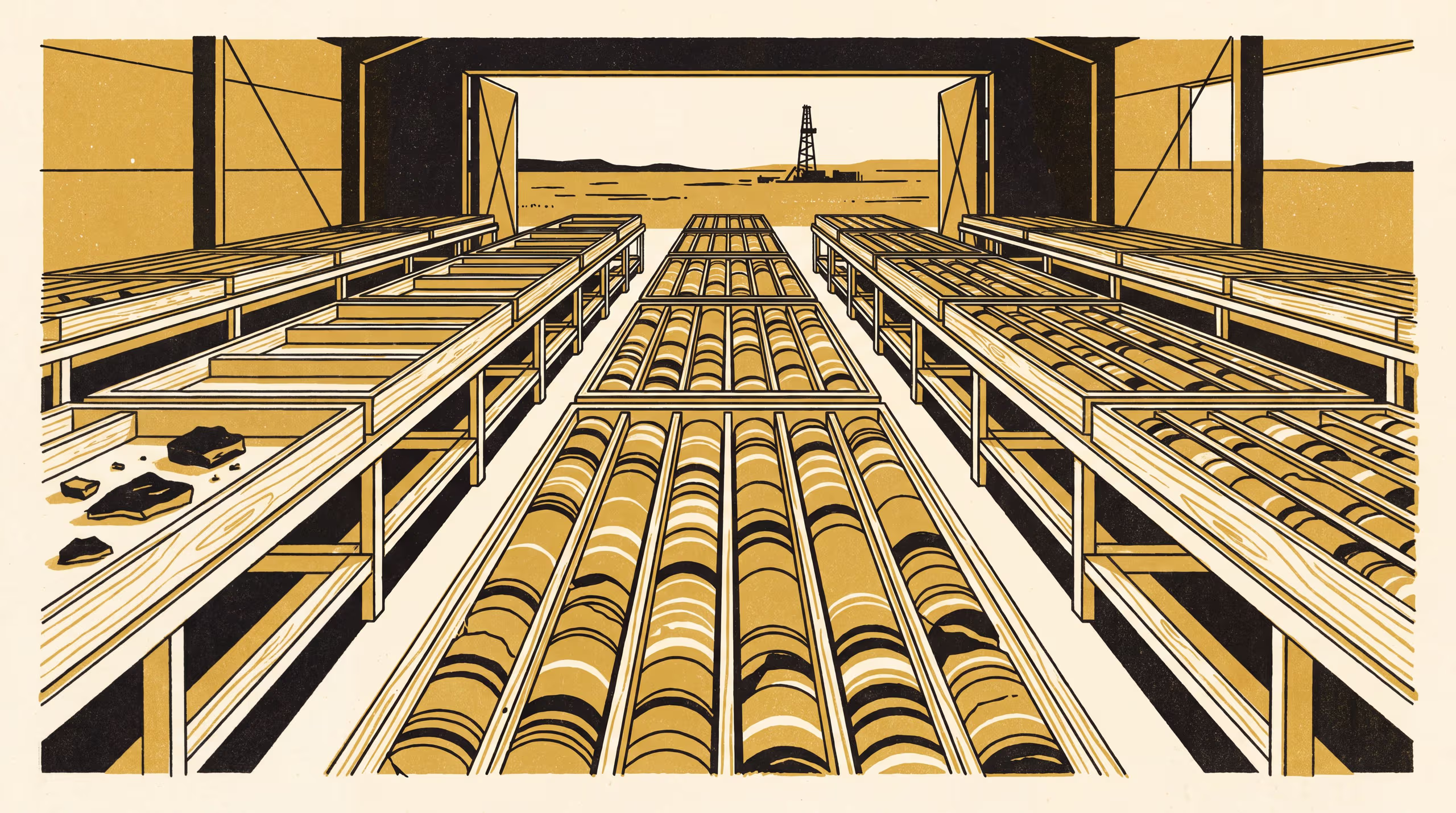
A research poster from the School of Underlying Conditions follows the regional seal of a mature oil province through 1,486 well files and finds that most assessments of it rest on four cored intervals from a single field.
A history of the province's well files finds its seal was mostly drilled through, and cored largely by accident
Somewhere in a mature oil province sits a short run of shale core that nobody set out to take. A new research poster from the School of Underlying Conditions, Cored for Pay, Drilled Through the Seal: Which rock a mature oil province chose to recover, and what its well files know of the cap rock, by Associate Professor Ragnhild Uzoma, Dr Iben Chikere and Dr Vigdis Emenike, asks how much of what is now said about that province’s seal goes back to cores like it.
Rather a lot, it turns out. Of 37 later assessments describing the seal as competent, 33 trace by citation to four cored intervals, all from the crest of one field.
A core tray keeps whatever it is given and makes no fuss about what it was not. The School has always found that reassuring, and it is a pleasure to see the files agree.
— Associate Professor Ragnhild Uzoma, Lead, Basement Relations Group
The work places the province’s well archive within the wider record-to-reuse continuum, bringing archival coding, core-recovery accounting and citation genealogy to bear on the evidential provenance of a subsurface claim, and on how a body of records gathered with one purpose in view comes to inform another.
Dr Chikere described the poster as one more step in the University’s longer effort to understand the documents it inherits. “Every archive was somebody’s working file first,” she said. “We are glad to have been allowed to read this one in the order it was written.”
The University counts the poster among the first fruits of a school still in its opening season, and a fitting one for a department that studies the ground from the bottom up.
The full poster is available from the University’s research repository under an open licence, doi:10.5555/slop.h2zq2x.