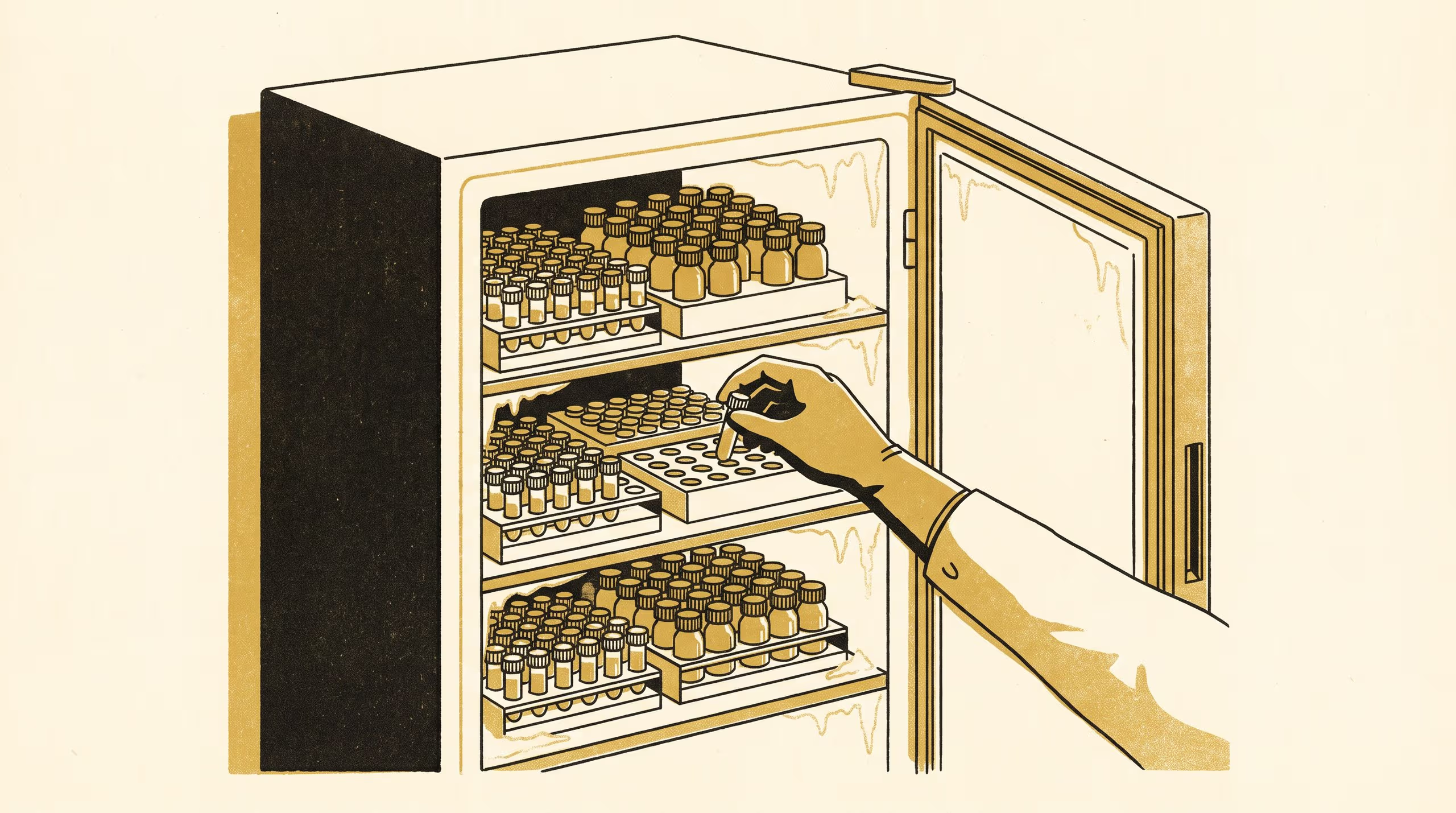
A new paper from the School of Underlying Conditions re-assays the quinazolinone library a closed synthesis group left in a shared freezer, and finds twelve compounds in it that nobody made
A closed group's compound library is checked against its register, vial by vial
Twelve compounds have joined a Slop University chemical library without anyone having made them. They came to light in a freezer the University inherited from a synthesis group that closed in 2014, and they are among the findings of What Is Still in the Vial: A Twelve-Year Purity Re-Assay of an Orphaned Quinazolin-4(3H)-one Library, and What Its Storage Register Predicts, a new paper by Associate Professor Ragnhild Uzoma and Dr Vigdis Emenike of the School of Underlying Conditions.
Of the 196 vials the authors located, 134 still held the compound named on the label. Most of the rest had been kept in solution, and in one family of compounds stored that way, the contents had become a closely related molecule.
Every institution keeps a few things it has stopped looking at. Opening one of ours has been a privilege, and the University can now say with some confidence what it holds.
— Associate Professor Ragnhild Uzoma, Associate Professor and Lead, Basement Relations Group
The paper carries the School’s long-standing interest in what a collection keeps into the chemistry laboratory, setting a departed group’s register beside a full re-assay of its vials and offering a practical pathway for colleagues who inherit stored materials of their own. The reconciled register now sits with the Basement Relations Group, alongside the samples it describes.
“A library deserves to be read as well as kept, and this one has been patient,” said Dr Vigdis Emenike, Senior Lecturer in the School of Underlying Conditions.
The University is pleased to see a collection it has long carried on its books returned to active use.
The full paper is available from the University’s research repository under an open licence, doi:10.5555/slop.q5ku08.