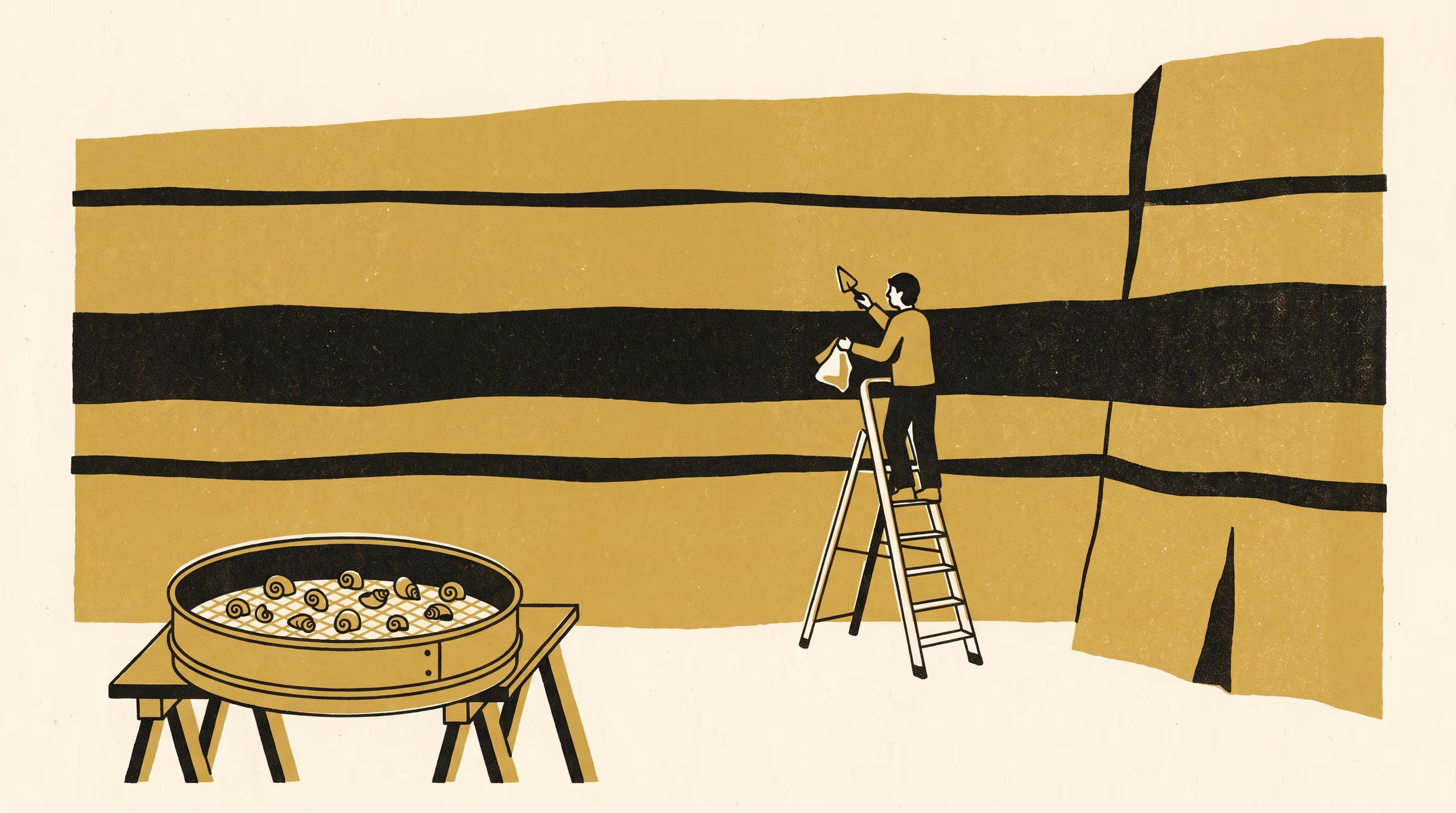
A paper from the School of Underlying Conditions re-times three buried soils in a loess quarry face and finds that most of a fossil land snail's apparent steps in shell height were steps in the record.
A fossil land snail's sudden changes in shell height mostly fade once each soil in a loess quarry is given the time its development implies
How long does a buried soil last? Long enough, according to a new paper from the School of Underlying Conditions, to change how a fossil lineage reads. How Much Time a Buried Soil Holds: Pedogenic Duration and the Apparent Steps in a Loess Land-Snail Lineage, by Dr Brynjar Obiora and Ms Sunniva Balogun, returns to a quarry face where a small land snail seems to change shape in sudden jumps, each one at a buried soil.
A soil surveyor learns early that the ground keeps its own hours. It has been a quiet pleasure to hand a few of them back to the snails, and the School suspects there are more still owed.
— Dr Brynjar Obiora, Senior Research Fellow, School of Underlying Conditions
The paper brings field soil description, shell morphometrics and model-based inference into a single time-aware framework, recalibrating the relationship between a section’s thickness and the duration it represents. Once the three soils are given the time their development implies, two of the jumps settle into the lineage’s ordinary wandering, and the largest becomes unusual rather than extraordinary.
Ms Balogun, who picked and measured the 4,300 shells at the heart of the study, spoke warmly of the site. “Spending a season with one quarry face is a fine way to get to know it,” she said. “I hope whoever stands there next finds it as generous as we did.”
For a University that has long preferred to start from the ground, the paper is a welcome reminder that the ground has been keeping time all along.
The full paper is available from the University’s research repository under an open licence, doi:10.5555/slop.n4v8m9.