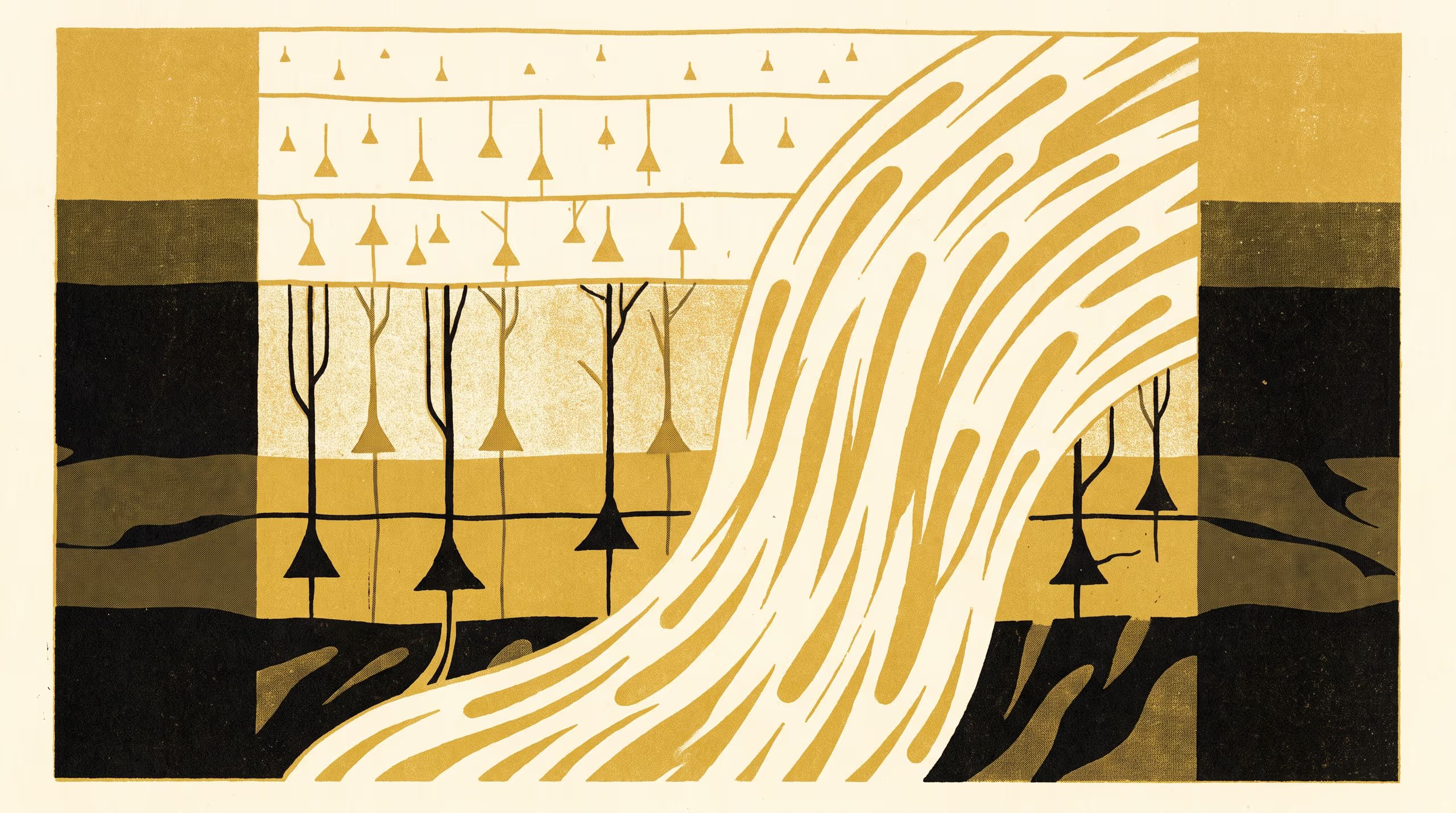
A new paper from the School of Underlying Conditions models the slow oscillation of deep sleep in a three-layer cortical column and asks why its up states begin where they do.
A three-layer model of the slow oscillation finds that recovery decides which layer leads only when the silences are short
A column of simulated cortex, three layers deep and run through many hours of slow, sleep-like rhythm, sits at the centre of the newest paper from the School of Underlying Conditions. The Down State Forgets: Adaptation Recovery Decides the Initiating Layer of the Slow Oscillation Only When Down States Are Short is the work of Associate Professor Ragnhild Uzoma, Lead, Basement Relations Group, and Dr Brynjar Obiora, Senior Research Fellow.
The paper asks a deceptively simple question of the brain’s deepest layers: does the bottom of the column start each burst of activity because it is the most ready, or because it is the quickest to recover from the last one? Its answer depends on how long the column has been quiet. After a long silence, readiness alone decides; after a short one, recovery gets a say.
We would be glad to hear from anyone who has the recordings to put this to the test. The model has said what it can, and the rest belongs to the people with electrodes.
— Associate Professor Ragnhild Uzoma, Lead, Basement Relations Group
The study aligns a compact rate model, a systematic sweep of excitability and recovery settings and close attention to the timing of every transition, positioning the slow oscillation within the broader question of how layered systems remember their own history. Dr Obiora said the School had “spent some time with fronts that settle on graded ground, and it was a pleasure to meet one that rests between shifts”.
The paper takes its place in the University’s continuing investment in the slower rhythms of research, and in the School’s own habit of beginning at the bottom.
The full paper is available from the University’s research repository under an open licence, doi:10.5555/slop.zzu8h3.