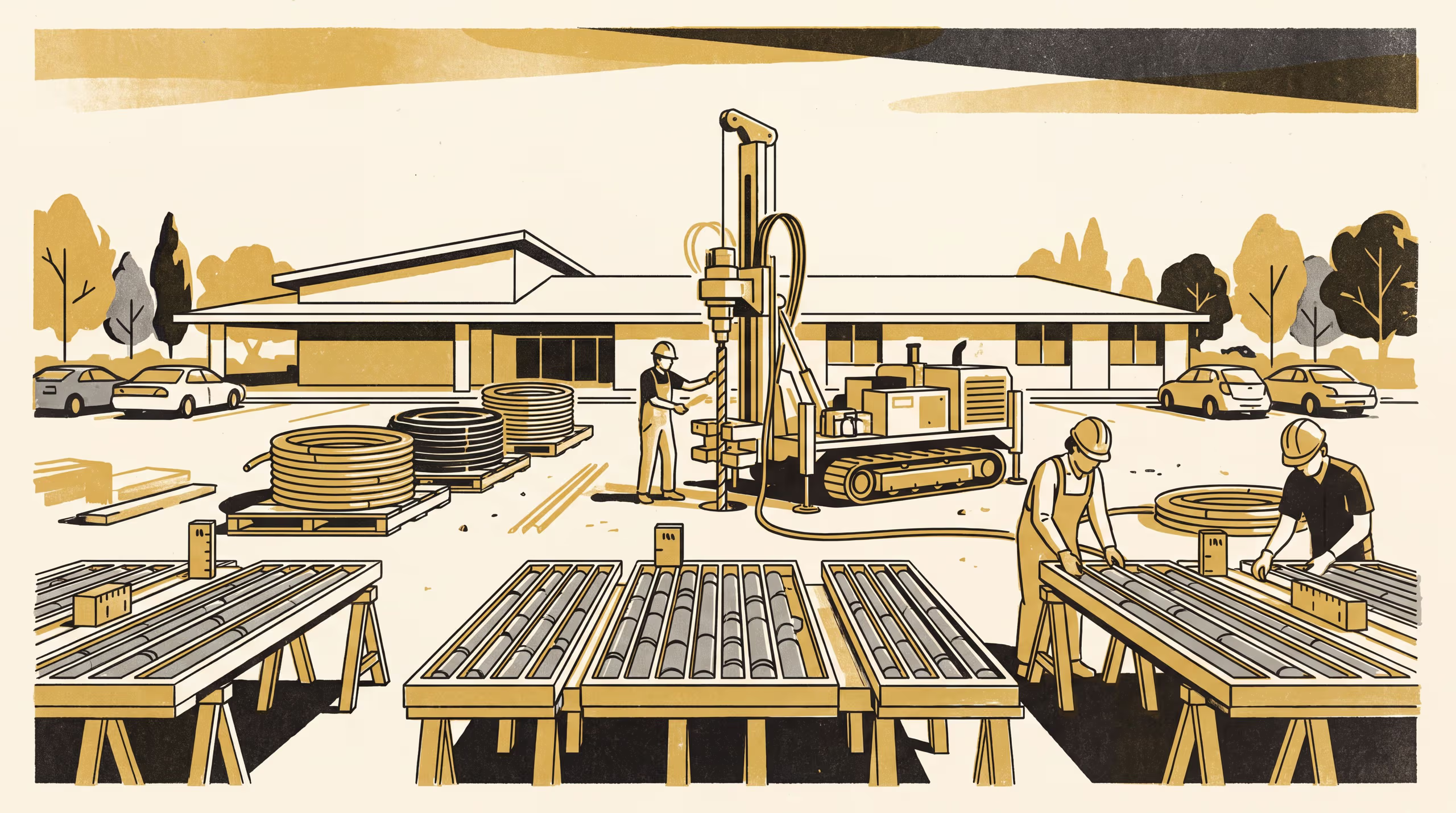
A new research poster from the School of Underlying Conditions asks whether the core a drill fails to recover should change how a ground-source heat pump field is sized.
A thermal response test run in the investigation hole absorbs 28 unrecovered metres within its own uncertainty
Twenty-eight metres of rock that never reached the core tray have turned out to matter very little to the heat pump borefield planned above them. That is the conclusion of Already in the Average: Core loss, the thermal response test and the design length of a borefield, a new research poster by Associate Professor Ragnhild Uzoma and Dr Vigdis Emenike of the School of Underlying Conditions.
We owe the most to the drilling crew, who stayed on through a wet fortnight, and to the people who use the building, who parked somewhere else for a month without a word of complaint. The ground was generous with us, and so were they.
— Dr Vigdis Emenike, Senior Lecturer, School of Underlying Conditions
The study brings laboratory characterisation of recovered core, an in-situ thermal response test and a probabilistic design framework into a single line of sight, mobilising the School’s established strengths in subsurface interpretation in support of renewable heating and cooling. Its finding is reassuring rather than dramatic: each reasonable way of accounting for the lost intervals shifts the field’s design length by less than the test itself can resolve, and only setting them aside altogether leaves the field short.
The University counts the poster among the clearer signs that its earth sciences school has something to offer the low-carbon transition, and that the offer begins below the surface.
“The School has always treated what stays in the ground as part of the record,” said Associate Professor Uzoma, Lead of the Basement Relations Group. “It is pleasing to meet a heating system that keeps the same accounts.”
The full poster is available from the University’s research repository under an open licence, doi:10.5555/slop.97ogru.