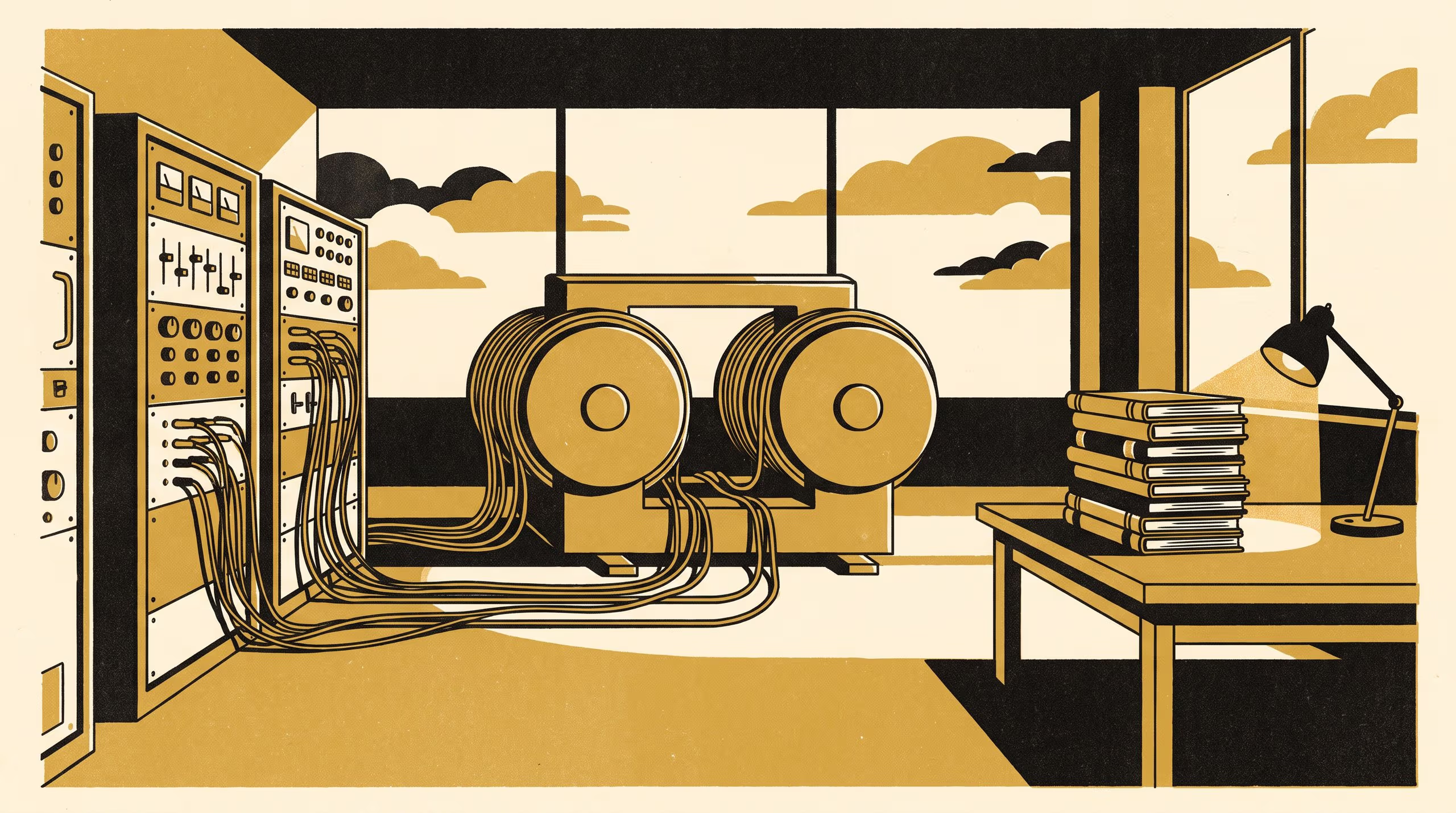
A research poster from the School of Underlying Conditions reads nine years of logbooks from one laboratory's Hall-effect station and finds that readings of the unwanted carrier sign sent the instrument for checking far more often than readings of the hoped-for one
A history of one p-type zinc oxide programme, read from its Hall-effect station's maintenance record
When a measurement station in one university laboratory returned the answer its researchers were hoping for, nobody went looking for a fault. When it returned the other answer, somebody usually did. That is the central finding of Checked When It Said n: Experimenter’s regress at one laboratory’s Hall-effect station, nine years into p-type zinc oxide, a new research poster by Dr Vigdis Emenike, Senior Lecturer in the School of Underlying Conditions, with Associate Professor Ragnhild Uzoma, Lead of the Basement Relations Group, and Associate Professor Casimir Beng, Lead of the Adaptive Metrics Lab.
None of this would exist without the people who kept those books and then agreed, years later, to sit down and talk about them. I am grateful to every one of them, and to whoever decided the logbooks were worth keeping.
— Dr Vigdis Emenike, Senior Lecturer, School of Underlying Conditions
The poster brings the School’s long engagement with instrument records into conversation with the history and philosophy of science, aligning a laboratory’s maintenance practice with the question of how an experimental community comes to trust its apparatus. It is the kind of patient, record-level scholarship the University counts among its quieter strengths.
Associate Professor Beng welcomed the collaboration as a meeting point between the two schools’ interests. “Every instrument carries a little of the hopes of the people standing next to it,” he said. “It has been good to work with colleagues who know how to read that in the margins.”
The full poster is available from the University’s research repository under an open licence, doi:10.5555/slop.g1k53t.