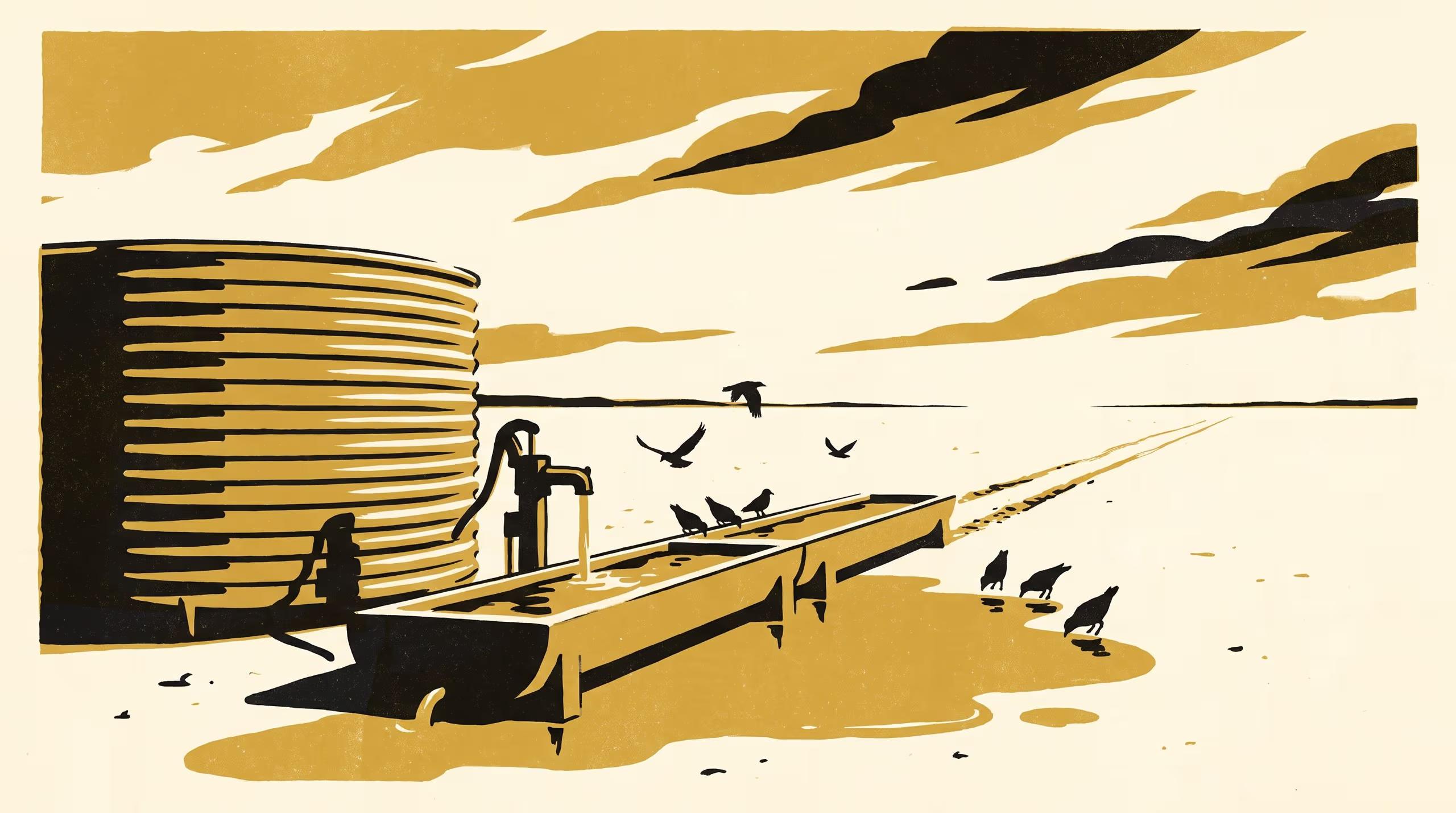
A paper from the School of Underlying Conditions surveys stock water points in a pastoral district for signs of illegal bird trapping and relates what it found to the condition of the plumbing
Two dry seasons at forty-six stock water points connect signs of illegal bird trapping to a trough that will not stop filling
Eight times over two dry seasons, two researchers from Slop University walked a circle around each of forty-six cattle troughs, separately and without conferring, and wrote down what had been left on the ground. The record they came back with is published today as Where the Trough Overflows: Illegal Bird-Trapping Sign at Artificial Water Points in a Semi-Arid Pastoral District, a paper by Dr Vigdis Emenike, Senior Lecturer, and Dr Brynjar Obiora, Senior Research Fellow, both of the School of Underlying Conditions.
The paper reports that signs of trapping were found at 14 of the 46 water points, that five of them accounted for more than half of what was recorded, and that the strongest association was with a pool of overflow on the ground beside a trough whose float valve had stopped sealing. Where station lessees replaced the valve between seasons, the paper reports, most of the signs went with the pool. The depth of the groundwater beneath each bore, which the authors measured throughout, was found to have no bearing on the matter.
The lessees let us follow their bore runs for two dry seasons and never once asked what we expected to find. I hope the paper is a fair return on that patience. I expect they will let us know.
— Dr Vigdis Emenike, Senior Lecturer
The study connects an established body of thinking about where offences concentrate with the School’s standing field presence in pastoral country, aligning place-based analysis, repeat observation and routine infrastructure assessment within a single survey framework. Dr Obiora, who judged the age of each mark from the soil surface around it, said the work had been “a reminder that a surface is always in the middle of saying something, whoever happens to be listening”.
The University counts the paper among the returns of a field programme that was established for one purpose and has been permitted to notice others.
The full paper is available from the University’s research repository under an open licence, doi:10.5555/slop.1a55ov.