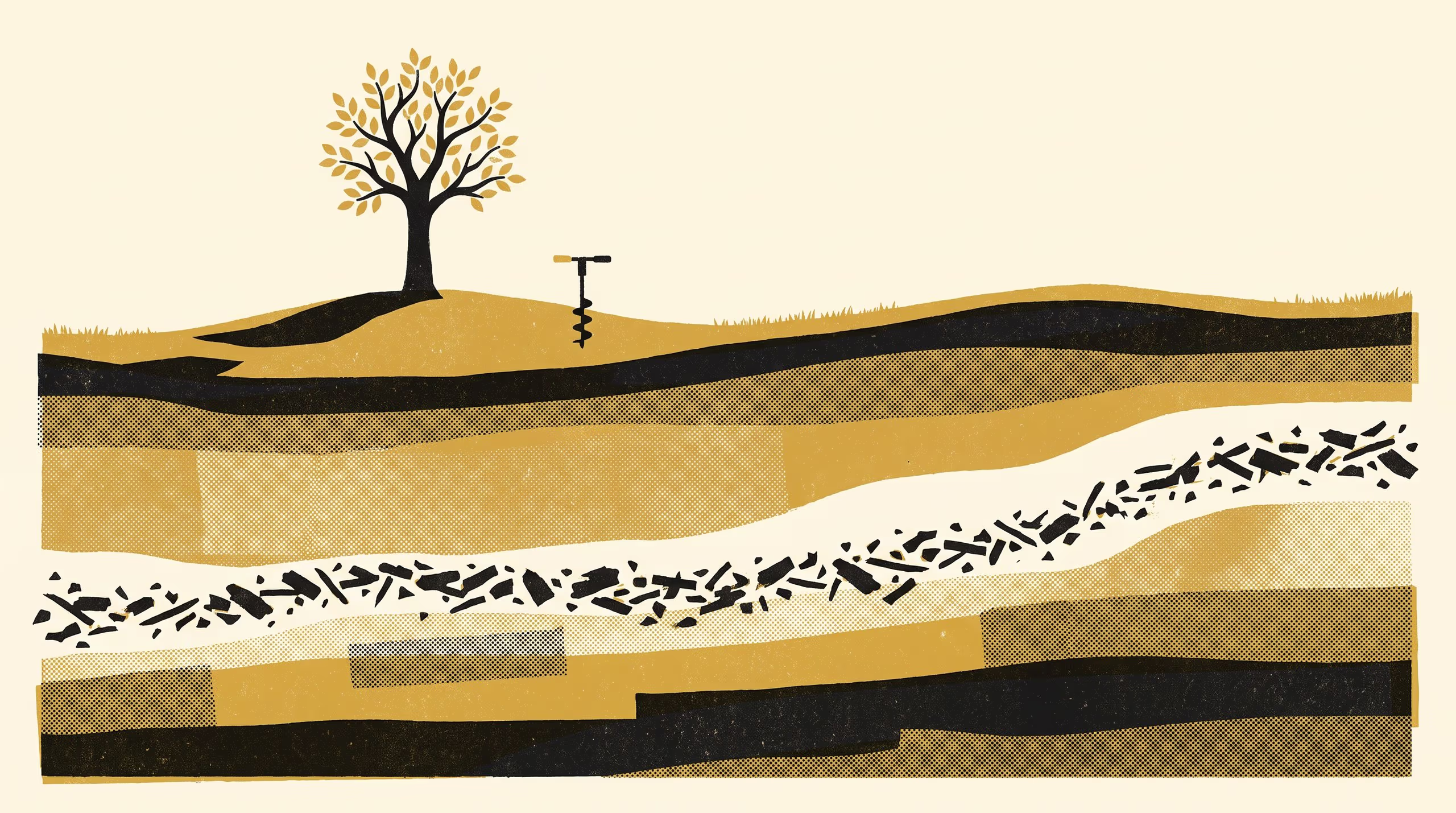
The School of Underlying Conditions has released a brochure inviting partners to stand behind its work on charcoal, from the fleck in a soil profile to the smoke over a valley town.
A new brochure gathers the soil survey, the laboratory bench and the charcoal kiln into one invitation to supporters
Supporters of Slop University are being asked to consider something most of them will have walked over without noticing. What the Fire Left: The case for the charcoal in the ground, a brochure issued today by the School of Underlying Conditions, sets out why the School believes the dark fragments in a soil profile deserve a partner’s sustained attention.
The brochure is the work of Dr Brynjar Obiora, Senior Research Fellow, with Dr Vigdis Emenike, Senior Lecturer, and Associate Professor Ragnhild Uzoma, Lead of the Basement Relations Group. The University regards it as a fitting expression of how far a young School’s sense of its own subject has already travelled.
I spent a good many years being paid to describe what came up in the auger, and nobody once asked me to make a brochure of it. I take the request as a kindness, and I have tried to describe the charcoal as carefully here as I would on the card.
— Dr Brynjar Obiora, Senior Research Fellow
Across three features, the publication aligns the School’s field, laboratory and community-facing activity around a shared material, mobilising its soil survey, its reference collection of described profiles and its bench programme into a coherent offer to prospective partners. It anchors that offer in the School’s own record, pointing readers to seven published outputs by title and identifier.
Dr Emenike said the brochure had been “a welcome occasion to see the School’s separate afternoons laid end to end”, adding that she hoped readers would find in it “roughly what we found, which is that it was all one thing”.
The full brochure is available from the University’s research repository under an open licence, doi:10.5555/slop.nruuxu.