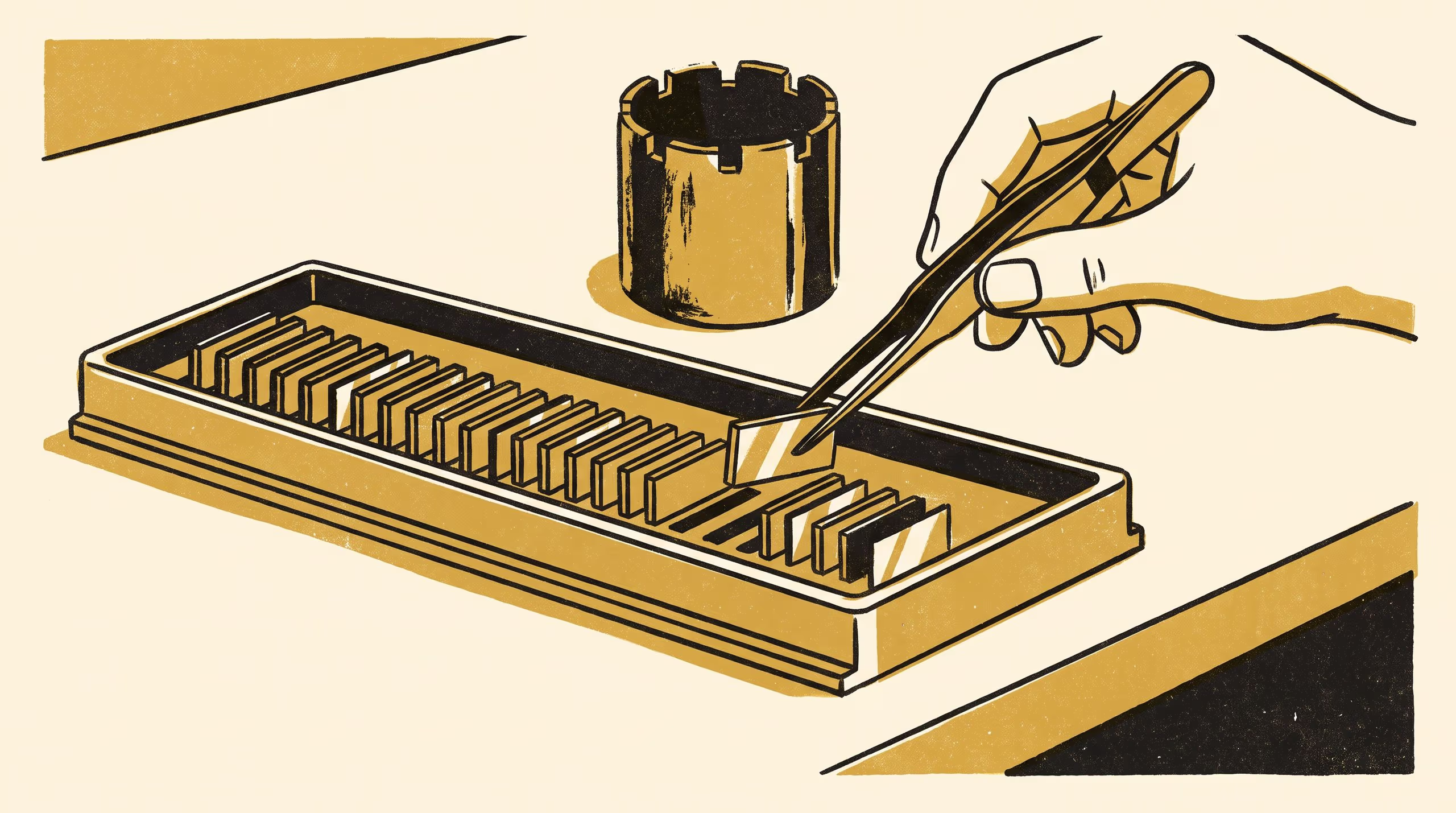
A research poster from the School of Underlying Conditions measures the magnetic properties of retired core-drilling bits slice by slice, from the working face inward.
Twenty-six core-bit crowns are sliced and measured, and seven are found softer at the working face
A drill bit that has run hot keeps the fact in a layer about a millimetre deep, and gives it up to a magnet. So reports Softer Toward the Face: Coercivity depth profiles in the Fe–Co–Cu matrix of 26 retired impregnated core bits, a research poster by Associate Professor Ragnhild Uzoma, Lead of the Basement Relations Group, and Dr Vigdis Emenike, Senior Lecturer, both of the School of Underlying Conditions.
The poster reports that seven of the 26 bits had become easier to demagnetise at the end that met the rock, in a layer between 0.8 and 1.6 millimetres deep, and that the other nineteen were the same all the way through. By heating unused pieces of the same metal and measuring those too, the authors put the seven at the equivalent of ten minutes at roughly 650 to 800 degrees Celsius.
We had the bits, we had the magnet, and we had an afternoon that turned into a term. I would not care to say which of the three the School ought to be thanked for first.
— Associate Professor Ragnhild Uzoma, Lead of the Basement Relations Group
Behind the result sits a sequence of slicing, magnetising and comparing, through which the School’s sample-preparation and characterisation capabilities were brought to bear on a single set of equipment that had already finished its working life. The poster stands, in the University’s view, as evidence that little leaves the School’s store without first being asked a question.
Dr Emenike said the work had left her “with a settled regard for the saw, and for everything that has to be given up to it before a measurement can begin”.
The full poster is available from the University’s research repository under an open licence, doi:10.5555/slop.gpndby.