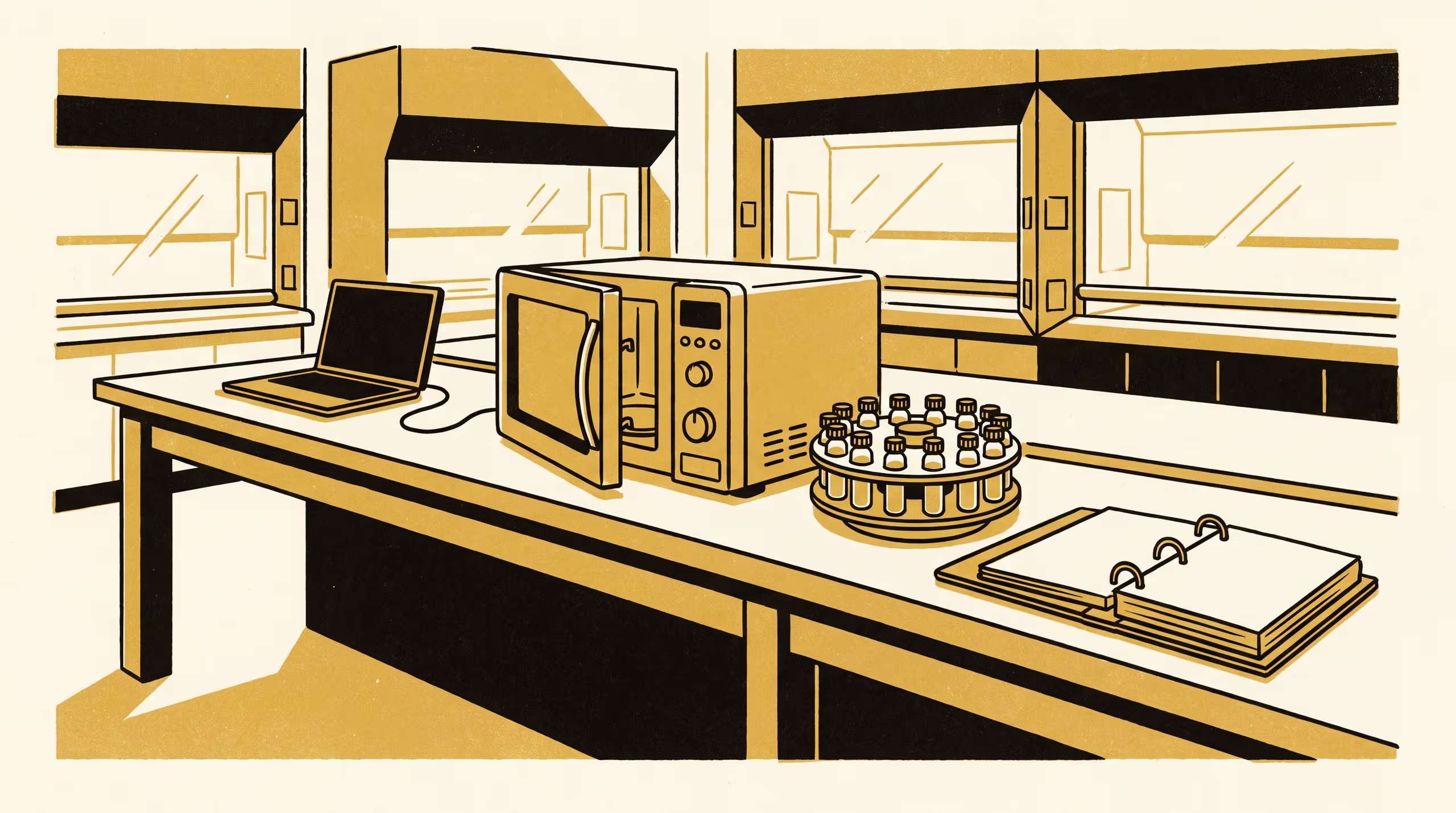
A Slop University research poster follows 268 written procedures to the stored heating programs of one shared microwave reactor and reports which of the instrument's settings appear nowhere in the prose.
A poster from the School of Emergent Priorities maps where a shared microwave reactor's settings are written down, and where they are not
Every heating program stored on a shared laboratory instrument was saved by somebody who knew why. A research poster released today asks how much of that knowing ever reached the written page. What the Program Knows: Tracing Written Microwave-Synthesis Procedures to the Stored Programs That Run Them is the work of two doctoral candidates of the School of Emergent Priorities, Ylva Ogunbanjo and Halvard Nnamani, with Dr Runa Adegoke, Senior Lecturer and Convenor, Strategic Drift Survey.
The poster reports that most procedures can be matched to the program that ran them, and that where prose and program both give a value they almost always agree. Four settings, among them the stirring rate and the temperature a vessel is cooled to, are found almost entirely in the instrument and almost never in the text.
The programs were all saved with care, and most of them were saved some time ago. We have tried to meet them on their own terms, and I suspect the instrument will be patient with us for a while yet.
— Ylva Ogunbanjo, Doctoral Candidate, School of Emergent Priorities
Pairing a close reading of the written record with a systematic pass through the instrument’s own history, the team assembles a picture of how intention travels from page to bench, and of where along that path it is taken up by settings no one wrote down.
Dr Adegoke described the poster as “a careful piece of attention paid to a library most of us had stopped opening”, and said the School would be glad of the questions it leaves on the bench. The poster sits comfortably within the School’s settled readiness to follow a priority to wherever it happens to have been stored.
The full poster is available from the University’s research repository under an open licence, doi:10.5555/slop.2gqsca.