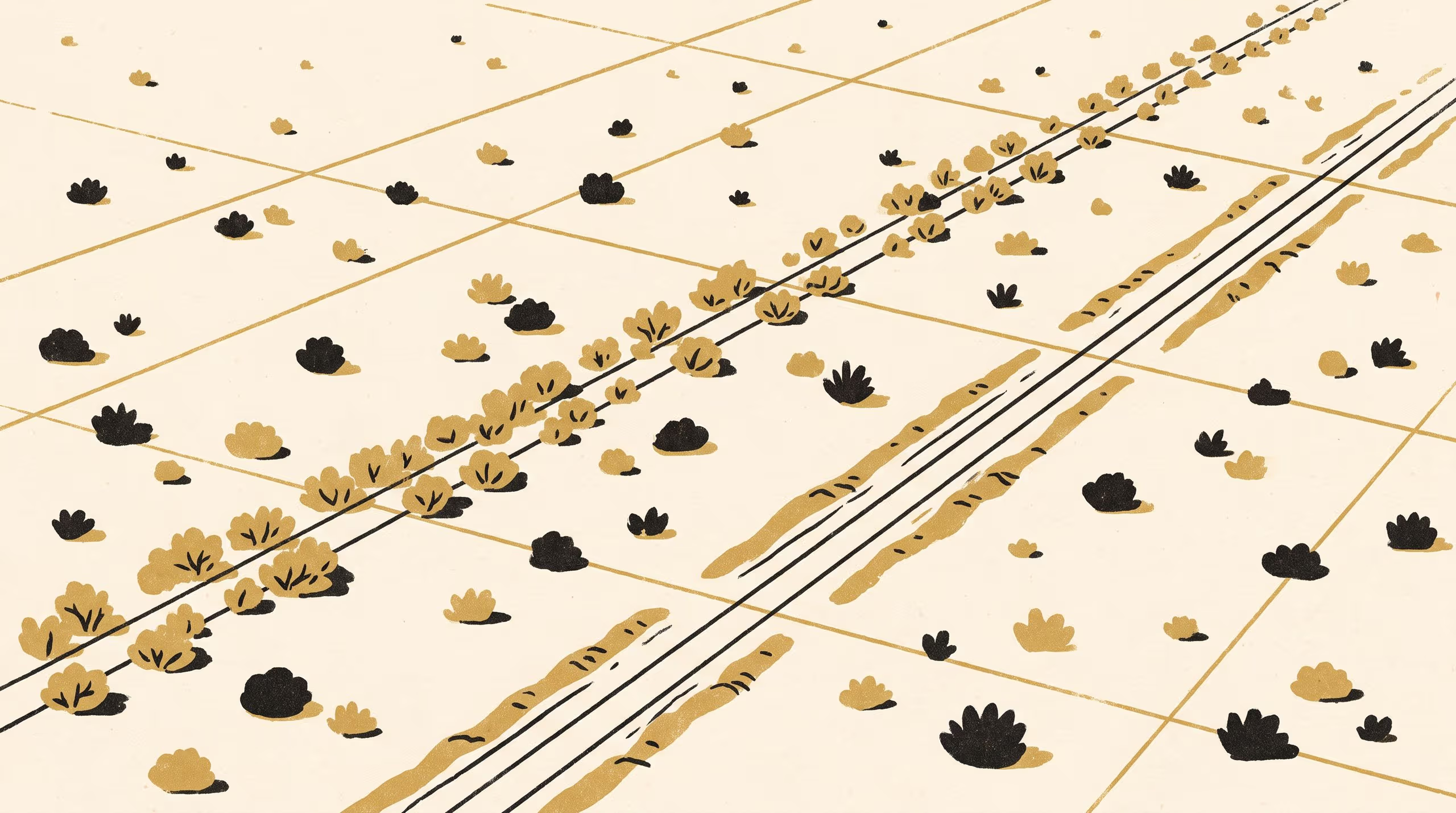
A paper from the School of Emergent Priorities and the School of Underlying Conditions returns to an abandoned seismic survey grid and finds that how each line was cut still decides whether it can be seen.
Forty-two lines cut for a seismic survey and left for thirty-one years are measured against the shrubland beside them
Two of the University’s schools shared a field season this year, and the paper that has come of it is published today. Thirty-One Years on the Cut Line: Shrub Regrowth across an Abandoned Seismic Survey Grid in a Semi-Arid Shrubland is the work of Ms Ylva Ogunbanjo, Doctoral Candidate in the School of Emergent Priorities, and Dr Brynjar Obiora, Senior Research Fellow in the School of Underlying Conditions.
The survey in question was cut in a single dry season and given up without a well being drilled. The authors found that lines made with the bulldozer’s blade raised had returned to a median 0.84 of the shrub cover beside them, and lines made with the blade lowered to 0.37. The width of a line made almost no difference. The banks of spoil left along the edges now carry more shrub than the country that was never touched.
The grid will be there for whoever comes after us, and in rather better order than most things left alone for that long. I hope they bring a longer tape than we did, and more patience with the pegs.
— Ms Ylva Ogunbanjo, Doctoral Candidate, School of Emergent Priorities
The team located each line from the original survey markers, set a measured length along it and another alongside, and brought ground readings together with five rounds of aerial photography into a single integrated account of recovery across the grid.
The University regards the paper as a considered instance of what its schools can do in one another’s company. “A doctoral candidate asked whether I had a penetrometer and a free month,” said Dr Obiora. “I had one of the two, and the School was good enough to find the other.”
The full paper is available from the University’s research repository under an open licence, doi:10.5555/slop.cy2m0a.