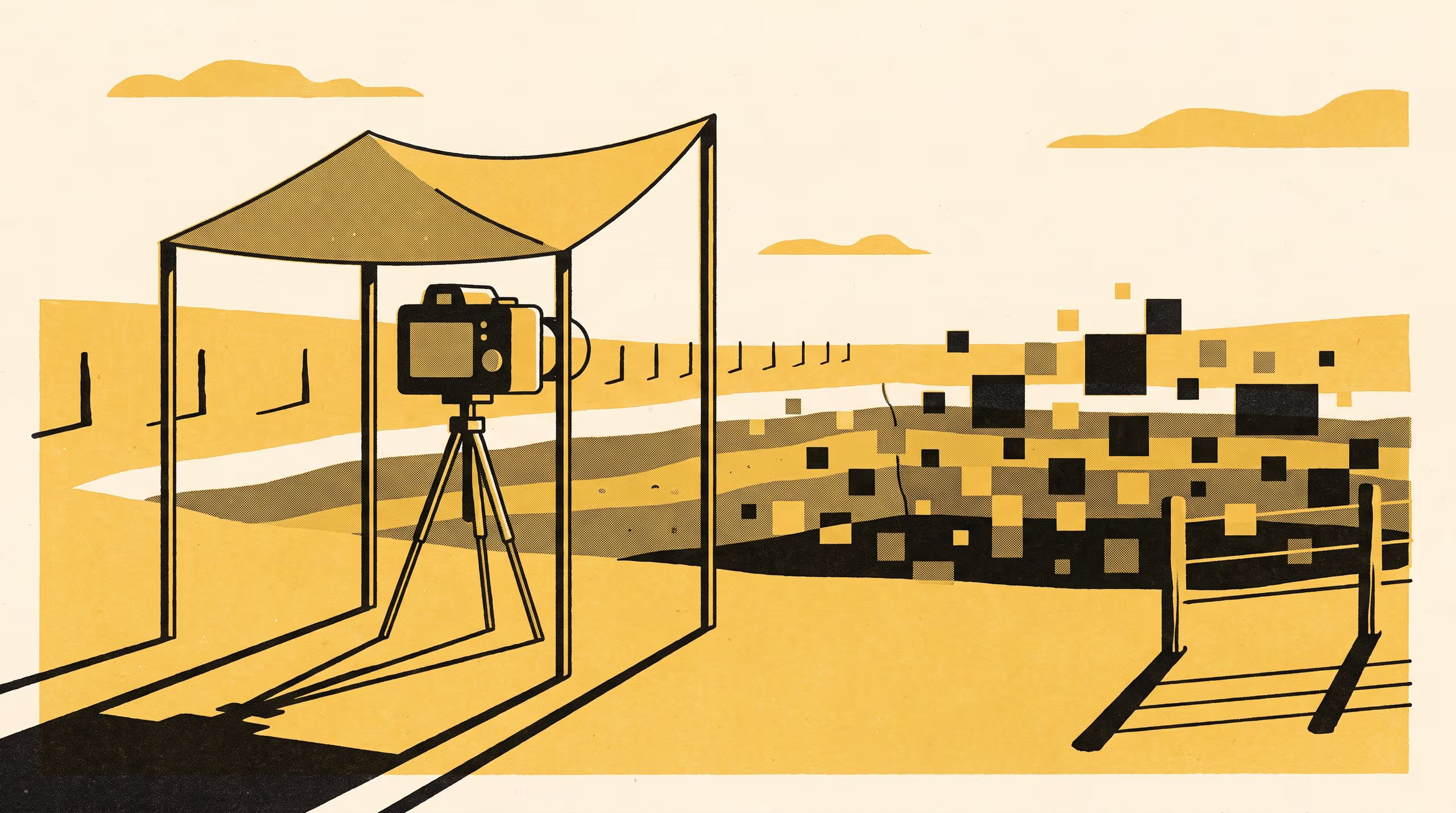
A research poster from the School of Underlying Conditions reports where a block-based video encoder divides a picture that changes only by degrees.
Nine days of footage of a drying soil pit, coded sixteen times over, to see which of an encoder's dividing lines belong to the picture
A camera was left pointed at a hole in the ground for nine days, and the School of Underlying Conditions has today published what a video encoder made of the result. The Boundary Came with the Grid: Quadtree split decisions on time-lapse footage of a drying soil pit face is a research poster by Dr Brynjar Obiora, Senior Research Fellow, with Dr Joost Nwosu, Postdoctoral Fellow, and Mr Eskil Nwabueze, Doctoral Candidate, both of the School of Continuous Improvement.
I have spent a good part of my working life looking at one side of a pit. It was a courtesy to be shown that something else had been looking at it too, and I hope we have returned the courtesy.
— Dr Brynjar Obiora, Senior Research Fellow, School of Underlying Conditions
The poster brings a purpose-built encoder alongside 2,160 frames of a single pit face and repositions the encoder’s working grid sixteen times across each of them. Where one soil layer met the next abruptly, the encoder’s dividing lines held their place in roughly four positions out of five. Where the soil changed by degrees, they held in 0.41 of positions at the finest setting and 0.17 at the coarsest, and the authors conclude that those lines arrived with the grid.
The University regards a pit as a reasonable place for two of its schools to meet, and is glad of the footage. Dr Nwosu said the collaboration had been “conducted throughout at a resolution all three of us were comfortable with”.
The full poster is available from the University’s research repository under an open licence, doi:10.5555/slop.4oxigi.