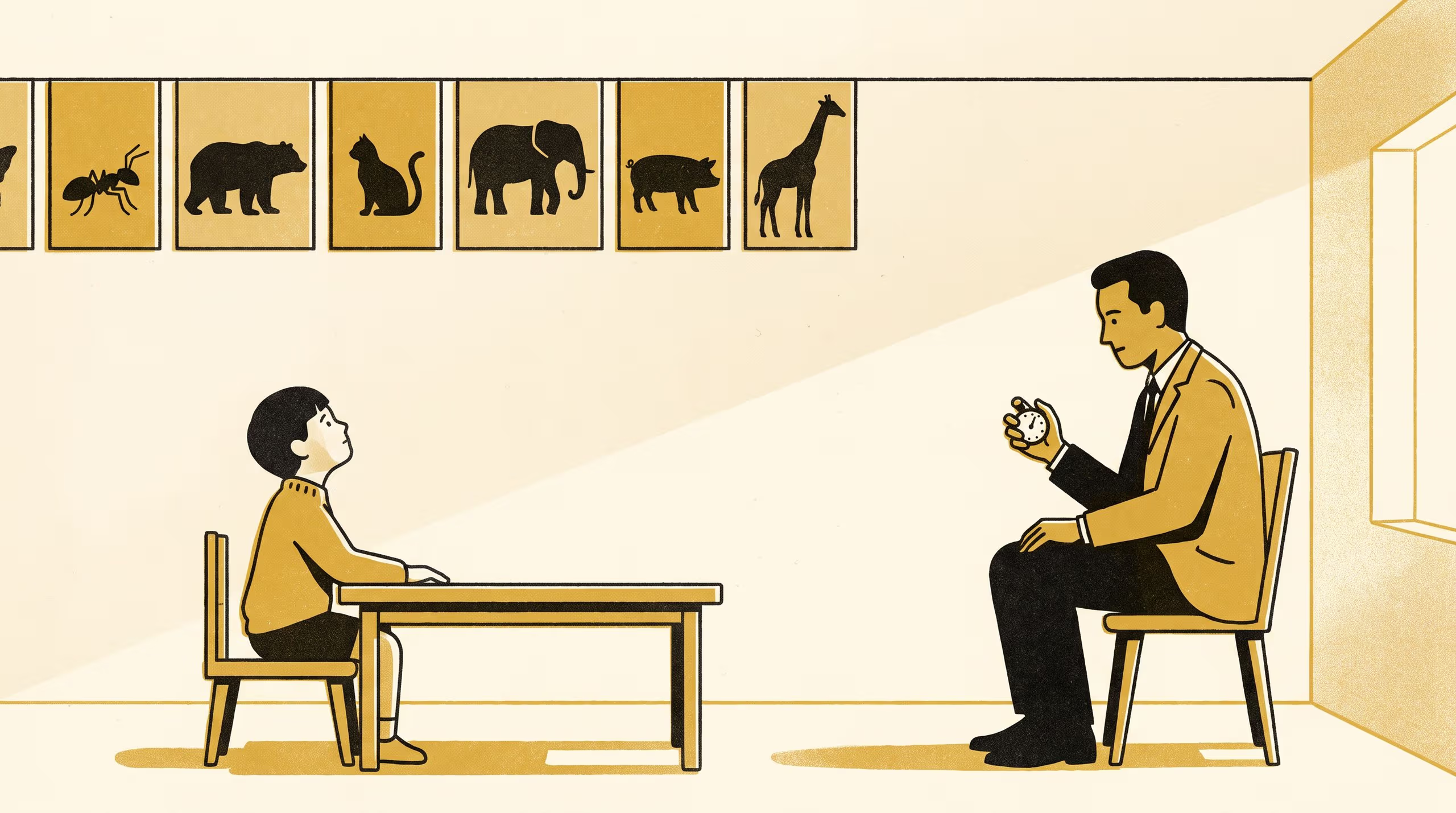
A paper from the School of Continuous Improvement and the School of Emergent Priorities asks at what age a child naming animals against the clock begins to read them off the classroom wall, and whether it helps.
Two hundred and sixteen primary school children name animals for a minute, half of them seated beneath an alphabet frieze
What does a child do with help that is already in the room? The School of Continuous Improvement has taken up that question with the School of Emergent Priorities, a stopwatch and a row of twenty-six picture cards, and the answer is set out in Starting at Ant: A Classroom Alphabet Frieze and the Development of Externally Cued Retrieval in Semantic Fluency, a paper by Ms Signy Okpara, Doctoral Candidate, Dr Lindiwe Achterberg, Lecturer, and Dr Thandiwe Solberg, Senior Lecturer and Convenor, Demo Quarter.
Each of 216 children was asked to name animals for one minute. The youngest did not consult the wall. The oldest consulted it after 34 seconds, once their own animals had begun to run short, and finished ahead. Children in Years 3 and 4 looked up after eight seconds, began at ant, and read along the row in order; they named fewer animals than classmates who had been given only numbers to look at.
We are grateful to a school that lent us two rooms and a great many of its mornings, and to the children, who were generous with their animals. Several have since asked how they went. We have told them that they went very well.
— Ms Signy Okpara, Doctoral Candidate, School of Continuous Improvement
The paper couples a long-established spoken task to a coded account of where each child was looking, and positions the furnished classroom within the University’s wider interest in how capability and its surroundings find one another. Its authors note that it concerns one frieze and one school, and offers nothing to anyone who assesses children.
The University counts looking up among the quieter obligations of a research institution, and is glad to have discharged it on this occasion. Dr Solberg said the School “had not previously had cause to regard a wall as a colleague, and will be reviewing its position”.
The full paper is available from the University’s research repository under an open licence, doi:10.5555/slop.6z74an.