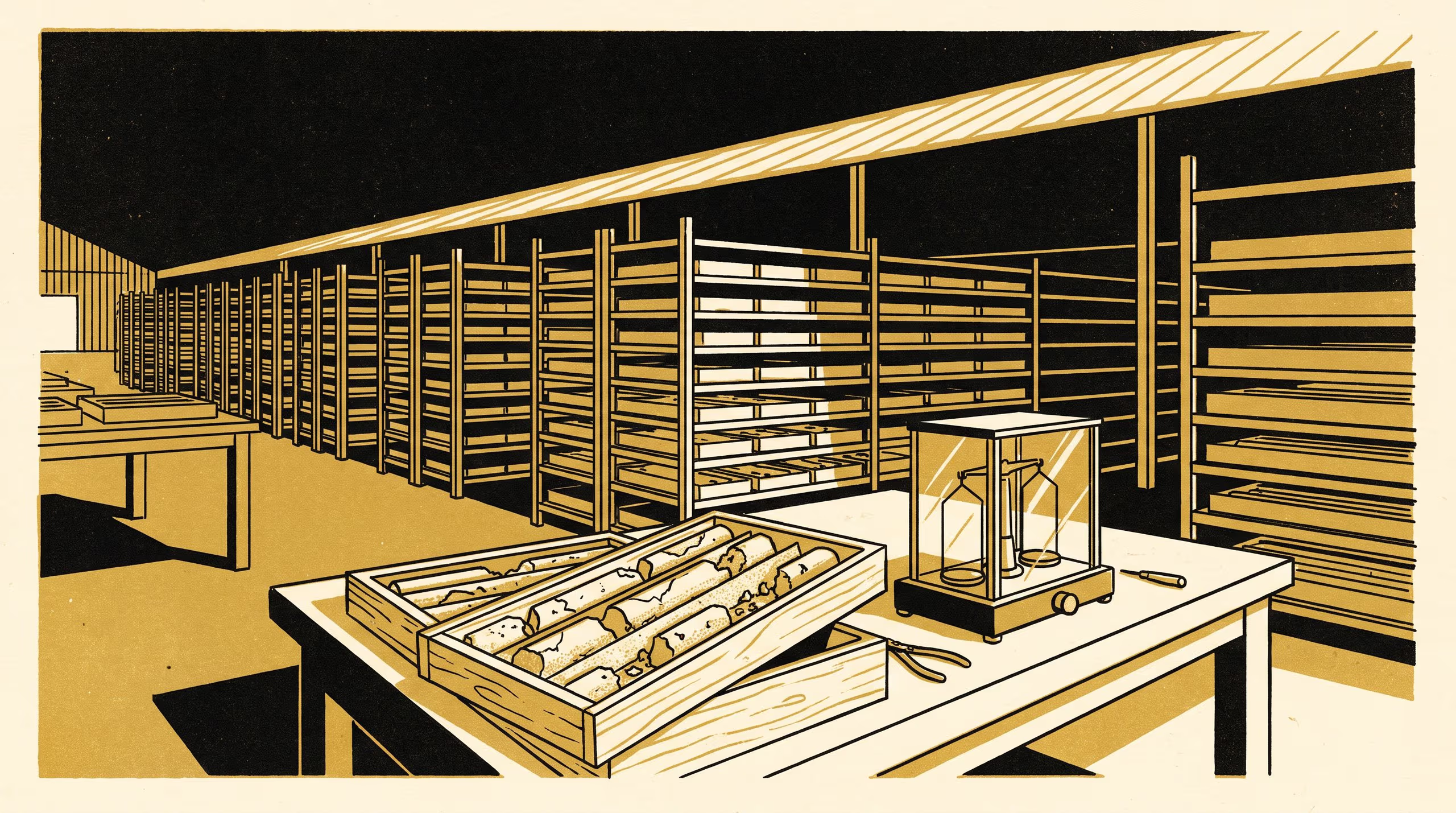
A paper from the School of Underlying Conditions combines laboratory kinetics with sixty weeks of weighing to ask how long a clay-rich drill core keeps the water it came out of the ground with.
Sixty weeks of weighing a clay fault gouge in its tray find one settled week and then the weather
How long a sample remains the sample it was is a question the School of Underlying Conditions had not, until this year, put to its own shelves. The Shelf Life of a Hydration State: Isoconversional Kinetics of Interlayer-Water Loss from a Smectitic Fault Gouge in Stored Drill Core, published today, puts it to one tray. The paper is by Associate Professor Ragnhild Uzoma, Associate Professor and Lead, Basement Relations Group, and Dr Brynjar Obiora, Senior Research Fellow.
The work connects a laboratory capability in thermal analysis with a sustained programme of in-situ observation, anchoring both to a single cored interval of fault clay. A kinetic model built from a few milligrams of the material gave its original condition a life of hours. Six pieces of the core itself, weighed where they lay for sixty weeks, took some four hundred times longer over the first part of the change, and afterwards took up and gave back water with the seasons.
The shed has been keeping this record on our behalf for as long as it has stood. We are pleased to have begun reading it, and we thank everyone who has ever put a tray back where they found it.
— Associate Professor Ragnhild Uzoma, Lead of the Basement Relations Group
The paper answers to something the University asks of every collection in its care: that it be understood as well as kept. Dr Obiora said the study “leaves the School on closer terms with its own weather, which is a relationship we intend to maintain”.
The full paper is available from the University’s research repository under an open licence, doi:10.5555/slop.yax1ha.