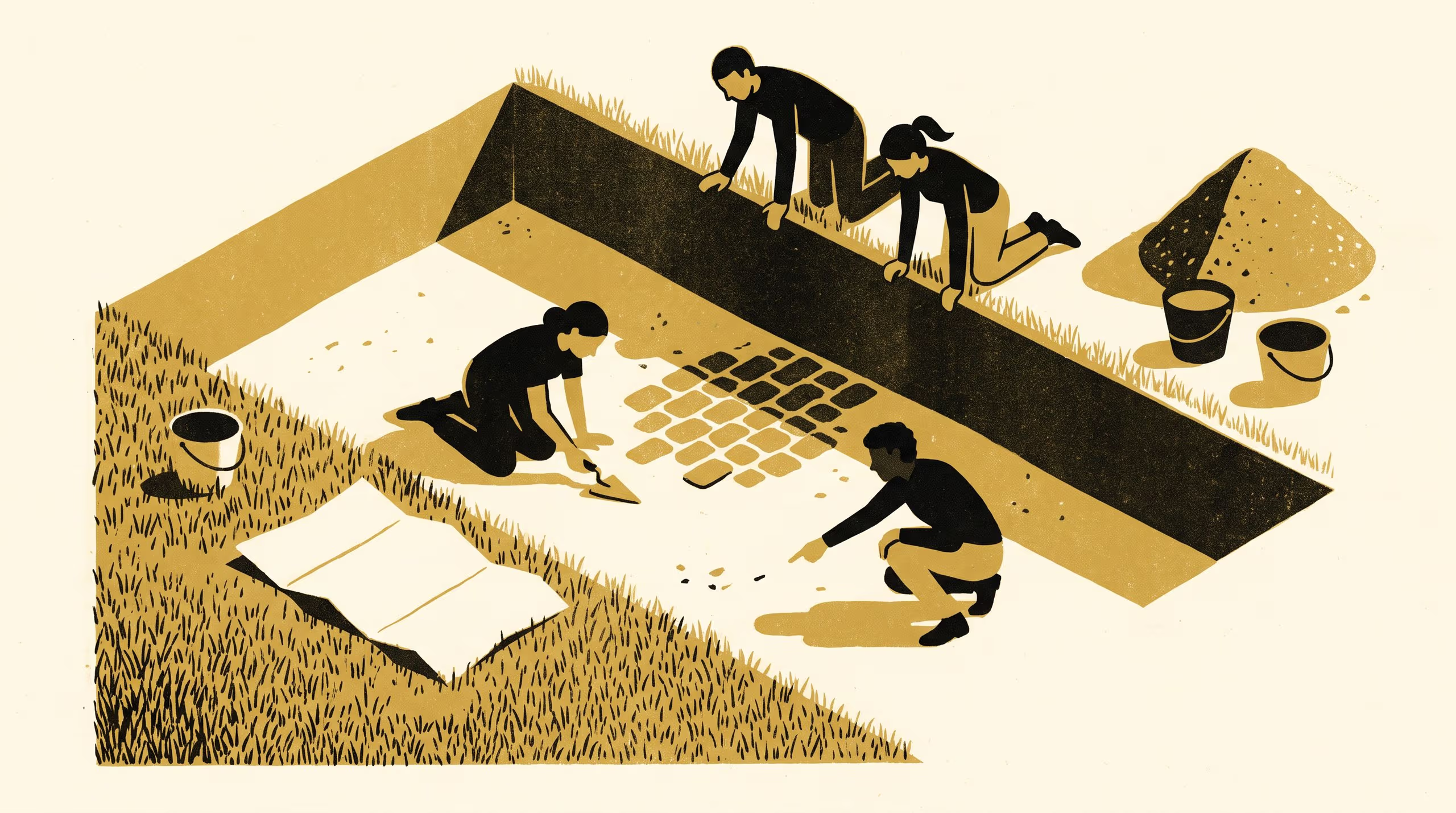
A paper from the School of Underlying Conditions follows 1,286 questions asked at the edge of a purpose-built teaching trench, and reports what supervisors do once the ground stops matching the drawing they were given.
Two seasons of recorded questions at a teaching excavation that twenty-one classes have dug and refilled
A supervisor who climbs down into a teaching trench has, on the evidence of a paper published today, usually run out of answers. What Have We Got Here? Supervisors’ Questions at a Teaching Trench Whose Layers Are No Longer the Ones That Were Buried is by Associate Professor Ragnhild Uzoma, Associate Professor and Lead, Basement Relations Group, and Dr Brynjar Obiora, Senior Research Fellow, both of the School of Underlying Conditions.
The trench was built for teaching, with its layers laid to a drawing, and has since been dug and refilled by twenty-one classes of students. The authors recorded two seasons at its edge and followed 1,286 questions that supervisors put to students about the ground. Where the drawing still held, supervisors asked from above. Where it did not, they got in 57 times, and students put down their tools to watch.
I have asked a great many questions over the years to which I held the answer in a folder. It has been instructive to count the others, and I would not care to say which kind I asked better.
— Associate Professor Ragnhild Uzoma, Associate Professor and Lead, Basement Relations Group
The paper carries a video-based account of teaching talk into an excavation setting, aligning what a supervisor says with where a supervisor stands and anchoring both in the accumulated history of a single piece of ground.
The University counts a hole it has been filling in for two decades among its longer-running commitments to teaching, and welcomes the news that the hole has been contributing. Dr Obiora said the School had “kept a drawing of that trench for a long time, and now also has a reason to”.
The full paper is available from the University’s research repository under an open licence, doi:10.5555/slop.70dfg2.