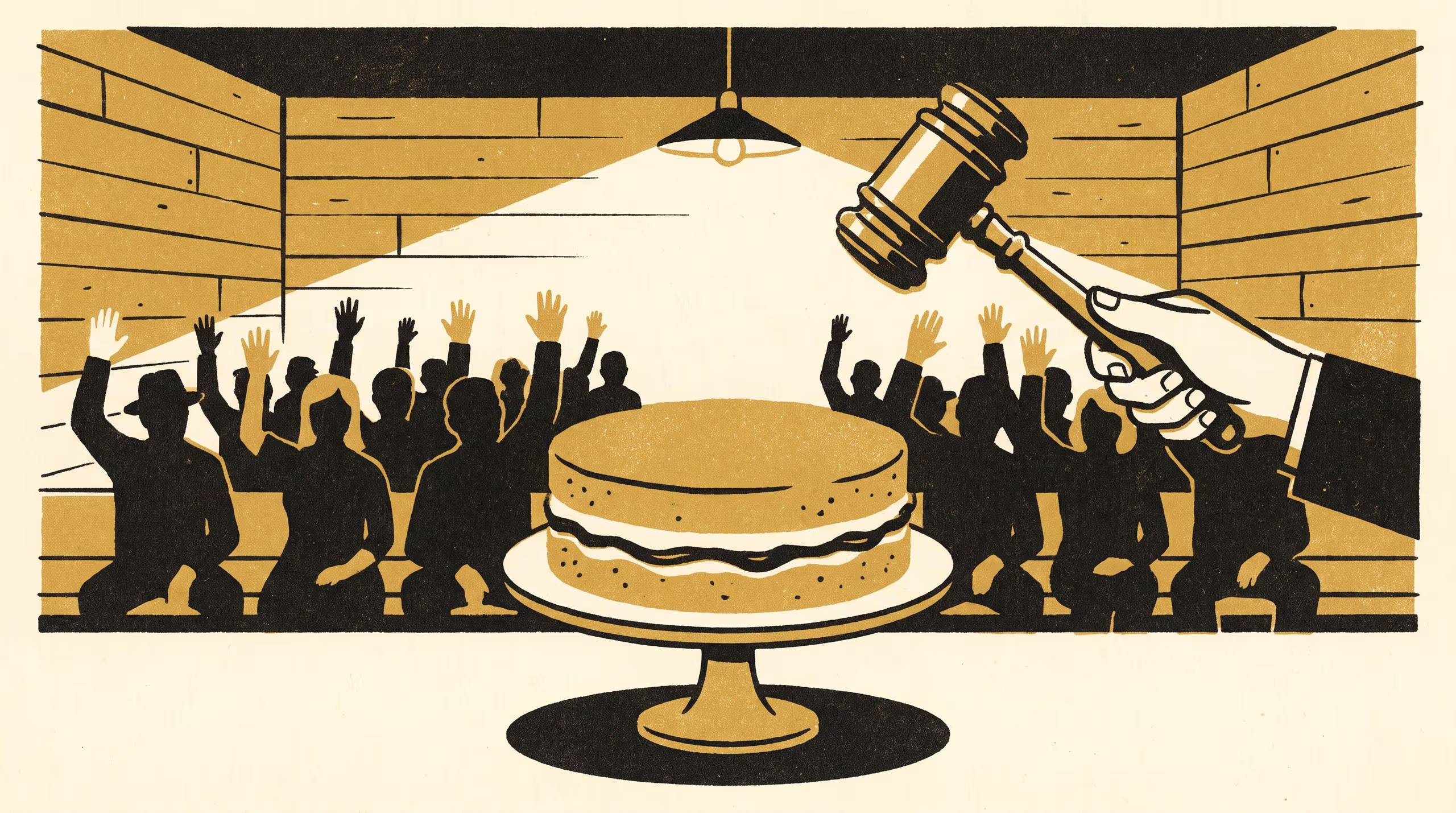
A research poster from the School of Underlying Conditions finds that naming the baker moves money between cakes without raising what the hall takes home.
Twenty-three years of a district hall's cake auction compare sales called by name with sales called by number
When a cake is sold for more than a cake costs, the University would like to know what else changed hands. Paying for the Baker: Name Effects in Twenty-Three Years of a District Hall’s Cake Auction, a research poster by Dr Brynjar Obiora, Senior Research Fellow in the School of Underlying Conditions, and Dr Iben Chikere, Lecturer in the School of Emergent Priorities, offers an answer from a single hall.
The hall’s committee lent the authors its sale books: 1,286 lots sold from the floor at 23 annual auctions. At 14 of those sales the auctioneer announced who had baked each cake. At the other 9 the cakes were called by number. Where names were called, the best-regarded bakers drew bids 38 per cent above the average; where they were not, 7 per cent. The hall’s takings were the same under either arrangement.
A hall is a room in which everybody already knows the answer and is too courteous to give it. We have tried to be as courteous, at rather greater length, and we are grateful to a committee that kept its books in ink.
— Dr Brynjar Obiora, Senior Research Fellow, School of Underlying Conditions
The poster brings an established theory of competitive bidding alongside a hand-transcribed record of community giving, and positions the auctioneer’s habit of address as the hinge between them. Its authors identify no hall and no baker, and make no recommendation to anyone holding a gavel.
Generosity is among the things the University is prepared to examine closely, and it is glad to report that generosity came through the examination intact. Dr Chikere said the team had “left a good deal of sponge unexplained, which is the proper amount”.
The full poster is available from the University’s research repository under an open licence, doi:10.5555/slop.lwkv4l.