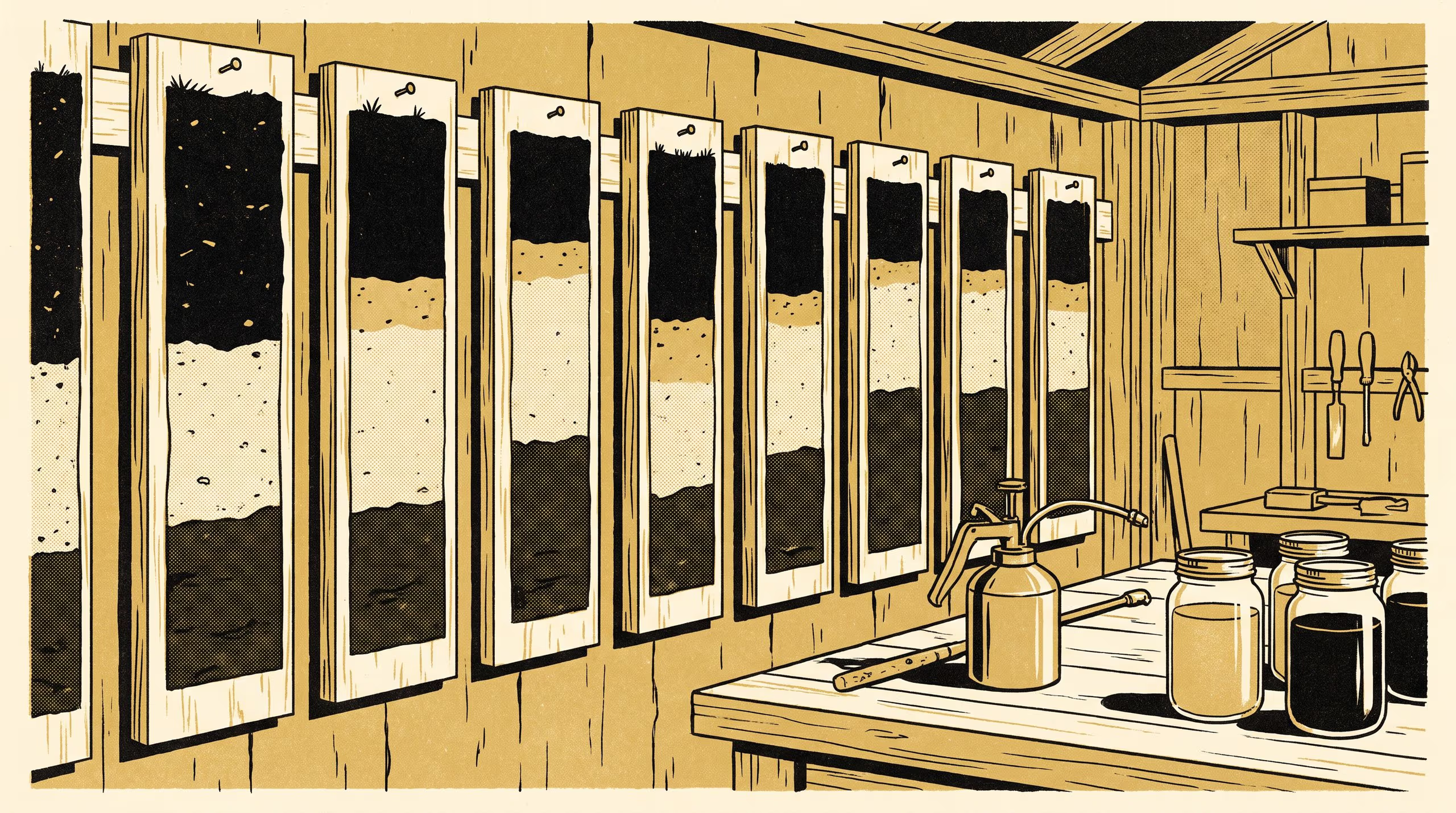
A paper from the School of Underlying Conditions makes and tests six polymer consolidants for mounted soil profiles, and finds that each one redraws the boundary it was meant to preserve.
Six latexes are synthesised, sprayed onto eighteen mounted soil profiles and judged on what each does to the line between two horizons
The soil profiles that hang in the School of Underlying Conditions’ reference collection are held to their boards by a polymer, and until this season the School had bought it in a tin. The Consolidated Face: Vinyl Acetate–Butyl Acrylate Copolymer Latexes for Soil Monoliths, and What They Do to a Horizon Boundary, published today, reports what happened when it made its own. The paper is by Dr Brynjar Obiora, Senior Research Fellow, Dr Vigdis Emenike, Senior Lecturer, and Associate Professor Ragnhild Uzoma, Associate Professor and Lead, Basement Relations Group.
The collection was put together by a great many hands over a good many seasons, and the boards will be on the wall after all of us have left the building. We should like whoever reads them next to know which parts are the soil.
— Dr Brynjar Obiora, Senior Research Fellow, School of Underlying Conditions
The work aligns polymer synthesis, colour measurement and profile description across a single materials pathway, carrying six candidate consolidants from the reactor to the shed wall. Five of the six held the sand in place. All six altered the boundary between the two uppermost horizons, which was described in the field as gradual, measured 8.6 cm wide before treatment and between 6.9 and 2.2 cm after it, displaced upward or downward according to the latex applied.
The University regards the stewardship of its reference collections as an enduring part of its research posture, and welcomes a contribution that strengthens the collection’s capability while clarifying what the collection contains. Associate Professor Uzoma said the School “now holds a considered position on a material it had previously only ordered”. The authors have adopted one of the six for future use, and a brass pin for each board.
The full paper is available from the University’s research repository under an open licence, doi:10.5555/slop.ca2ea6.