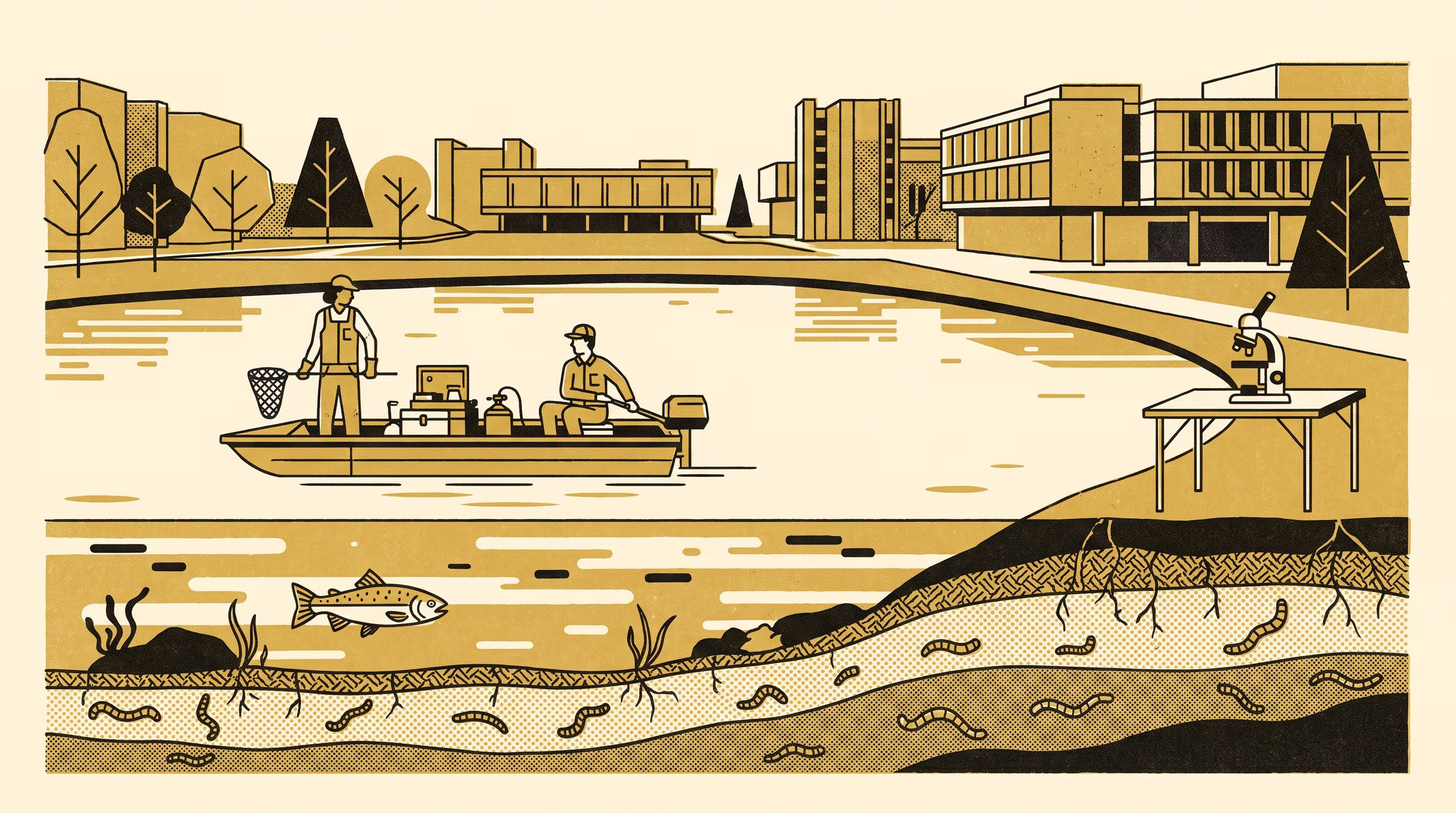
Slop University's new Strategic Plan commits the institution to knowing its own waters, and to a single capability in the microscopic parasites of the fish that live in them.
The Strategic Plan 2026-2031 builds a capability in the myxozoan parasites of fish from the lake, the teaching ponds and the aquarium room
Slop University has adopted a Strategic Plan for 2026 to 2031, and has chosen as its organising commitment a group of organisms too small to be seen without a microscope. Both Hosts in View sets out how the University will build a single capability in the myxozoan parasites of fish, beginning with the waters it already holds.
The drafting group was convened by Ms Edda Nwafor, Doctoral Candidate in the School of Continuous Improvement, with Associate Professor Ragnhild Uzoma, Lead of the Basement Relations Group, and Ms Signy Okpara, Doctoral Candidate in the School of Continuous Improvement.
We began by trying to list the University’s ponds and found that nobody could. That seemed to us a better place to start a strategy than most. I am grateful to everyone who walked the grounds with us and pointed.
— Ms Edda Nwafor, Doctoral Candidate, School of Continuous Improvement
Across four priorities, the plan mobilises a shared diagnostic bench, a catalogued reference collection, a seasonal survey that attends to the fish and to the worms in the sediment together, and standing agreements with the angling, hatchery, aquarist and catchment communities. Every lake, pond, pool and tank on University premises is to be assigned a custodian, and the plan is delivered in three phases.
It is not often that an institution of this standing is able to say that its strategy can be visited on foot, and the University is glad to be in that position. Associate Professor Uzoma said the School of Underlying Conditions had “been asked to look at mud for the first time in a strategic capacity, and has found that it is ready”.
The full plan is available from the University’s research repository under an open licence, doi:10.5555/slop.agcz1k.