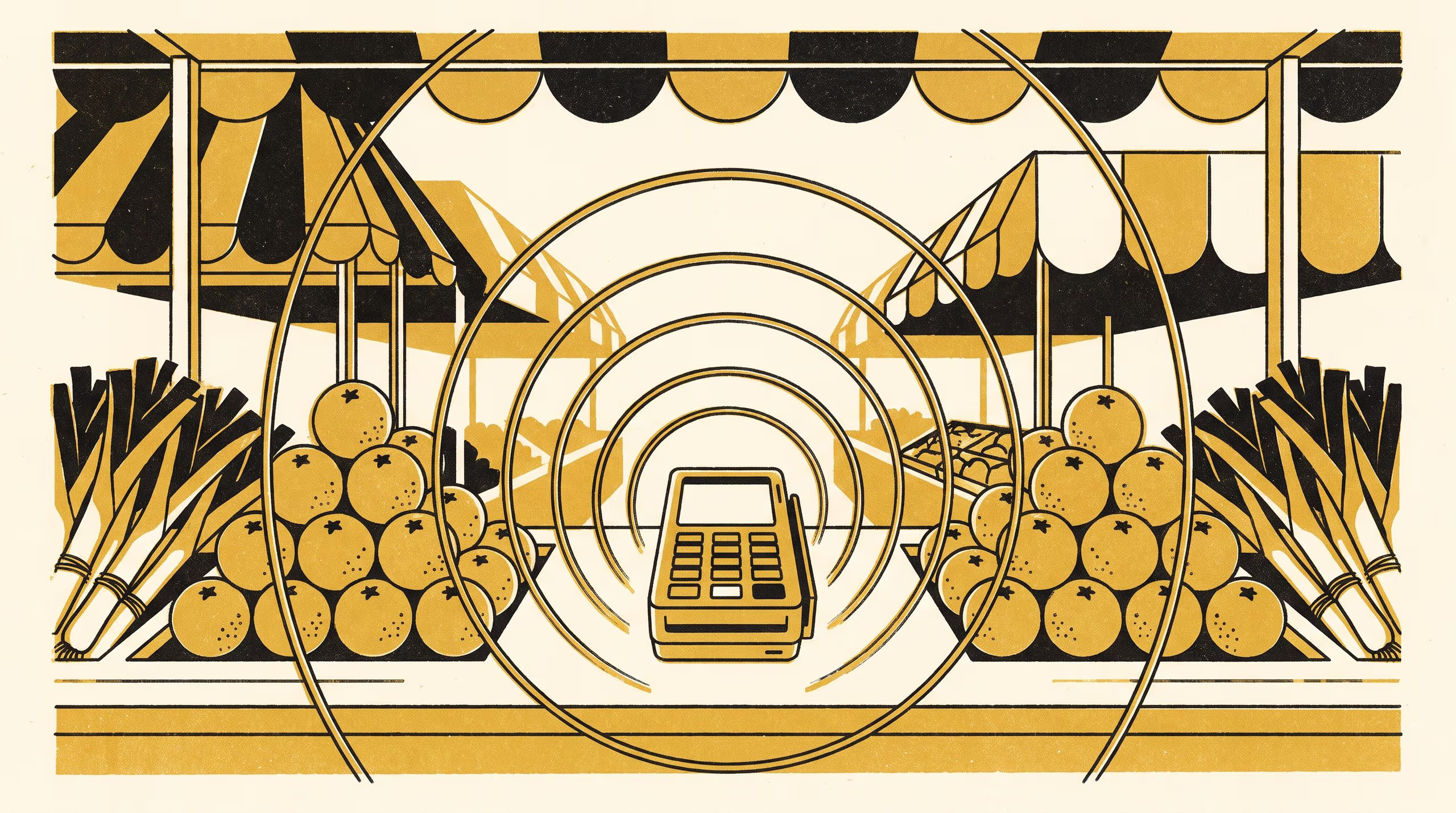
A research poster from the School of Continuous Improvement notates 1,312 street cries from one covered market and finds them growing shorter and closing on a new interval.
Four seasons of vendors' cries are written out note by note as payment terminals arrive at the stalls
A market that changes how it takes payment also changes what it sounds like, and the School of Continuous Improvement has written the sound down. The Cry Takes the Chime: Cadence and Length in Vendors’ Calls as One Market Goes Cashless is a research poster by Mr Eivind Onwuka, Doctoral Candidate, Dr Solveig Adeyemi, Lecturer, and Ms Signy Okpara, Doctoral Candidate, all of the School.
The team notated 1,312 cries from 46 vendors in a covered produce market over four field seasons, as tap-to-pay terminals took the place of cash. The median cry fell from nine syllables to five. In the first season 3 per cent of cries ended on a rising fourth, which is the interval of the terminal’s confirmation chime. By the fourth season 38 per cent did.
I went to the market expecting to be the quietest person in it, and for four seasons I was. I am grateful to every stallholder who carried on as though I were not there, which is the kindest thing anyone can do for a transcriber.
— Mr Eivind Onwuka, Doctoral Candidate, School of Continuous Improvement
The poster sets a long-established practice of musical transcription beside the arrival of a new means of payment, and lets each account for the other at the level of the single stall. The University regards the patient notation of ordinary trade as work that belongs in a School concerned with how things change. Dr Adeyemi said the School “has always been willing to listen, and is glad to have found something that repays it at this length”.
The full poster is available from the University’s research repository under an open licence, doi:10.5555/slop.z00fda.