A research poster from the School of Underlying Conditions follows random lasing in six drying pigment films for fourteen hours and reports that the lasing modes settle well after the films stop losing mass.
Six pigment films were dry to the finger, to the balance and to the laser at three different hours
Six films of white pigment were drawn down on glass in a University laboratory this year and attended to, hourly, until the following morning. The account of that night is Three Kinds of Dry: Random Lasing in a Pigment Film Through Fourteen Hours of Drying, a research poster by Dr Brynjar Obiora, Senior Research Fellow, and Associate Professor Ragnhild Uzoma, Lead of the Basement Relations Group, both of the School of Underlying Conditions.
A film of this kind, given a little dye and a pulse of green light, will lase without mirrors, on the strength of its own scattering. The authors report that their films were dry to a fingertip at 2.9 hours and had stopped losing mass at 5.2, and that the fine structure of the laser light went on rearranging itself from one pulse to the next until 7.4 hours, when it stopped.
There is a point in most undertakings at which one would like to be told that matters have settled. I would not say that we were told. But we were in the room at the time, and I have come to think that is the larger part of it.
— Dr Brynjar Obiora, Senior Research Fellow, School of Underlying Conditions
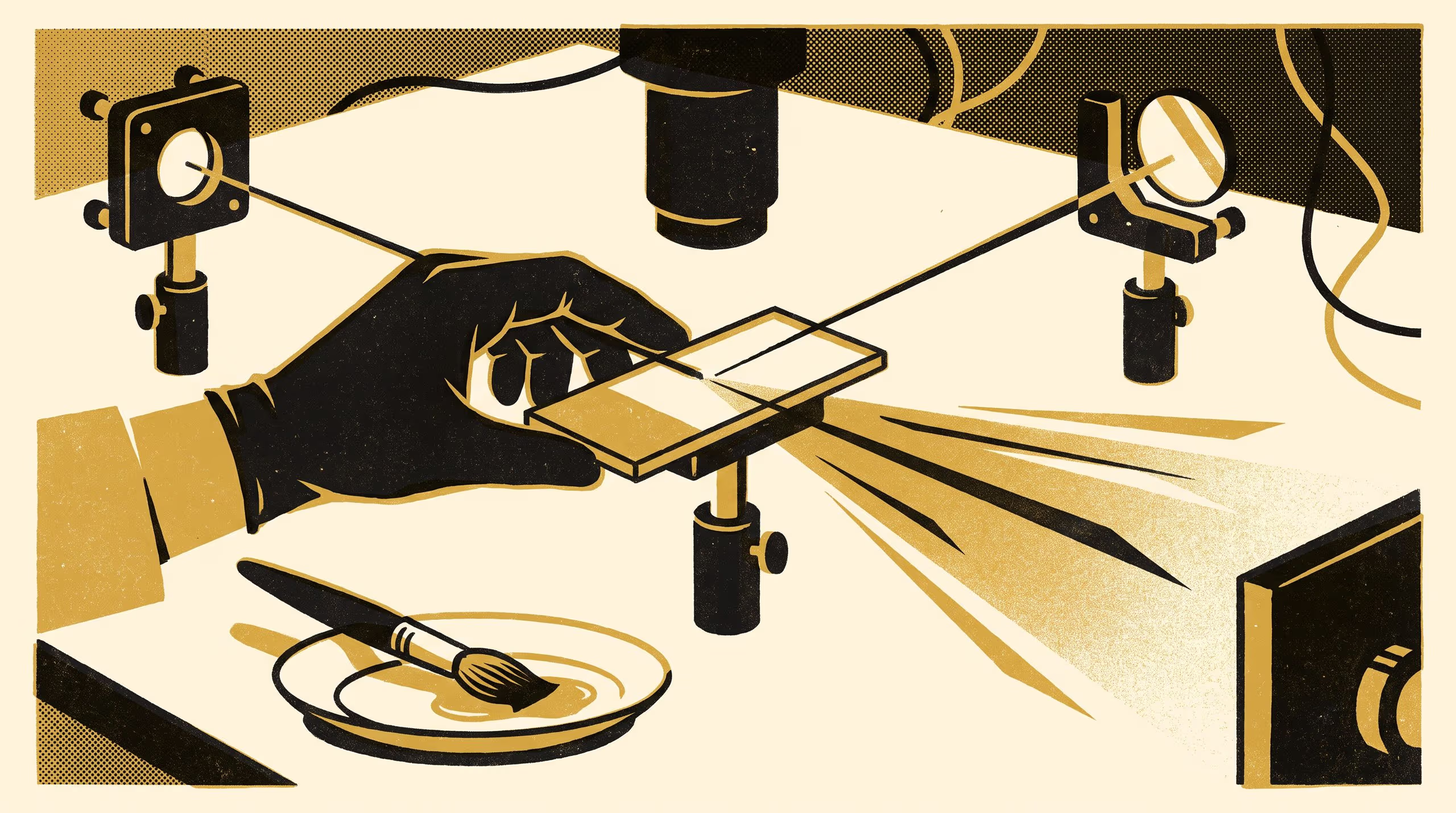
In practice the team paired a pulsed source with an hourly reading of how far light travels inside the film before it finds its way out, and set both beside two older authorities on the question, the finger and the balance. The poster offers a suggestion as to what the film is doing in the interval and notes, plainly, that the suggestion has not been tested.
The University is glad to contribute a third opinion to a matter that is ordinarily closed with a fingertip. Associate Professor Uzoma said the study “falls comfortably within what the School means by a surface, a term we have always defined generously”.
The full poster is available from the University’s research repository under an open licence, doi:10.5555/slop.asreqm.