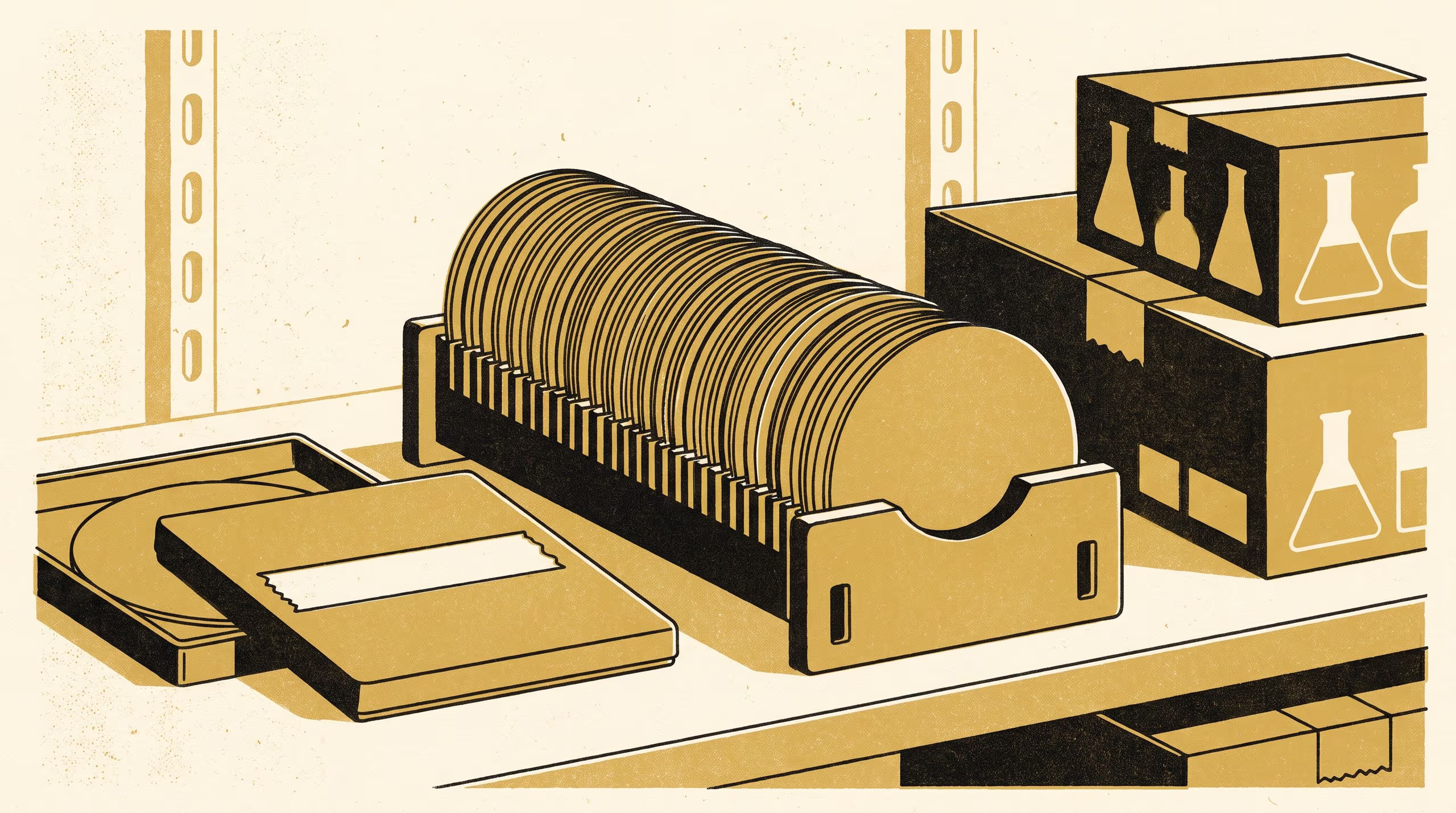
A paper from the School of Continuous Improvement and the School of Underlying Conditions works out, by electrical measurement alone, what an unlabelled cassette of silicon wafers contains and how well its lid had been keeping them.
Twenty-five silicon wafers from a teaching laboratory's store are sorted into four groups by measurement, and one corner of the lid is found to have left its mark
The consumables store of one of the University’s teaching laboratories is one item better documented than it was at the start of the year. The item is a cassette of twenty-five silicon wafers that turned up at stocktake without a label, a record or an owner, and the documentation is Twenty-Five Wafers, No Label: Electrical Identification of an Unlabelled Cassette and a Storage Gradient in Its As-Found Surfaces, a paper by Ms Signy Okpara, Doctoral Candidate in the School of Continuous Improvement, Dr Brynjar Obiora, Senior Research Fellow in the School of Underlying Conditions, and Dr Thandiwe Solberg, Senior Lecturer and Convenor, Demo Quarter.
The cassette proved to hold four kinds of wafer, loaded in runs. Two independent estimates of what each wafer is made of agreed on all twenty-four for which both could be had. The twenty-fifth had been put in backwards.
There is an engraved label on it now. I would like whoever wrote the first one to know that we tried it under every lamp in the building, and that the fault was not in their handwriting.
— Ms Signy Okpara, Doctoral Candidate, School of Continuous Improvement
Established techniques of electrical characterisation were aligned across every position in the cassette, underpinning an integrated account of its contents and of their surroundings. Pieces oxidised without cleaning carried a contamination that was strongest in the first slot and gone by the eleventh, on the side of the one lid corner whose tape had lifted. Cleaning removed it throughout.
The University holds that an inventory is a form of knowledge, and is pleased to see one of its own carried through to the last slot. Dr Solberg said the cassette “has gone back on the shelf it came from, which the School understands to be the best result a stocktake can return”.
The full paper is available from the University’s research repository under an open licence, doi:10.5555/slop.uqjc0k.