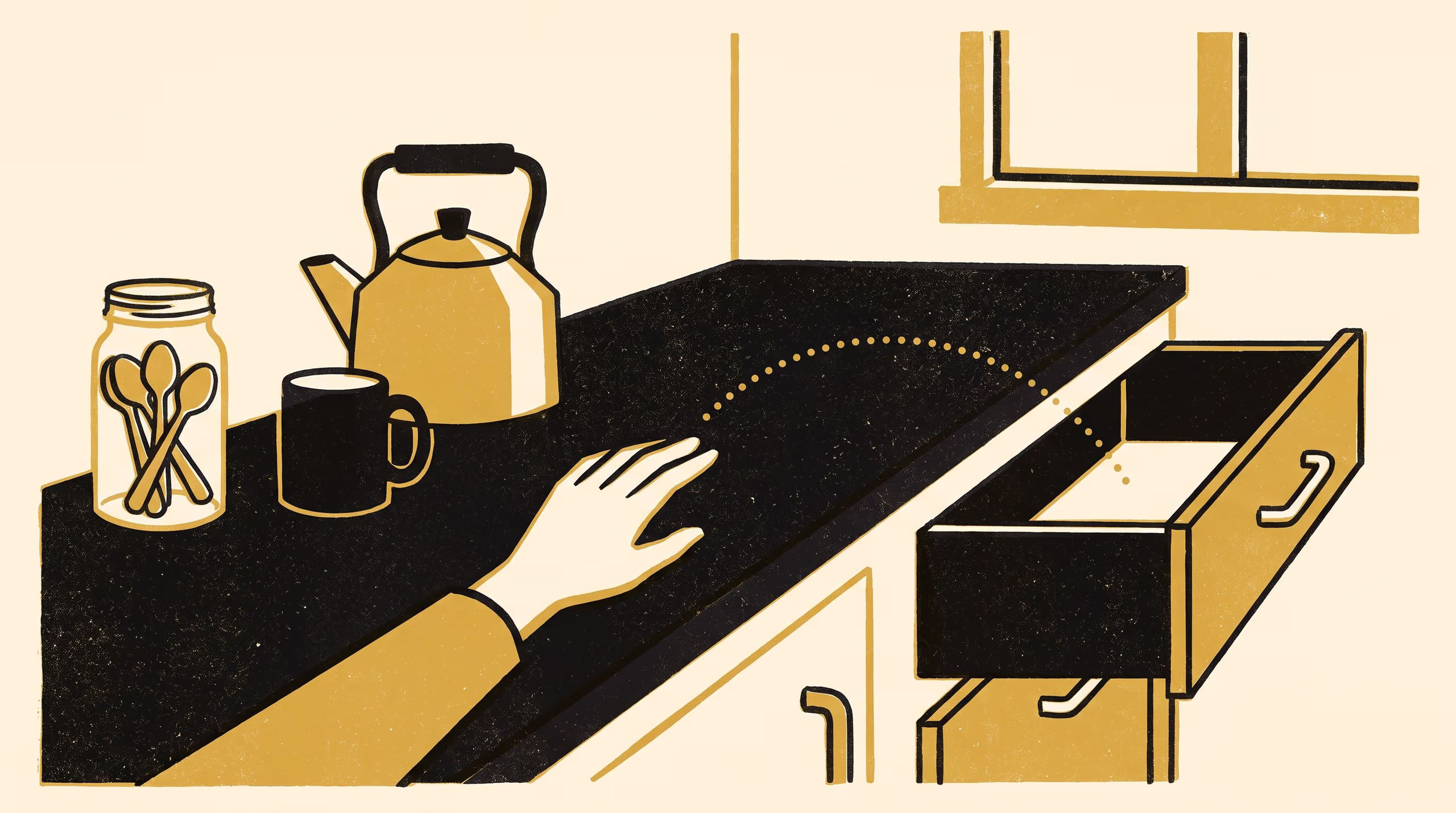
A paper from the School of Emergent Priorities reports how often, and for how long, people making tea in a rearranged copy of their own kitchen reach first toward where things are kept at home.
A motion-capture study follows the first tenth of a second of each reach in a copy of the participant's own kitchen, with half of what they need moved
A kitchen on castors has been assembled, taken apart and assembled again in a Slop University laboratory, once for each of the twenty-eight people who agreed to make tea in it. The Drawer That Isn’t There: Homeward launches of the reaching hand in a rearranged kitchen, published today, is a paper by Dr Iben Chikere, Lecturer in the School of Emergent Priorities, with Tove Ilesanmi, Doctoral Candidate in the same School, and Solveig Adeyemi, Lecturer in the School of Continuous Improvement.
Each kitchen was built to match the participant’s own and then altered, with four of the eight things needed for a cup of tea put somewhere new. Participants were shown the changes until they could point to every item without error. The paper reports that one in five of their first reaches to a moved item nevertheless set off toward where it lives at home, and that in the week afterwards eleven of them reached, in their own kitchens, for a place that had only existed in the laboratory.
Twenty-eight people let us into their kitchens with a tape measure, and then came and stood in ours. We owe them a debt we are unlikely to be able to repay in tea, though it was offered, thirty times each.
— Dr Iben Chikere, Lecturer, School of Emergent Priorities
The study couples a reconfigurable domestic environment to a movement-capture capability, bringing the opening instant of an everyday action into alignment with a long-running scholarly conversation about how far thinking reaches into the rooms it happens in. Tove Ilesanmi said the teaspoons had “asked more of the team than any other item, and given more back”.
The University holds that an institution is entitled to some quiet satisfaction when its researchers go looking for the mind and return with the location of a cutlery drawer.
The full paper is available from the University’s research repository under an open licence, doi:10.5555/slop.uadu4b.