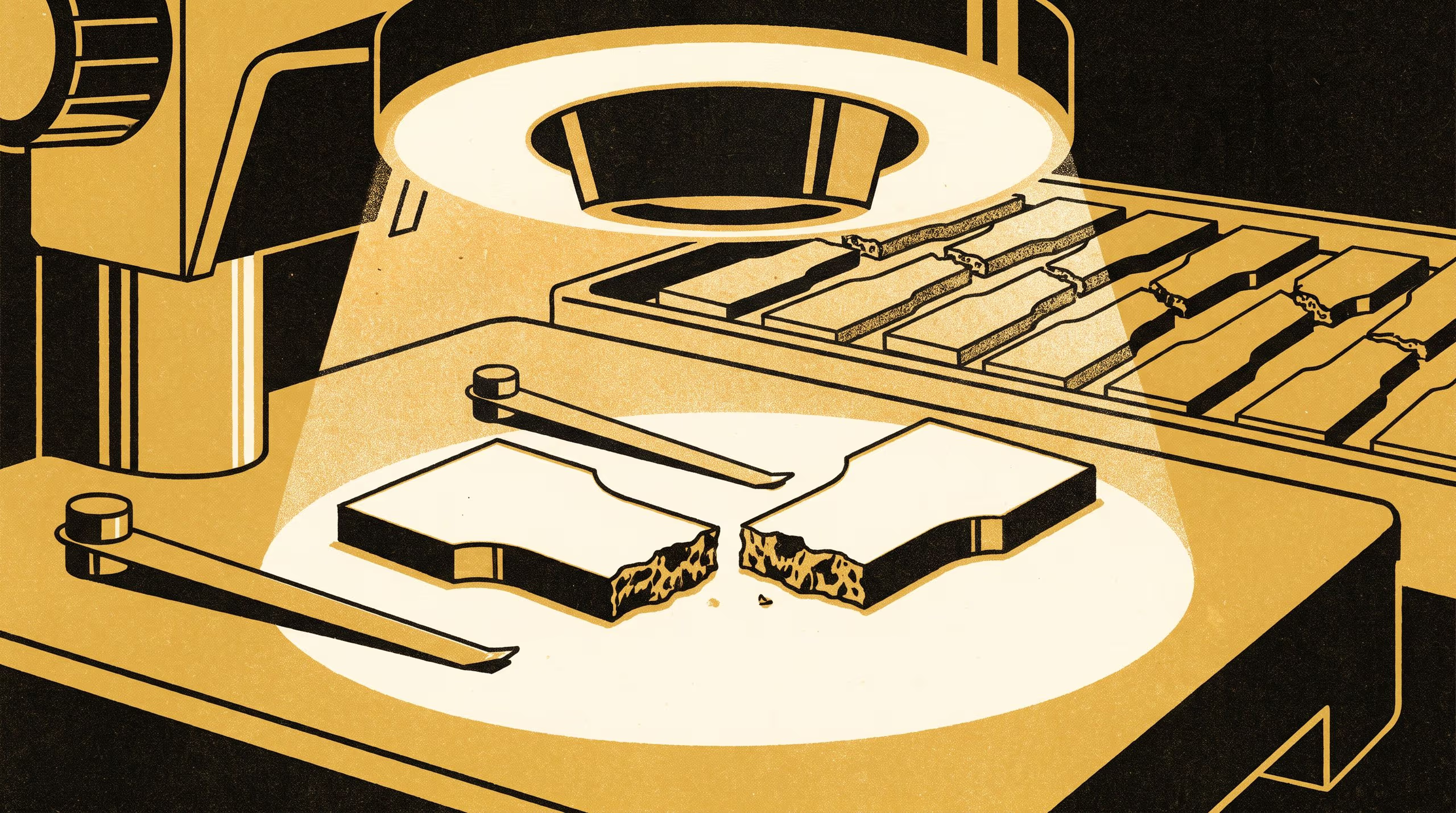
A research poster from the School of Emergent Priorities traces the fracture origin on every tensile bar machined by six intakes of a professional master's program in materials engineering.
Both halves of 428 student-machined tensile bars from six intakes of a coursework program are kept and examined for where each fracture began
Every tensile bar pulled apart in a teaching workshop leaves two halves, and the ordinary fate of both is the bin under the bench. A research poster published today by the School of Emergent Priorities reports what was found when, for six intakes of a coursework master’s program in materials engineering, the halves were kept instead.
The Radius Before the Edge: A Fractographic Survey of 428 Self-Machined Tensile Bars across Six Intakes of a Professional Master’s Program is by Ms Ylva Onyekwere, Doctoral Candidate, and Dr Iben Chikere, Lecturer, both of the School, with Dr Brynjar Obiora, Senior Research Fellow in the School of Underlying Conditions.
We began with several boxes of broken plastic and no particular expectation of them. I think the School now understands a little more about boxes, and rather more about expectation.
— Ms Ylva Onyekwere, Doctoral Candidate, School of Emergent Priorities
The poster aligns workshop practice, specimen preparation and the close inspection of fracture surfaces across a full teaching term. Each of 214 students machined one bar in the third week and another in the eleventh, and each wrote a short note on why their bar had failed before seeing the surface. The share of fractures that began at a machining mark fell from 59 per cent to 36 per cent over the term. Those that remained had moved away from the curved shoulder of the bar, which students are shown how to finish, and onto its straight edge, which they are not.
The University holds that a program is known in part by what its students are permitted to keep, and it welcomes a contribution that enlarges the category. Dr Chikere said the authors had “recommended that the halves be retained, and have so far retained them ourselves”.
The full poster is available from the University’s research repository under an open licence, doi:10.5555/slop.0qatje.