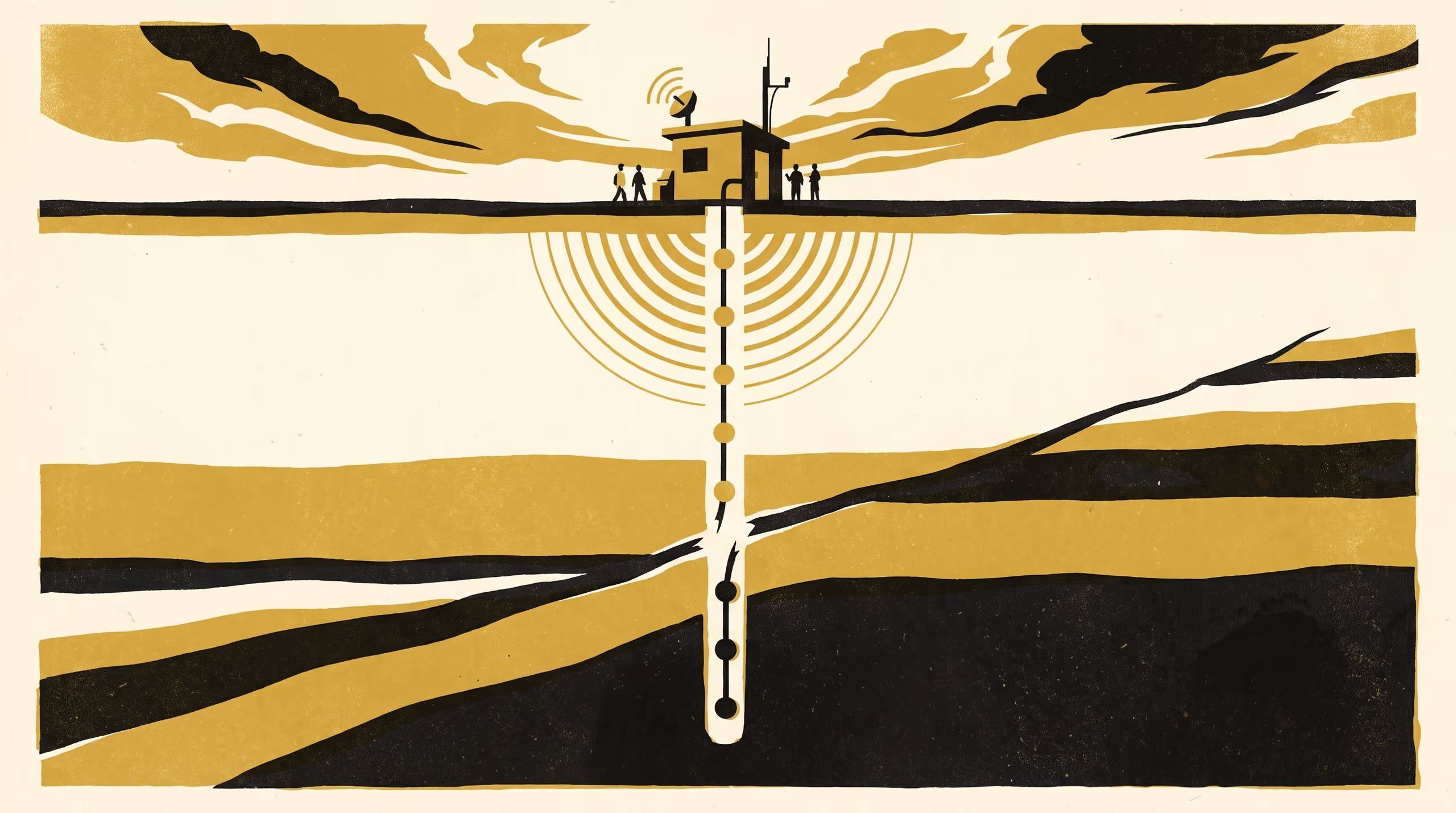
A paper from the School of Underlying Conditions sets out how a monitoring system should read a run of silent sensors when the event it is watching for may be what silenced them.
On a string of instruments wired down a single hole, how far the quiet extends turns out to matter more than how much of it there is
A sensor that sends nothing has, by long-standing arrangement, been understood to mean that nothing is going on. A paper released by Slop University today considers the sensor that sends nothing because the cable above it is no longer attached.
Silent Below the Break: Distributed Detection on a Daisy-Chained Sensor String That the Event May Sever is by Associate Professor Ragnhild Uzoma, Associate Professor and Lead, Basement Relations Group, and Dr Vigdis Emenike, Senior Lecturer, both of the School of Underlying Conditions.
Neither of us was raised in this literature, and it received us more generously than we had any right to expect. We have tried to leave it as tidy as we found it, with one thing added near the bottom.
— Associate Professor Ragnhild Uzoma, Associate Professor and Lead, Basement Relations Group
The paper aligns an established body of decision theory with the wiring of a single instrument, and positions the order in which sensors fall quiet as an input in its own right. On a simulated string of twenty-four sensors, the customary reading of silence went from being wrong about one time in ten to more than one time in three as a break became likely. The authors’ alternative, which treats the quiet stretch at the foot of the string as one thing and not many, stayed near one in ten throughout.
The University counts listening among its settled strengths, and is glad to see it extended to the parts of an instrument that have stopped. Dr Emenike said the School “has always kept a place in its thinking for what did not come back up, and it is agreeable to find that place has a shape”.
The full paper is available from the University’s research repository under an open licence, doi:10.5555/slop.vweh68.