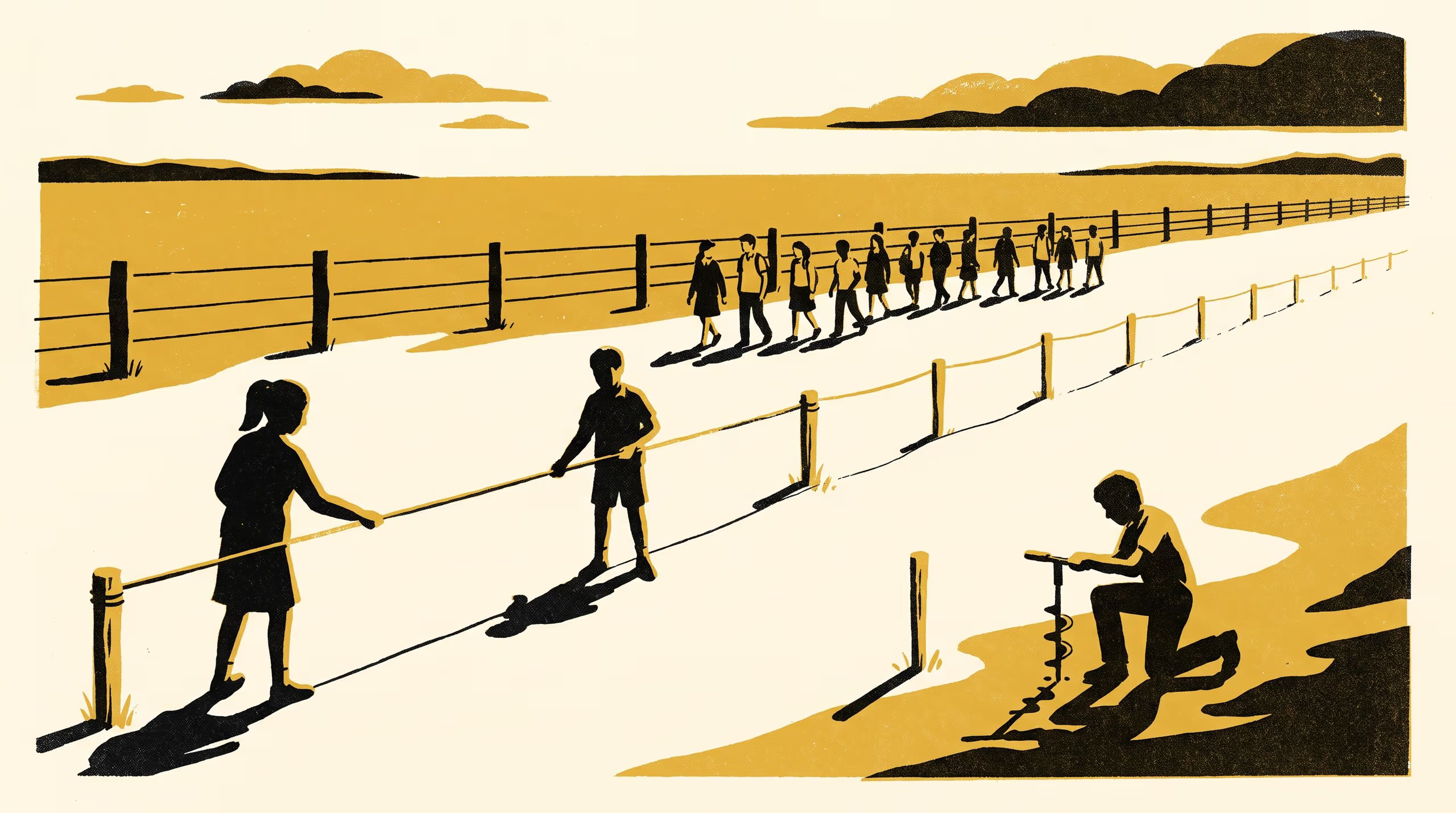
A paper from the School of Underlying Conditions and the School of Emergent Priorities follows three classes through a peace education unit built around a simulated boundary dispute on a school farm.
Year 9 students given an auger and a disputed fence stop looking for the real line and start asking who chose it
Most people can recall a lesson about two neighbours and a fence. It is usually taught at a desk, from a sheet of paper on which the fence has already been measured. A paper published today by Slop University describes what became of that lesson when three classes were instead handed an auger and walked to the fence in question.
Walking the Disputed Fence: A Design-Based Study of a Boundary Unit in Secondary Peace Education is by Dr Brynjar Obiora, Senior Research Fellow in the School of Underlying Conditions, and Dr Lindiwe Achterberg, Lecturer in the School of Emergent Priorities. It follows 71 Year 9 students at one regional secondary school, each assigned to one of two invented households with a shared fence and differing views of it.
The teachers did the teaching and the students did the digging, and between them they did most of the thinking as well. Our part was to bring the pegs and to keep out of the way of both, and I would like to thank them for making that so easy.
— Dr Brynjar Obiora, Senior Research Fellow, School of Underlying Conditions
The paper mobilises a place-based learning design across three successive refinements, positioning shared description of the ground as the enabling condition for a conversation about fair process. In the first class, working from a plan, 5 of 23 students later named a way of deciding an unrelated dispute; in the third, working in mixed teams from a single description card, 17 of 23 did, and every group reached an agreement. The authors note that the dispute was simulated and that the paper says nothing about how any actual boundary is or should be settled.
The University holds that a question is best understood from wherever it is standing, and counts a paddock among the places it is prepared to go. Dr Achterberg said she had “evaluated a good many pilots, and this is the first that concluded with the participants proposing their own review date”.
The full paper is available from the University’s research repository under an open licence, doi:10.5555/slop.rifu2s.