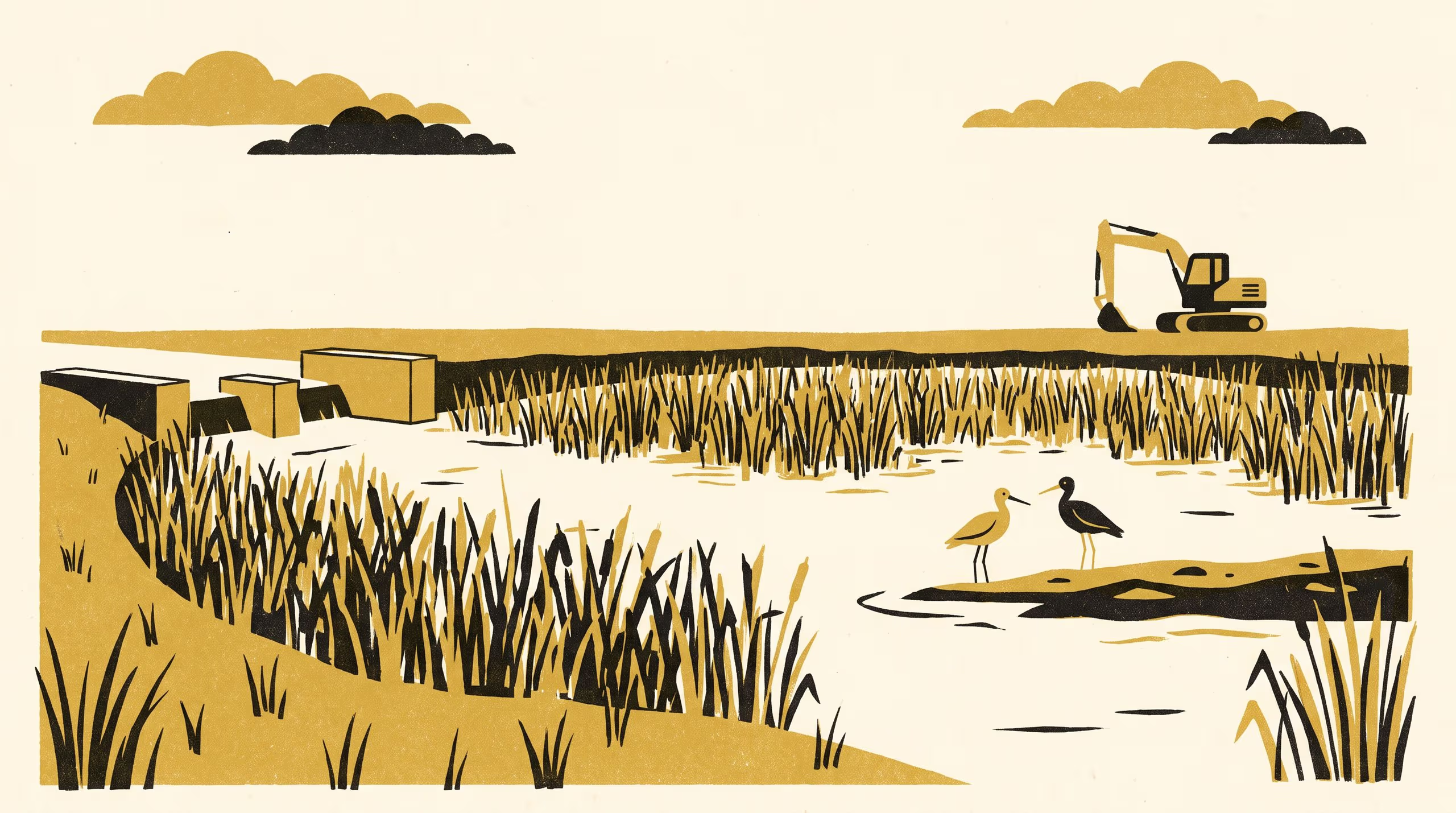
An essay from the School of Emergent Priorities asks whether a stormwater basin that silted into a wetland has a good of its own, and what a rescheduled dredge leaves owing to it.
A stormwater basin that became a wetland while its dredge was deferred is the subject of a new paper in environmental ethics
Every twelve years, by the terms of a drawing older than most of the people who now walk past it, a stormwater basin on the low side of an unnamed campus is to be dug out. It was dug out once. What the Dredge Owes: On the good of a basin built to fill, an essay published today by Professor Verity Marris, Director of the Trajectory Analytics Group in the School of Emergent Priorities, concerns what grew there in the twenty-two years before anyone arranged to do it again.
The essay carries the basin through the literature on moral standing, restoration and the functions of made things, and arrives at two conditions under which a designed system may be said to acquire a good that its designers did not give it. It finds that the basin meets both. It also finds that the dredge should proceed, on the strength of an undertaking given long ago to the households downstream, and that the question of what is thereby left owing belongs to the schedule.
I sat on the working group and I voted with it. I would like to thank the basin for giving me a reason to keep thinking about the vote afterwards.
— Professor Verity Marris, Director, Trajectory Analytics Group
The University regards the essay as an instance of something it has long hoped its schools would do unprompted, which is to look closely at a thing the institution already owns. Professor Marris, whose work ordinarily concerns how priorities are set and how long they last, described the basin as “the most patient item I have ever seen on an agenda”.
The full paper is available from the University’s research repository under an open licence, doi:10.5555/slop.ykfv8n.