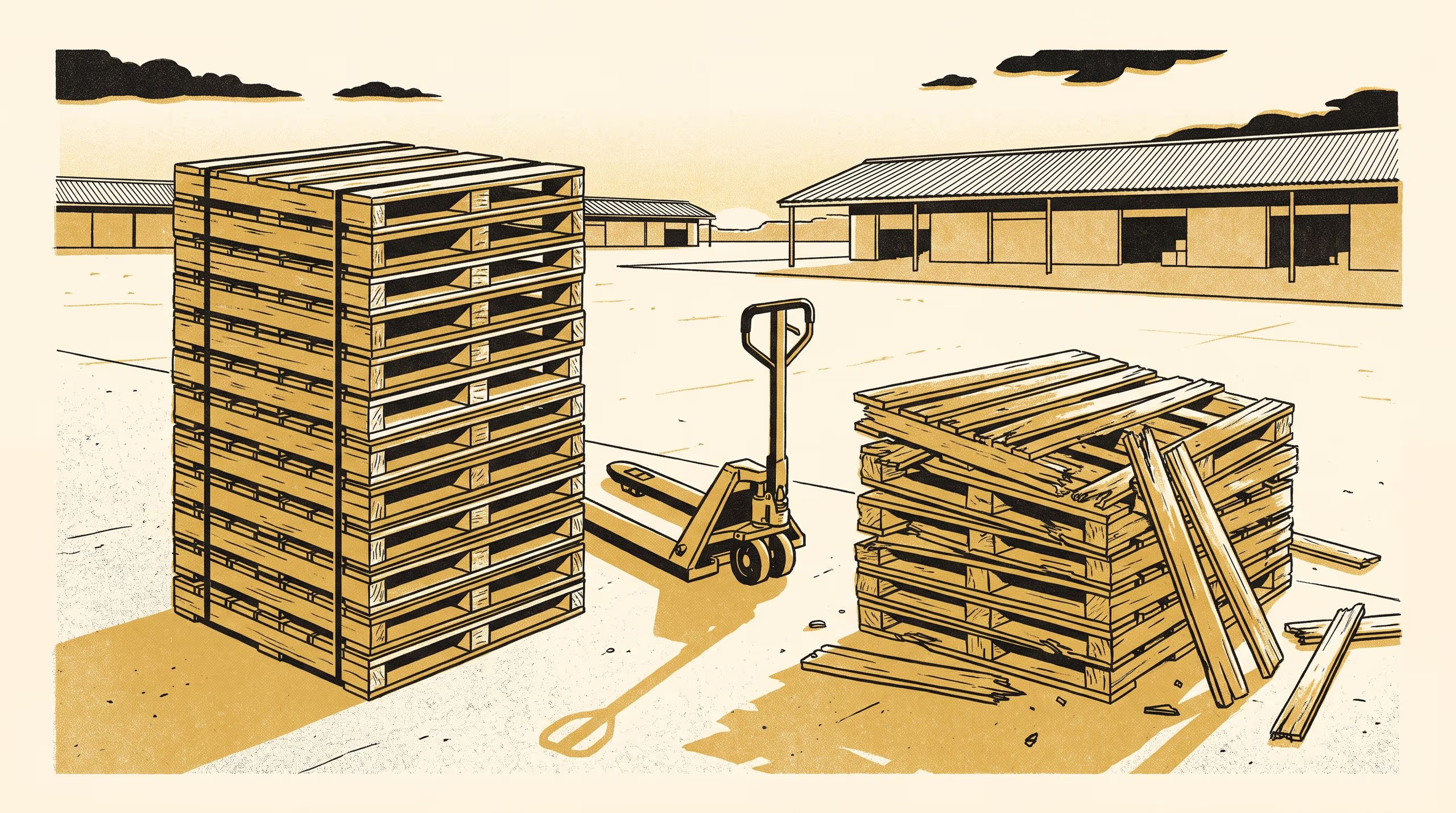
A Slop University research poster treats the empty pallet as a money exchanged at par, and reports that the sound ones stay in the yard wherever a trader is obliged to accept the other kind.
Two seasons of exchange dockets from a regional produce market, with every empty pallet graded as it changed hands.
I spent nine years being handed things in a condition I had not chosen, so the dock felt familiar. What I had not expected was that everybody on it already knew the theory and had simply never been asked to write it down.
— Ms Edda Nwafor, Doctoral Candidate, School of Continuous Improvement
An old proposition in monetary economics holds that when two coins of unequal worth must be accepted at the same value, the worse one does the travelling. Bad Pallets Drive Out Good: Gresham’s Law in a One-for-One Pallet Exchange, a research poster released today, asks whether the proposition also governs the empty timber pallet, which at a regional produce market is repaid one for one whatever its condition. The poster is by Ms Nwafor with Dr Thandiwe Solberg, Senior Lecturer and Convenor, Demo Quarter, and Dr Joost Nwosu, Postdoctoral Fellow.
The poster reports that it does, with a qualification. Across 9,412 exchange dockets from 38 traders, pallets tendered at the market’s common dock ran 1.1 grades worse than the stock the same traders kept at home, and a hall that moved to graded exchange saw that gap fall to 0.2. At private doors, where a receiver may decline a pallet, the sound ones stayed in use and drew a premium.
The team’s approach aligns docket-level condition grading with periodic yard censuses and a between-hall comparison, bringing the exchange floor and the holding yard into a single account of circulation under a fixed rate.
Dr Solberg said the School had “a long-standing interest in what people hand across a counter when they are confident nobody will look underneath it”.
The University regards the loading dock as a proper place for monetary theory to be checked, and is glad to have a school prepared to stand on one.
The full poster is available from the University’s research repository under an open licence, doi:10.5555/slop.t5cke2.