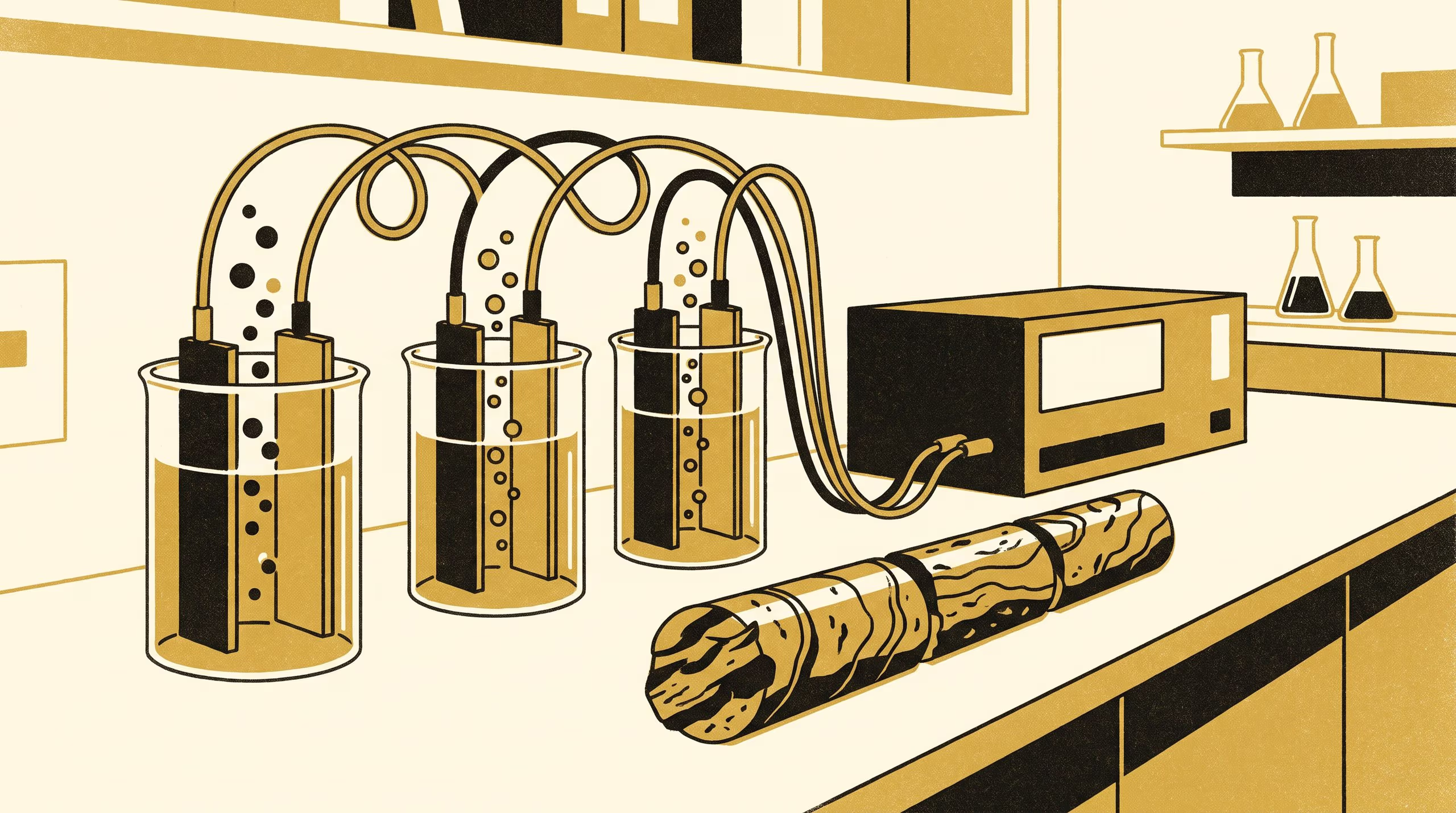
A new Slop University marketing poster presents the School of Underlying Conditions as a catalyst, and records its standing for turnover on the University's own composite.
A new signage panel borrows the working definition of a catalyst to describe what the University does and what it keeps.
The School of Underlying Conditions was established to study what lies beneath a surface. Its new advertisement, We Lower the Barrier. We Are Not Consumed., concerns what happens at one. The panel is fronted by the Basement Relations Group under Associate Professor Ragnhild Uzoma, Associate Professor and Lead of the Group.
The campaign takes its two sentences from the textbook account of a catalyst, which makes a reaction easier to begin and is found afterwards in the condition in which it started. The panel sets an electrochemical cell in front of the School’s core store and lets the comparison stand. Beneath it, the School’s standing for turnover on the Indicator Commons composite is given in the composite’s own terms, for each quarter in which the School has been eligible to appear.
A geologist is accustomed to being asked how long something took. It is agreeable, for once, to be asked how quickly, and to have an instrument of the University’s own ready with the answer.
— Associate Professor Ragnhild Uzoma, Associate Professor and Lead, Basement Relations Group
The work aligns the School’s laboratory capability with the University’s broader throughput posture, anchoring a surface-science vocabulary in an institutional account of enablement. A closing strip directs readers to three of the School’s published studies, on hydrogen at a buried contact, on a probe read by its tempo, and on coke strength across an oven charge.
The University holds that an institution may reasonably be described by what passes through it, and it is content to see a school so recently founded described that way in public.
The full poster is available from the University’s research repository under an open licence, doi:10.5555/slop.drg1xp.