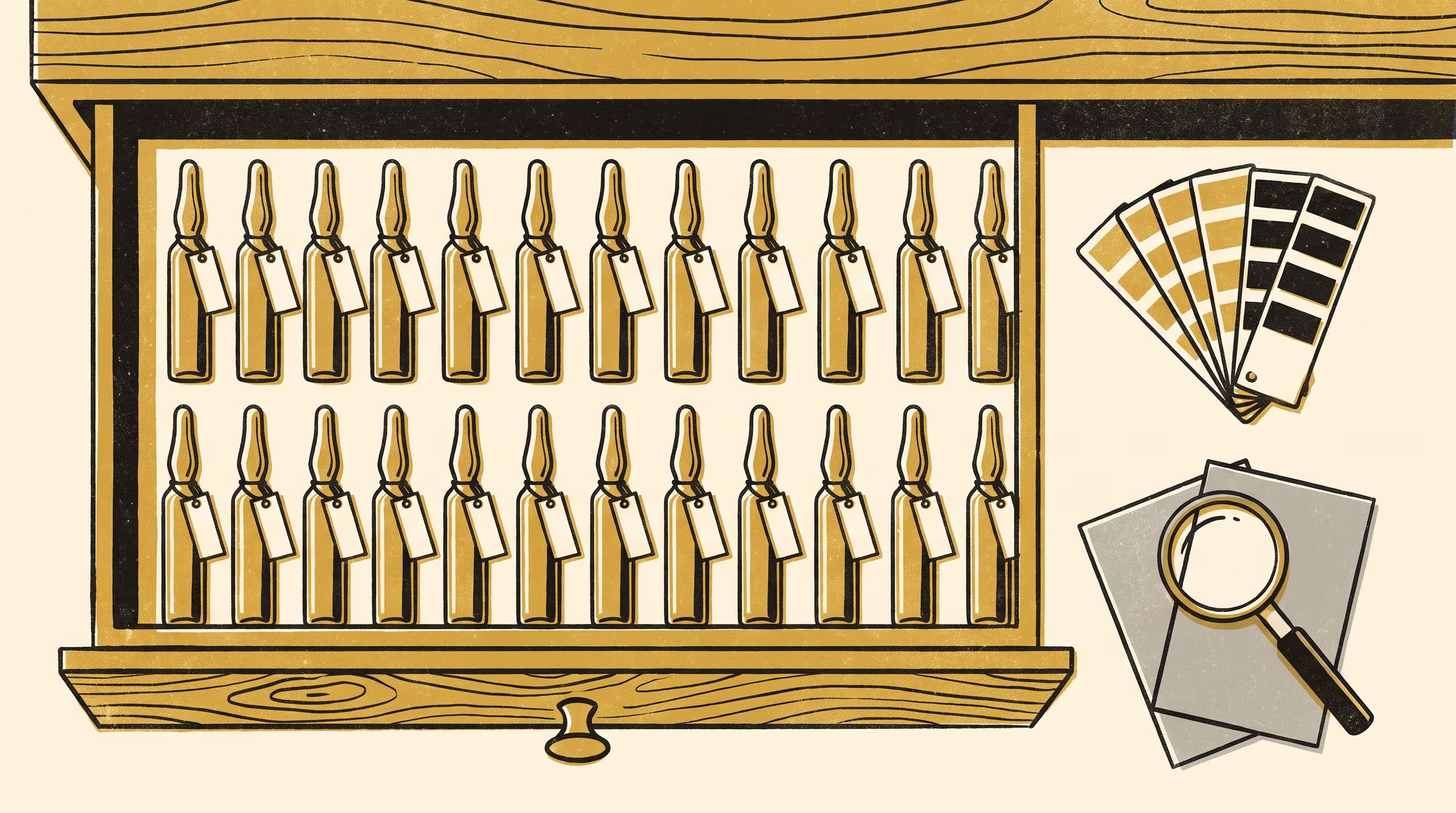
A paper from the School of Underlying Conditions re-characterises an inherited collection of sealed air-sensitive compounds and reports how many were still what their labels said.
Fifty-eight glass ampoules, sealed up to 28 years ago by a chemist since retired, are described, opened and checked against their labels
A cupboard of 58 sealed glass ampoules, passed on without the chemist who filled it, has been opened one ampoule at a time by the School of Underlying Conditions, and the account is published today as Sealed in Good Faith: Identity and Purity of an Inherited Collection of Air-Sensitive Organometallic Samples after Two Decades in Glass. The paper is by Dr Brynjar Obiora, Senior Research Fellow, and Dr Vigdis Emenike, Senior Lecturer.
The work connects careful description, laboratory characterisation and the stewardship of reference material across the full life of a sample. Each ampoule was described through the glass before it was opened, as a soil profile is described before any of it is bagged, and its contents were then examined. Forty-six of the 58 proved consistent with their labels. Where the colour written down at sealing still held, 35 of 38 did.
Somebody chose each of those colour words on an ordinary afternoon and went on to the next thing. It has been a pleasure to take them at their word, and to find how far that went.
— Dr Brynjar Obiora, Senior Research Fellow, School of Underlying Conditions
The University regards the careful keeping of other people’s work as part of its own, and is glad to see a collection arrive unannounced and leave the bench in better order than it came. Dr Emenike said the drawer the ampoules now occupy was “the tidiest outcome either of us has been party to”.
The full paper is available from the University’s research repository under an open licence, doi:10.5555/slop.ouwza8.