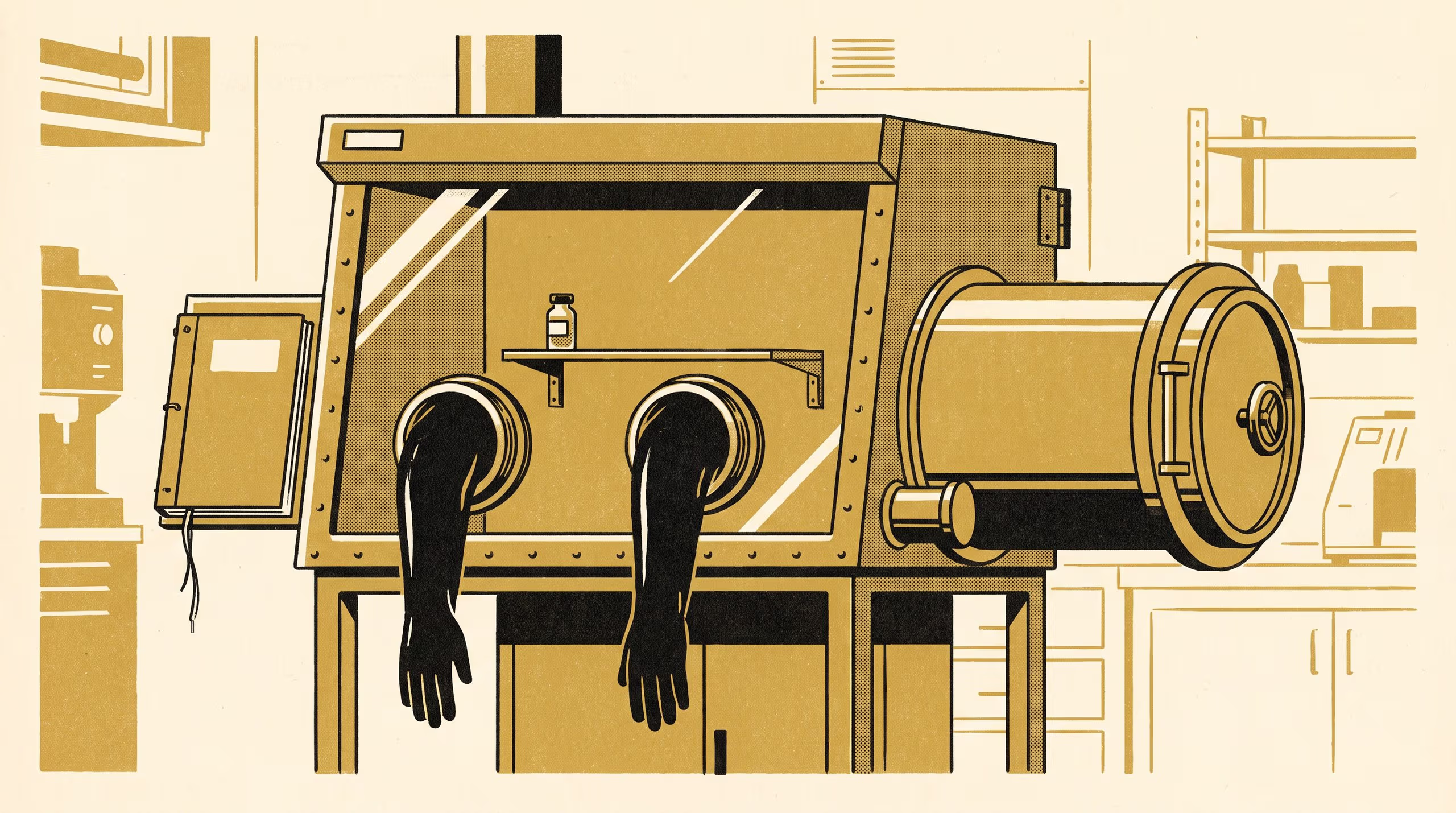
A paper from the School of Continuous Improvement follows a synthetic chemistry group's care of its shared glovebox and asks who is held responsible when the atmosphere inside it fails
Eleven months beside a nitrogen-filled cabinet, four of them without permission to put a hand in it
The School of Continuous Improvement has always maintained that an induction is best understood from the receiving end. Dr Ingeborg Nwachukwu, Lecturer and Convenor, Capability Sprints, has now spent eleven months at the receiving end of one, and her account of it is published today as Matter Out of Place at One Part per Million: Purity, Breach and Blame around a Shared Glovebox.
The setting is a research group whose compounds do not survive contact with air, and the cabinet of nitrogen in which it handles them. Dr Nwachukwu brings the anthropology of ritual purity into alignment with the daily practice of a synthesis laboratory, mapping the group’s rules for what may enter the box, the three cycles every object undergoes at its door, and the seven occasions during her stay on which the atmosphere inside was judged to have failed. On six of them, the paper reports, somebody or something had been held responsible before a cause was looked for. One of the seven was attributed to the author’s pencil.
I went to learn how a group brings its newcomers in, and it obliged by bringing me in. The School speaks often of learning as a shared undertaking, and I am glad to have been able to hold up my half of it for as long as I did.
— Dr Ingeborg Nwachukwu, Lecturer and Convenor, Capability Sprints
The University regards it as a mark of a settled research culture that one of its schools can stand quietly in another discipline’s laboratory for the better part of a year and be missed when it leaves. Dr Nwachukwu said the group had been “generous with its time, its threshold and, eventually, its gloves”, and that she expected the experience to inform the School’s thinking for some time without wishing to say in which direction.
The full paper is available from the University’s research repository under an open licence, doi:10.5555/slop.rzzcq9.