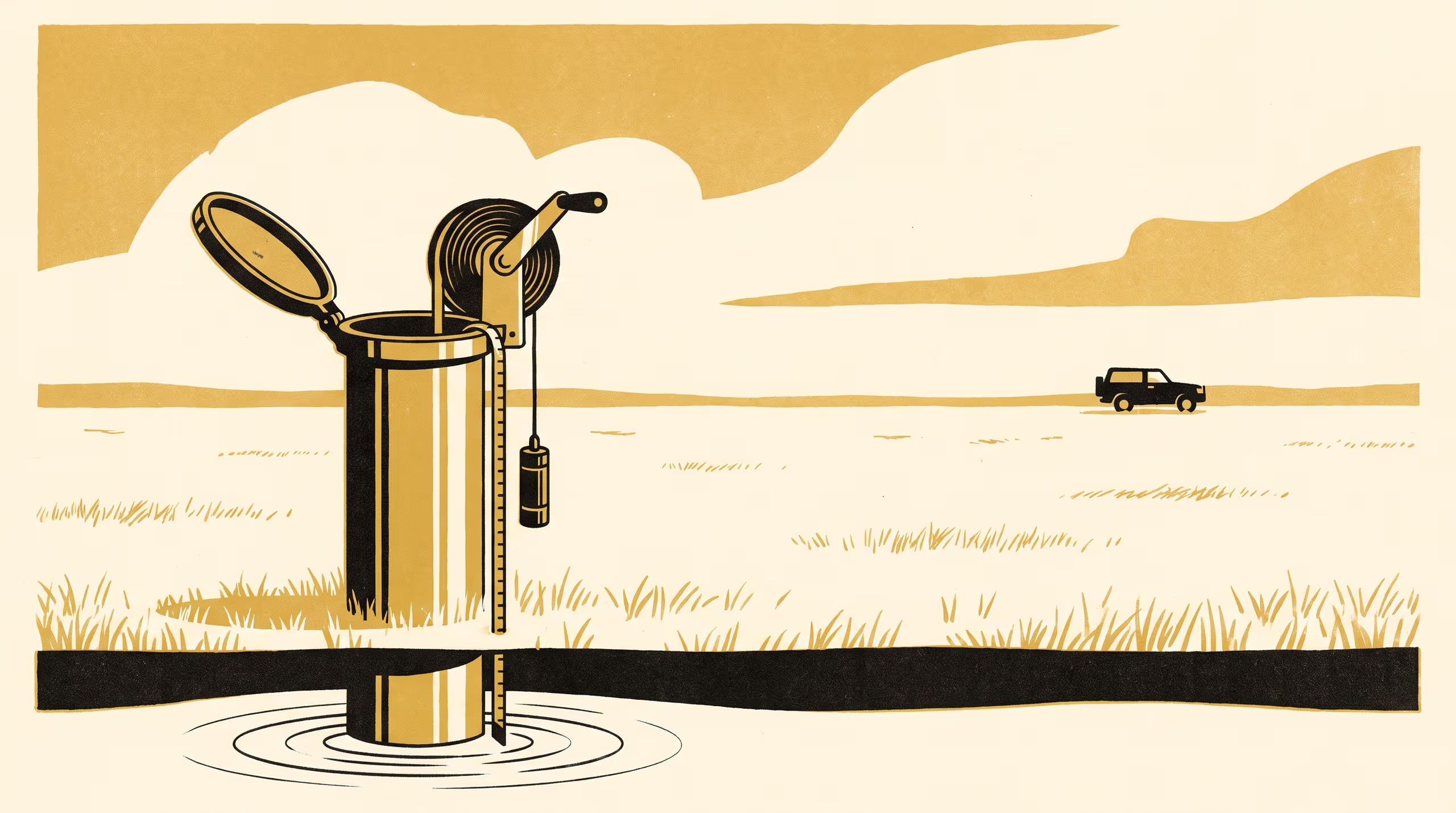
A paper from the School of Underlying Conditions puts a 4.1 kB classifier on a groundwater logger so that the record marks for itself when it was checked by hand, and finds the model had first learned who was checking.
A classifier small enough for the instrument's own processor recognises the technician's dip tape from the water it disturbs
A water-level logger hanging in a monitoring bore can now record, beside its own reading, that somebody came and checked it. The capability is set out in Somebody Was Here: On-Logger Recognition of the Manual Dip in a Monitoring Bore’s Pressure Trace, a paper by Dr Vigdis Emenike, Senior Lecturer, and Dr Brynjar Obiora, Senior Research Fellow, of the School of Underlying Conditions.
The paper aligns embedded machine learning, field instrumentation and the monthly routine of a groundwater round within a single low-power device. Working from 1,912 short recordings gathered at 23 bores, the authors report a model that tells a dip from a lifted logger, a neighbouring pump and a gust of wind, and that does so on bores it had never met. It did less well on a technician it had never met, and the paper gives a full account of why and of what was done about it. Over three months on six bores the logger marked 17 of 18 visits.
The two colleagues who do the round were generous with their time and with their wrists. We now know a little more about each than we set out to, and we have taken care that the logger knows a little less.
— Dr Vigdis Emenike, Senior Lecturer, School of Underlying Conditions
The University regards an instrument that keeps its own visitors’ book as a natural extension of the School’s interest in what lies beneath, and of its readiness to borrow from wherever the tools are. Dr Obiora said the project had been “a useful occasion to think about how much of a record is the ground, and how much is the afternoon it was taken on”.
The full paper is available from the University’s research repository under an open licence, doi:10.5555/slop.d7s0ux.