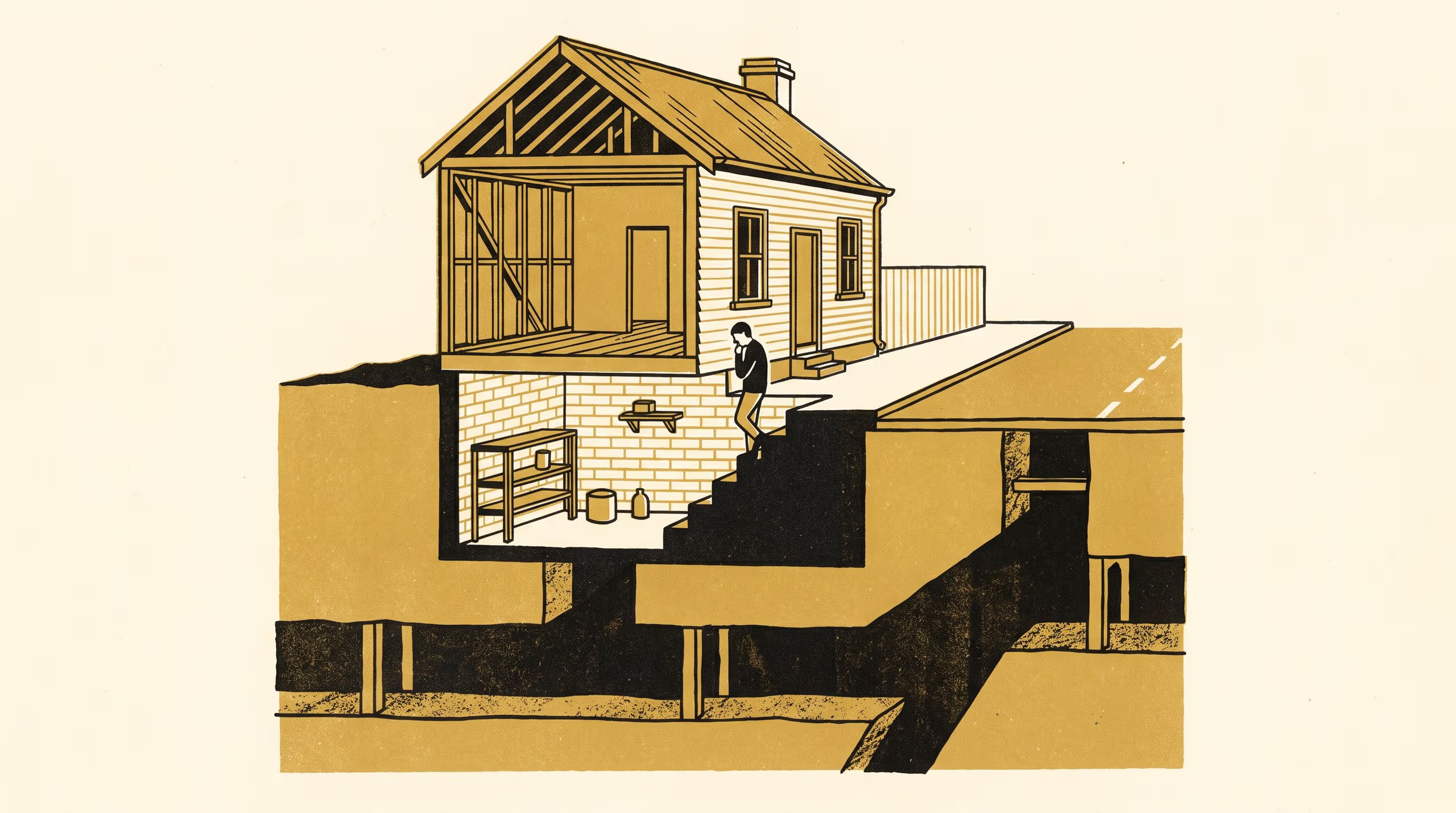
A paper from the School of Underlying Conditions estimates the price of a cellar in a town built over an abandoned mine, and finds the room adds to a house in some streets and subtracts from it in others.
Nineteen years of house sales in a former mining town, set against the plan of the workings beneath its streets
The School of Underlying Conditions has until now left the price of things to other parts of the University. With Below Grade: The Price of a Cellar in a Town Built over Its Own Workings, a paper by Associate Professor Ragnhild Uzoma, Associate Professor and Lead, Basement Relations Group, and Dr Vigdis Emenike, Senior Lecturer, it has taken up the question for one room of the house, and has stayed within its field by choosing the lowest.
The paper reports that in the parts of an unnamed inland town the mine never reached, a cellar adds 6.8 per cent to the price of a house. Over the mapped workings the same room takes 5.1 per cent away. Houses over the workings with no cellar sell for much the same as their neighbours, and thirty-four owners who filled their cellars in between two sales appear, over the workings, to have been paid for doing so.
I went down a great many stairs for this paper and was made welcome at the bottom of nearly all of them. I would like the town to know that we looked at the shelves as well.
— Associate Professor Ragnhild Uzoma, Lead of the Basement Relations Group
Its evidence base aligns a sales record, a doorstep survey and an archive plan into a single house-by-house account, underpinned by a boundary comparison at the edge of the old mine’s outline and anchored by the regional water authority’s monitoring bores. The authors conclude that the ground is priced where a house shows it, and that a cellar is where a house shows it.
Slop University takes a quiet satisfaction in a school that can borrow a neighbouring discipline’s instruments and return them in good order. Dr Emenike said the collaboration had “given the water table a walk-on part, which is the size of part it prefers”.
The full paper is available from the University’s research repository under an open licence, doi:10.5555/slop.1bw1ah.