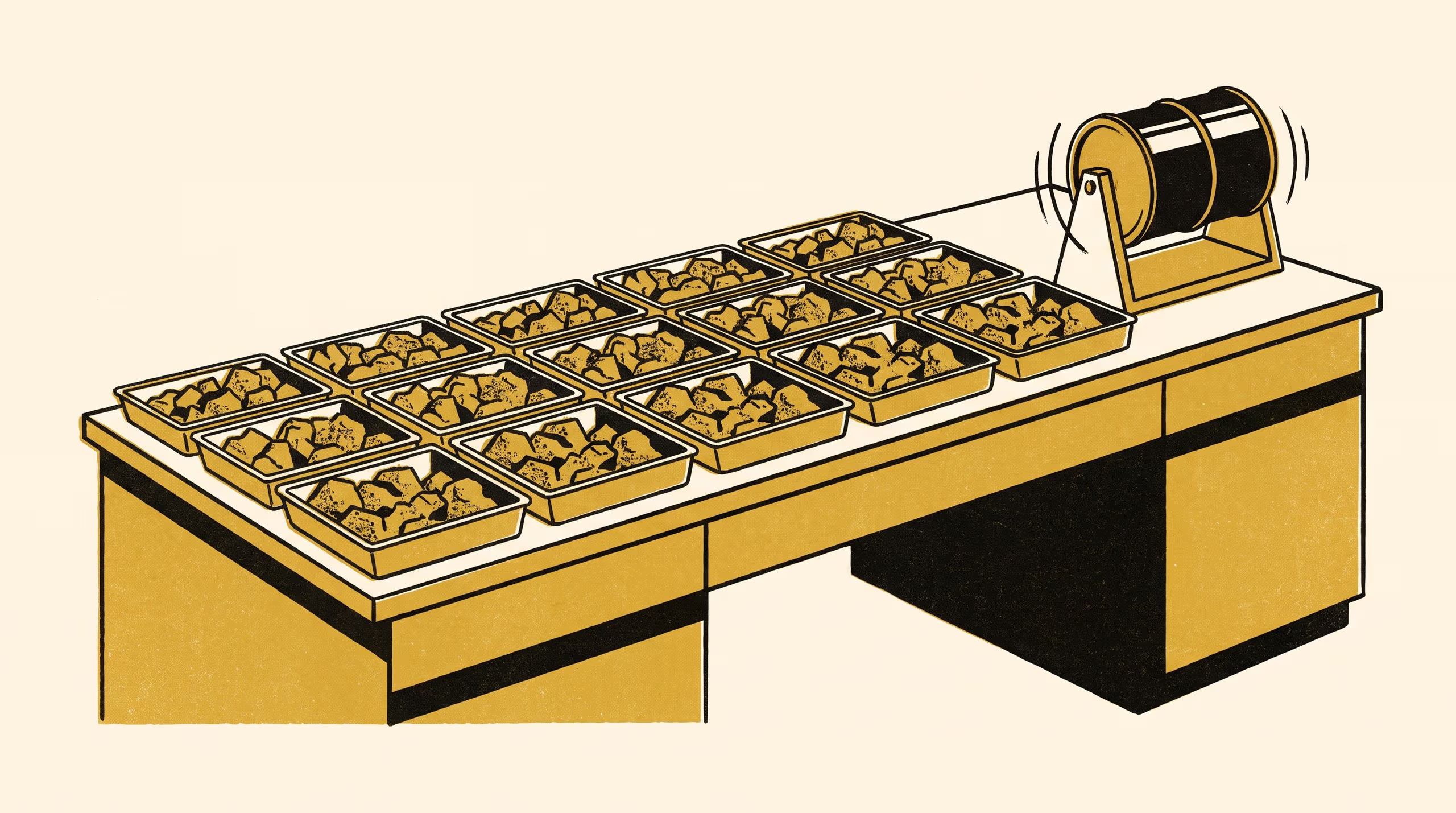
A research poster from the School of Underlying Conditions reports that the coke from a single pilot-oven charge differed more by where in the oven it was made than from one push to the next.
Twelve pushes of a pilot coke oven, fifteen sampling positions and 180 reactivity tests
Twelve times a pilot oven in the School of Underlying Conditions was emptied onto a marked floor, and twelve times its coke was set down in the order it had stood in the chamber. The record of that exercise is Where in the Oven the Coke Was Made: Positional variation in coke strength after reaction across twelve pilot-oven pushes, a research poster by Associate Professor Ragnhild Uzoma, Lead of the Basement Relations Group, Dr Brynjar Obiora, Senior Research Fellow, and Dr Vigdis Emenike, Senior Lecturer.
Somebody has to stand at the wharf with a shovel and remember which end was which. We had people who did that twelve times without being asked twice, and the poster belongs to them at least as much as it does to the three of us.
— Associate Professor Ragnhild Uzoma, Lead of the Basement Relations Group
The poster brings a single coal blend, a fixed coking practice and a fifteen-cell sampling frame into one position-resolved account of a charge. Across 180 tests, coke from the middle of the oven is reported as 9.6 points stronger than coke from under the roof at the pusher end, a difference the authors set against a push-to-push variation of 1.4 points.
The University offers the poster as evidence that a young school can keep its attention on one object for as long as the object requires. Dr Obiora said the School’s laboratories had “become a place where a thing is put down carefully, which is most of what any of us can promise in advance”.
The full poster is available from the University’s research repository under an open licence, doi:10.5555/slop.vvd11e.