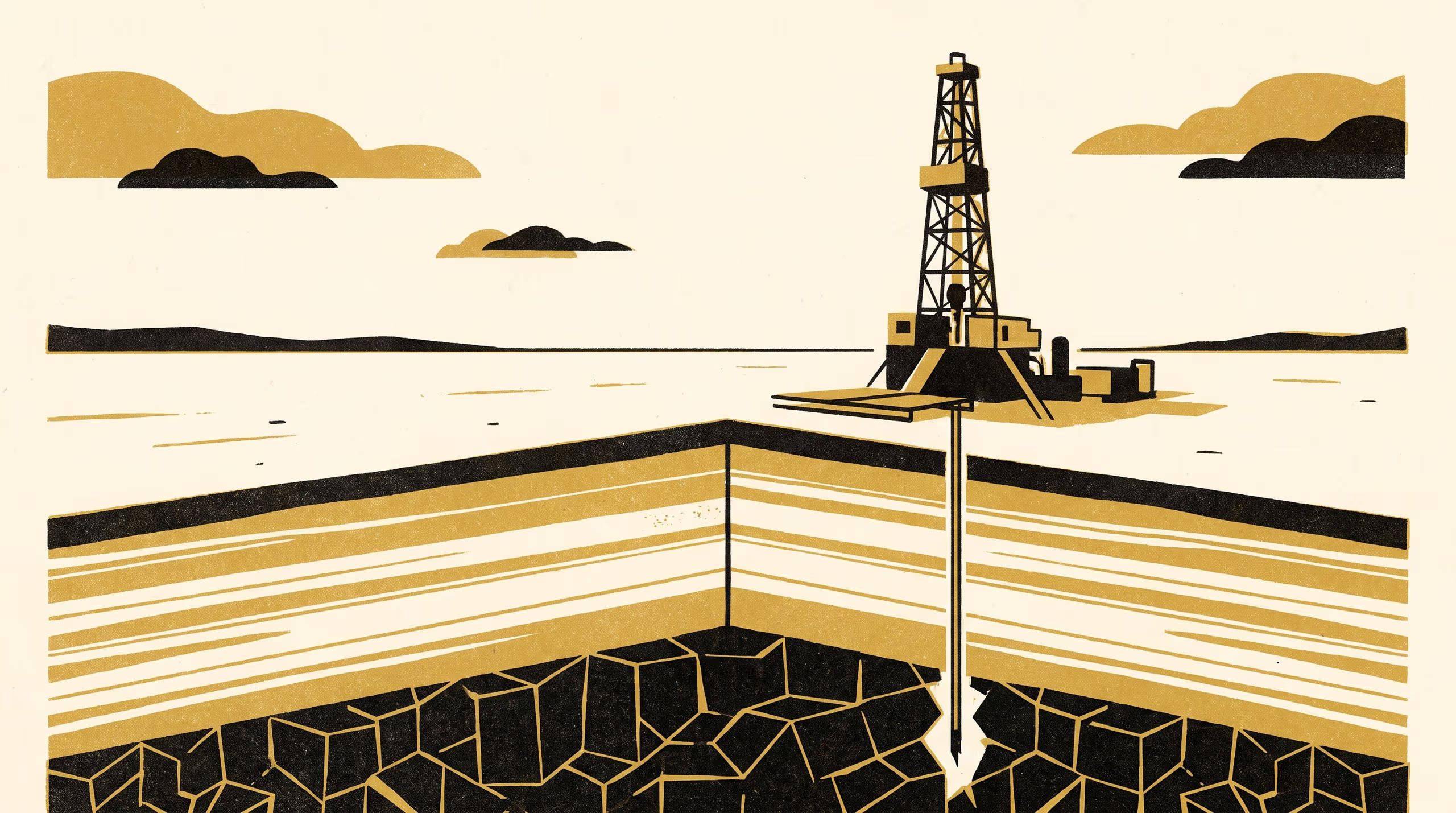
A research poster from the School of Underlying Conditions measures the hydrogen released by drill core across one buried contact and finds most of it in rock that was weathered before it was covered.
Twelve intervals of one drill core, reacted with water for ninety days, place the most productive rock a few metres under the contact
There is a good deal of core in this country that was drilled for one reason and looked at once. It is a quiet pleasure to take a tray down for a second reason and find it had been keeping something back.
— Associate Professor Ragnhild Uzoma, Associate Professor and Lead, Basement Relations Group
The tray in question holds the place where one borehole passes out of sandstone and into the much older rock beneath it. Hydrogen at the Unconformity: Water–rock reaction of drill core as the energy budget of a buried habitat is a research poster from the School of Underlying Conditions by Associate Professor Uzoma with Dr Vigdis Emenike, Senior Lecturer, and Dr Brynjar Obiora, Senior Research Fellow. It asks where, across that single contact, rock and water together make hydrogen, the fuel long proposed for the earliest life below ground.
The team took core from twelve intervals, sealed it with water in glass vials, kept the vials warm for 90 days, and measured what gathered above the water. The sandstone gave nothing. The fresh basement gave a steady amount. The most came from between them: the buried weathering profile at the top of the basement, which at the cooler of two temperatures out-yielded the fresh rock about four to one.
Dr Obiora, who logged the profile before any vial was opened, said the result “sits well with a school that has always found the edges of things more rewarding than their middles”.
The University regards the poster as a fair instance of what its newest school was founded to do, which is to look closely at a small piece of ground and report what is there.
The full poster is available from the University’s research repository under an open licence, doi:10.5555/slop.aw86e0.