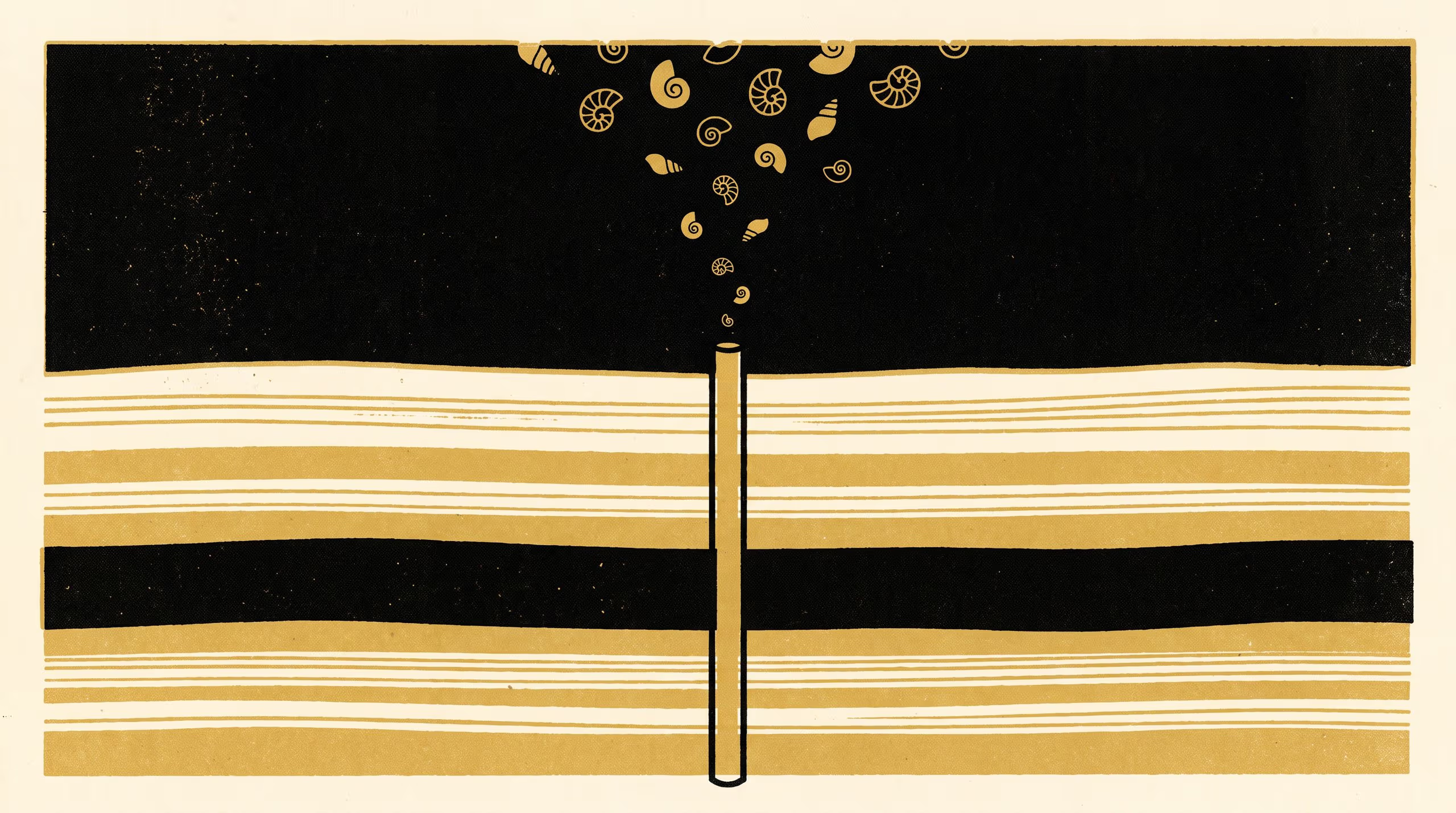
A new Slop University research poster restores the carbonate sediment dissolved beneath a clay layer in a single deep-sea core, using the insoluble material the dissolution left behind.
A residue budget for one archived deep-sea core puts up to three metres of dissolved sediment behind a 31 cm band of clay
The questions this raises are mostly about the next core, and we would be glad to be asked them. A second hole will either agree with the first or be more interesting than it.
— Associate Professor Ragnhild Uzoma, Associate Professor and Lead, Basement Relations Group
So the School of Underlying Conditions introduces The Burn-Down Budget: Restoring the Carbonate Dissolved Beneath an Acidification Horizon in One Pelagic Core, a research poster by Associate Professor Uzoma with Dr Brynjar Obiora, Senior Research Fellow, and Dr Vigdis Emenike, Senior Lecturer.
The poster concerns a band of clay 31 cm thick in a core of pale deep-sea sediment, laid down when the water above it turned corrosive enough to dissolve the seafloor. The authors ask how much sediment the band stands in for. Their answer, for this core, is up to 3.0 m: 2.43 m accounted for by the clay itself, and the remainder by a 38 cm zone of damaged sediment beneath it that restores to 0.96 m.
The approach aligns a sample-by-sample account of what dissolves with a matching account of what does not, anchoring the reconstruction in the material that stayed where it fell. Forty samples underpin the budget, which the poster sets out alongside a profile of the section and a statement of what a firmer figure would require.
The poster is the kind of patient accounting the University hopes its earth sciences school will go on supplying, on subjects well beyond the shoreline. Dr Obiora said the team had “restored rather more than we sampled, and tried throughout to keep the two columns apart”.
The full poster is available from the University’s research repository under an open licence, doi:10.5555/slop.qyzwkw.