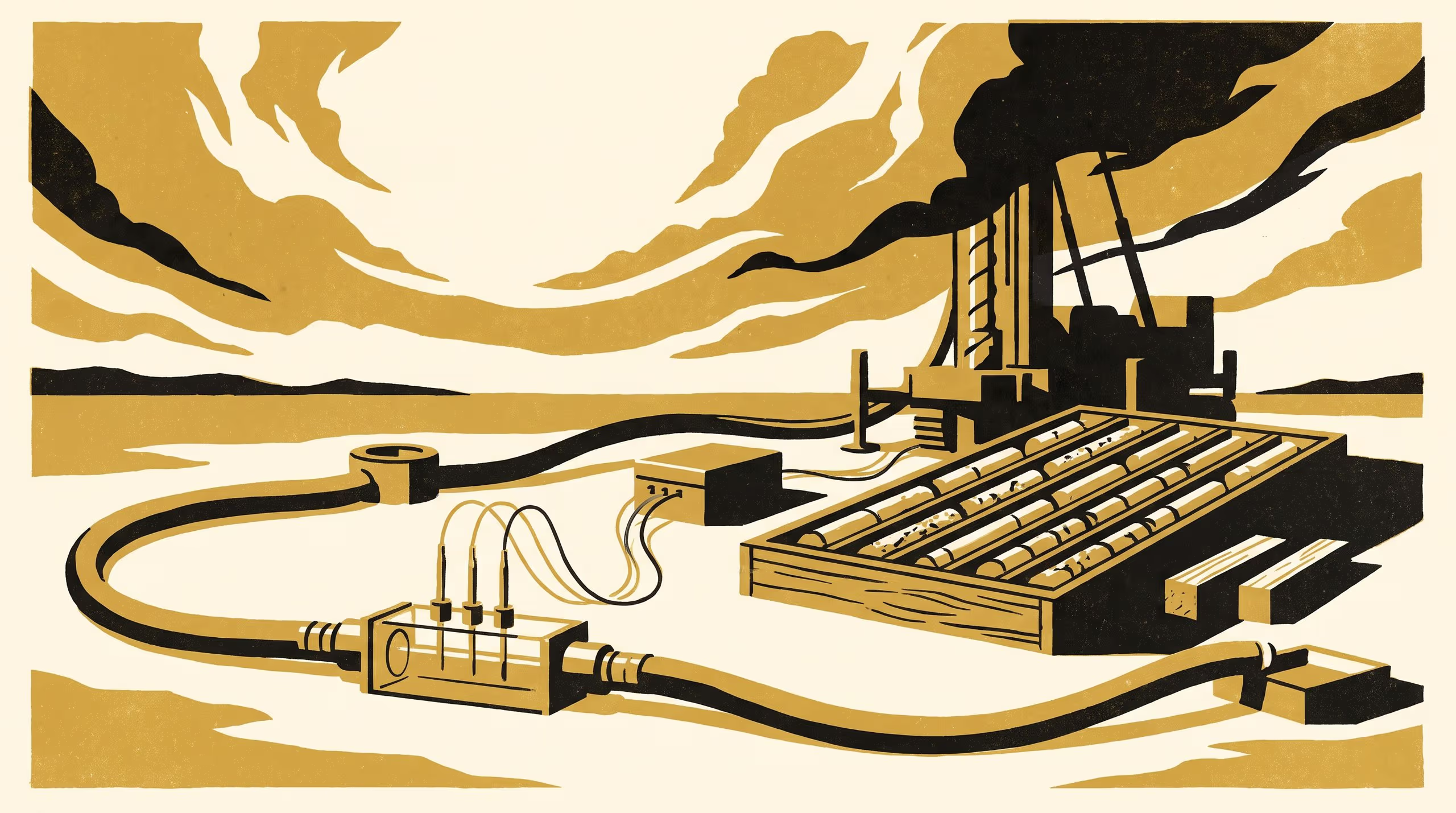
A paper from the School of Underlying Conditions logs the chemistry of a drill hole's flush water to say what became of the core that was never recovered.
Electrodes on one drill rig's return line sort the hole's missing core into rock that was ground, rock that was not, and rock that was not there
When a drill brings up less rock than it went through, a wooden block goes into the tray where the rock should be, with the missing length written on it. A new paper from Slop University’s School of Underlying Conditions turns to the one thing that did come up from those lengths, which is the water.
What the Return Water Saw: In-line Potentiometric Logging of Drilling-Fluid Returns across Intervals of Core Loss is by Ragnhild Uzoma, Associate Professor and Lead, Basement Relations Group, Dr Vigdis Emenike, Senior Lecturer, and Casimir Beng, Associate Professor and Lead, Adaptive Metrics Lab.
A block tells you how much. I have wanted for some time to be told a little more than how much, and the water was going past the whole while.
— Associate Professor Ragnhild Uzoma, Lead of the Basement Relations Group
The paper brings sensing capability, process thinking and a single borehole into alignment. It positions the water returning from the hole as a continuous account of the ground it has passed, anchors that account to depth, and mobilises it across the 23 places in the hole where the tray holds a block. Of those, 19 could be read: nine as core ground away at the bit, six as rock left standing when the loss was written down, and four as places where there was less rock to grind than the hole on either side.
The University regards an absence that has been sorted into kinds as an advance on an absence, and is pleased to have one of each. Associate Professor Beng said the collaboration between the two schools had been “conducted largely through a hose, which concentrates the mind”.
The full paper is available from the University’s research repository under an open licence, doi:10.5555/slop.05dlje.