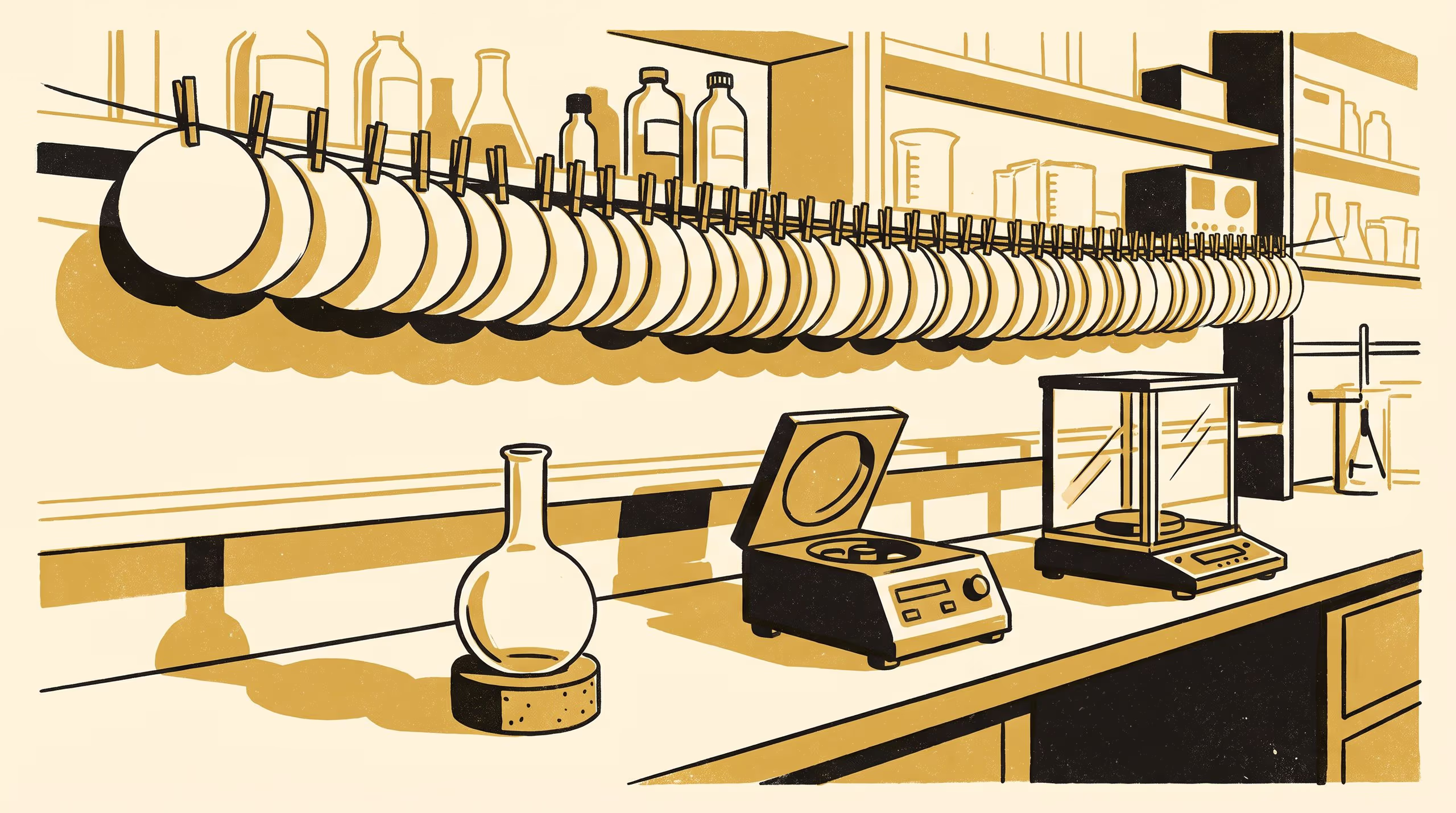
A paper from the Schools of Emergent Priorities and Underlying Conditions follows one batch of catalyst through thirty uses and finds the part that went missing.
Thirty reuses of one batch, with every filter paper kept and weighed
I had not weighed a filter paper before this year and I do not expect to stop now. It is rare to be handed a question that can be answered by keeping everything.
— Sunniva Balogun, Doctoral Candidate, School of Emergent Priorities
So the lead author of a new Slop University paper describes a campaign in which one batch of catalyst was used thirty times and nothing that touched it was thrown away. Where the Catalyst Went: A Gravimetric Mass Balance over Thirty Recycles of a Silica-Immobilised Palladium Catalyst is by Ms Balogun with Halvard Nnamani, Doctoral Candidate, and Ragnhild Uzoma, Associate Professor and Lead, Basement Relations Group, in the School of Underlying Conditions.
The paper brings bench chemistry, patient bookkeeping and a tared flask into a single accountable workflow. A catalyst that appeared to give up close to half its performance across thirty uses was found to be working as well, gram for gram, at the end as at the start, and of the 50.0 mg the team began with, 22.7 mg was located in the filter papers. A second run, in which the material stayed in one tube throughout, held steady.
The University counts the paper among the dividends of letting two schools share a balance. Associate Professor Uzoma said the collaboration had “put a school that looks ahead and a school that looks down at the same bench, where it turns out there is room”.
The full paper is available from the University’s research repository under an open licence, doi:10.5555/slop.efb68v.