A paper from the School of Underlying Conditions reconstructs a retired plaque assay from its surviving kit and handwritten protocol, and describes the waste a practised bench leaves behind.
Two researchers ran a deaccessioned bench kit twenty-four times with nothing living in it, and recorded what the instructions leave out
Slop University’s field methods have been taken indoors. In Thirty-One Steps, Seventy-Four Gestures: An Experimental Reconstruction of a Retired Haemolytic Plaque Assay and the Waste It Leaves, Dr Brynjar Obiora, Senior Research Fellow, and Associate Professor Ragnhild Uzoma, Associate Professor and Lead, Basement Relations Group, treat a laboratory procedure as archaeologists treat a stone tool: by making it again and keeping what falls on the floor.
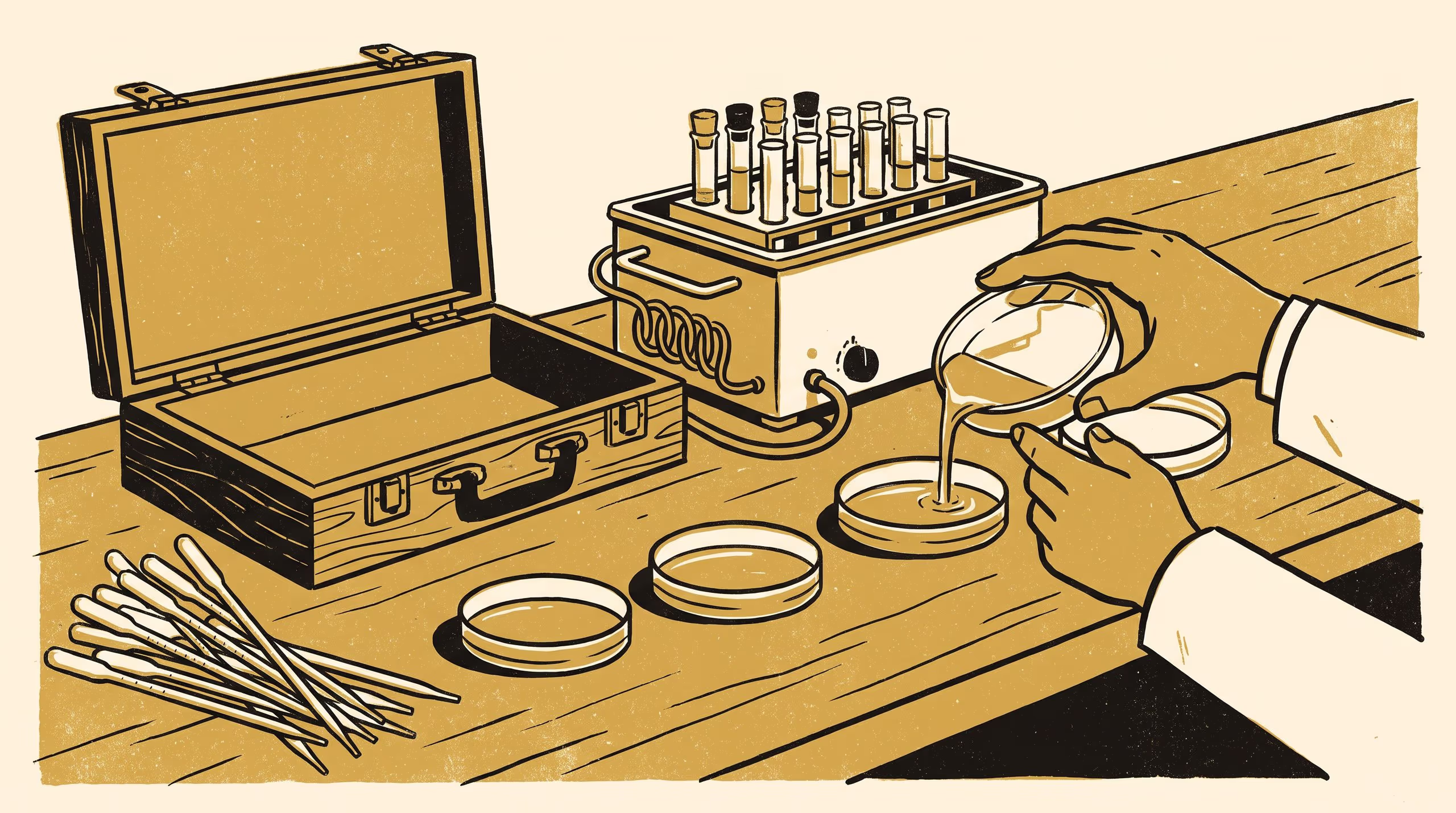
The paper anchors a replication-to-refuse continuum in a single plywood case acquired by the School of Underlying Conditions with its contents undisturbed. The two authors worked the kit twelve times each, with inert stand-ins for every reagent, and a retired technician who had once used it attended a single session of each. Seventy-four gestures were recorded against a written protocol of thirty-one steps, and the glass a run discards was logged by where it came to rest.
It is not often that a school of earth sciences is trusted with somebody else’s glassware. We broke rather less of it as the weeks went on, and the paper is in some sense an account of that.
— Dr Brynjar Obiora, Senior Research Fellow, School of Underlying Conditions
The University sees in the work a school willing to bring its instruments to bear on a room it had previously only walked past. Associate Professor Uzoma said the kit “has gone back in its case, and the case has gone back on the shelf, which is the outcome we would wish for most things we study”.
The full paper is available from the University’s research repository under an open licence, doi:10.5555/slop.eytlha.