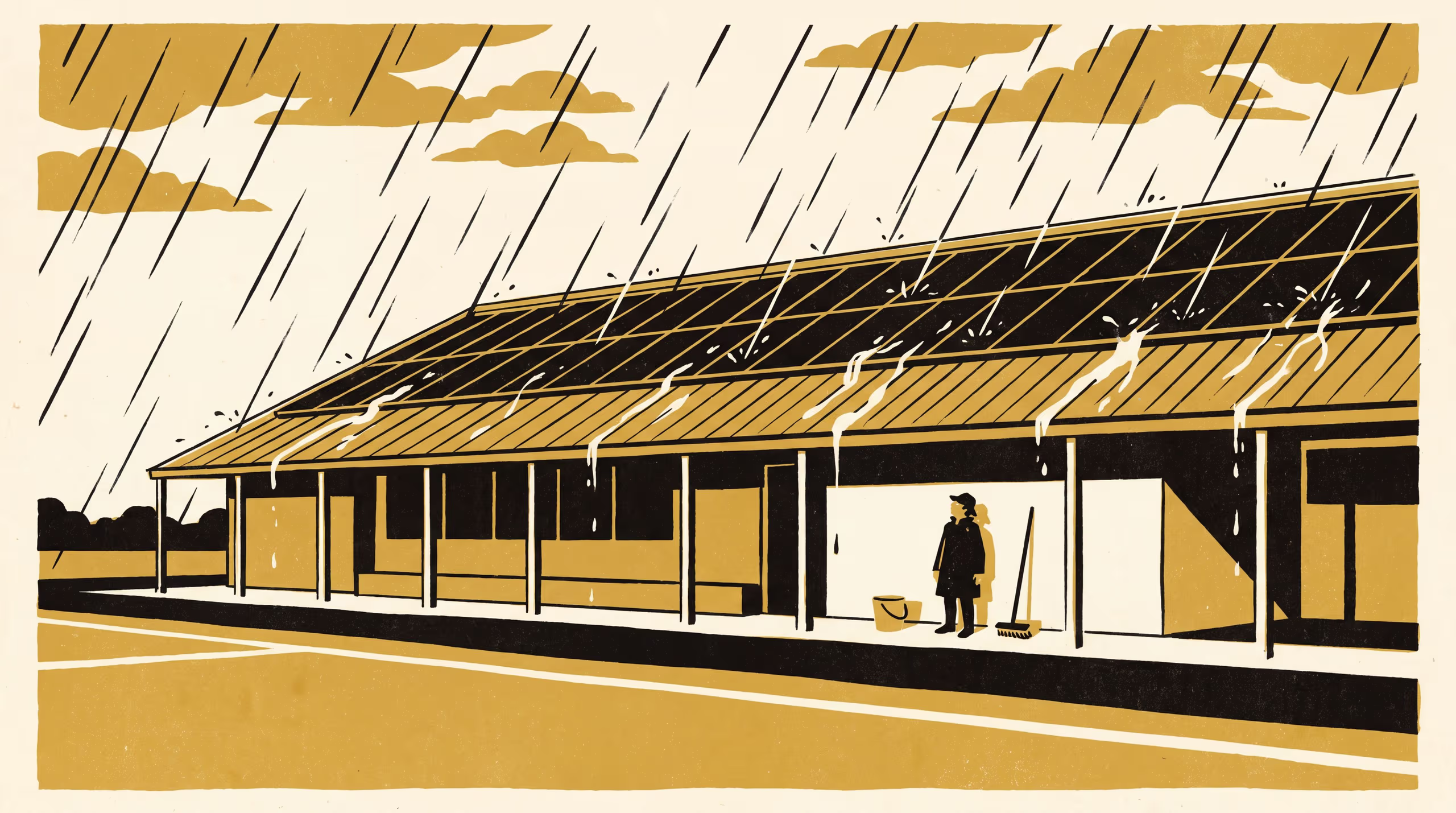
A new Slop University display advertisement carries the School of Continuous Improvement's trial of rooftop-solar washing onto the University's screens.
A landscape display advertisement from the School of Continuous Improvement presents its solar research by way of a bucket and a brush.
I convene a commons of indicators, and most of them have never been rained on. It has been a pleasure to spend a season with one that has.
— Dr Renke Sabel, Senior Lecturer and Convenor, Indicator Commons
Slop University’s landscape screens now show a clubhouse roof in a shower, with a bucket and a long-handled brush set down under the eave. The display advertisement, We washed the panels. So had the rain., was prepared by Dr Sabel for the School of Continuous Improvement, and it places one piece of the School’s published energy research in front of anyone waiting for a bus.
Behind the line sits a pre-registered trial that washed the rooftop solar arrays of forty community sports clubs on a quarterly rotation across eight quarters. The trial found the wash’s effect on performance to fall inside the bounds its authors had registered in advance as negligible, with rainfall accounting for roughly an order of magnitude more recovery than the wash. The advertisement carries that into eight words and a picture, anchoring the School’s evaluation-ecosystem agenda in a setting most passers-by have stood under.
It is a matter of some institutional satisfaction that a School can put a finding of no difference on a screen and remain standing beside it. Dr Sabel said the campaign “leaves the brush where the study left it, which is against the wall, in good order, and still on the schedule”.
The advertisement closes on a strip directing readers to three further University studies of photovoltaic systems in ordinary use, and is expected to stay in rotation through the teaching period.
The full poster is available from the University’s research repository under an open licence, doi:10.5555/slop.7lrtvf.